







Question: The below is my hash function and insert function : int hashCode( int letter) { //hash code that will return the index of array return
The below is my hash function and insert function :
int hashCode(int letter) { //hash code that will return the index of array return letter % 5; } void insert(int letter,int number) { int hashIndex = hashCode( letter); struct node *newnode = createNode( letter, number); /* head of list for the bucket with index "hashIndex" found for the key enetered */ if (!hashTable[hashIndex].head) { hashTable[hashIndex].head = newnode; hashTable[hashIndex].count = 1; return; } /* adding new node to the list */ newnode->next = (hashTable[hashIndex].head); /* * update the head of the list and no of * nodes in the current bucket */ hashTable[hashIndex].head = newnode; hashTable[hashIndex].count++; }
When I run the program the below output is given :
Data at index 0 in Hash Table: Letter Number -------------------------------- P 10 A 8 Data at index 1 in Hash Table: Letter Number -------------------------------- L 11 Data at index 2 in Hash Table: Letter Number -------------------------------- R 3 C 4 H 5 M 9 Data at index 3 in Hash Table: Letter Number -------------------------------- S 0 X 7 Data at index 4 in Hash Table: Letter Number -------------------------------- E 12
This out put is wrong as it should be like the one in the picture below. It was given to me as a guide to make a hash table with and array for access of the computed hashes and with linked lists storing key-value pairs with collisions.
Kindly can you tell me whether there is something wrong in my code ?
Thanks.
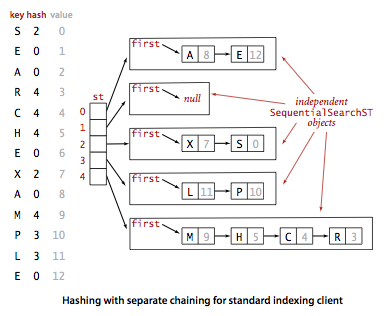
key hash value rst rst st null SequentialSearchST objects L 11 P 10 rst P 3 10 311 E 0 12 Hashing with separate chaining for standard indexing client
Step by Step Solution
There are 3 Steps involved in it

Get step-by-step solutions from verified subject matter experts
 Study Help