







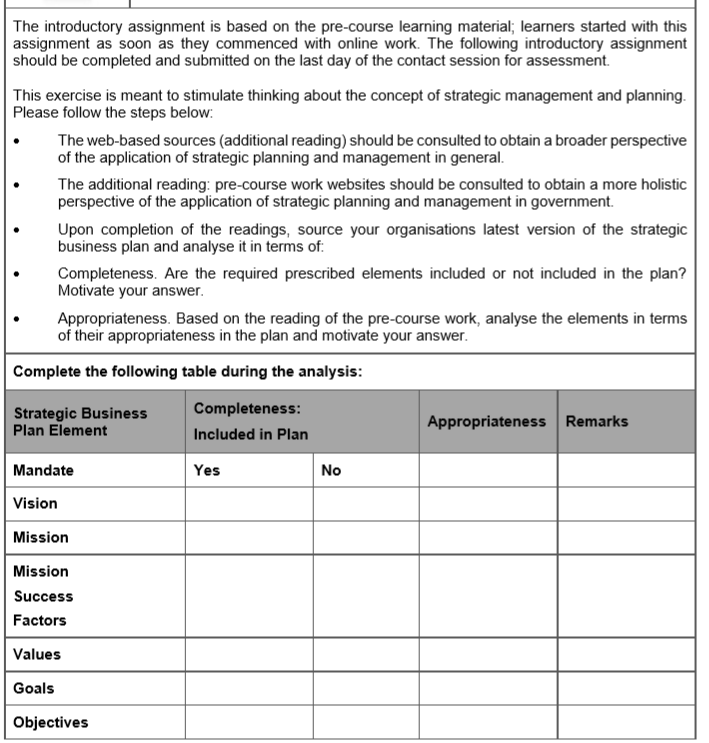
Question: The below is the summary of a government strategic Plan for the quarter 2020/21 to 2021/22 Our Strategic Focus 5. Vision The Department of Employment
The below is the summary of a government strategic Plan for the quarter 2020/21 to 2021/22
Our Strategic Focus
5. Vision
The Department of Employment and Labour strives for a labour market which is conducive to investment, economic growth, employment creation and decent work. 6. Mission
Promote employment and regulate the South African labour market for sustainable economic growth through:
- Appropriate legislation and regulations
- Inspection and enforcement
- Protection of worker rights
- Provision of Employment Services
- Promoting Equity
- Provision of Social protection
- Promote Social dialogue
7. Values
We shall at all times be exemplary in all respects:
We treat employees with care, dignity and respect
We respect and promote:
- Client centred services
- Accountability
- Integrity and ethical behaviour
- Learning and development
We live the Batho Pele Principles
We live the principles of the Departments Service Charter
We inculcate these values through our performance management system.
8. Situational Analysis
The Department of Employment and Labour acknowledges the low performance of the South African economy and labour market. While good progress has been noted regarding the implementation of the National Development Plan, Vision 2030, it appears that it was still not enough to achieve the expected transformation and inclusive growth targets. The evidence has shown that the low economic growth in the country is also associated with low absorption rates. Thus, the overall impact will probably reside in the long-term in the poor or rural community that could diminish their purchasing power.
8.1. External Environment Analysis
South Africa is faced with triple socio-economic challenges of high unemployment, inequalities and poverty as identified in the National Development Plan (NDP), vision 2030. The highest rate of unemployement, in June 2019 it reached 29% (official definition) or 38.5% (expanded definition).The most affected group with youth unemployment rate of 41% (official definition) and 52% (expanded definition).
Compliance levels in the country remains relatively static with 1 in every 3 employers complying when inspected. Some sectors have better compliance levels than others. Transformation in the market place remains a challenge with very low compliance levels at a DG review level with little or no movement in relation to black people in senior management level positions and little movement in relation to women in senior positions. The National Minimum Wage Act that was introduced on 1 January will receive most of the attention throughout the 2019/2020 financial year. OHS has been focussed more on the formal sector and to some degree on the SMMEs but very little attention has been given to the informal sector that makes up most of the population. Very little attention has also been paid to the important aspect of HIV/AIDS at the workplace and this should change as it has the potential to destabilise the existing workforce.
8.2 Environment Analysis
Supporting work-seekers
The National Development Plan sets an employment target of 11 million jobs to be created from when it was concluded to 2030. At the State of the Nations address in June 2019, the President announced the target of 2 million new jobs for young people, to be met within a decade. To support the achievement of these targets, the Employment Services Act (2014) aims to provide free public employment services and regulate private employment agencies. The Departments employment services system is an IT portal where work-seekers can register as unemployed and provide information about their work experience, qualifications and the kind of work they are looking for. Employers can use the portal to register vacancies and other opportunities they may have, such as training, learner ships, and internships. The system matches work-seekers to opportunities, and after an assessment process, refer work-seekers to employers. To increase the number of registered work-seekers and the number of work-seekers placed in registered employment opportunities, the Department will conduct advocacy campaigns, integrate the employment services system with the Unemployment Insurance Fund, the Compensation Fund and national learner database systems, and establish partnerships with other stakeholders such as the Department of Higher Education and Training, the Department of Public Works, the National Youth Development Agency, organised business, and municipalities. Through a new counselling strategy, the Department aims to get work-seekers job ready and thus reduce the time it takes to place a work-seeker. The Department will also explore partnerships to modernise the systems assessment tests. The Branch Public Employment Services will strive to leverage the resources it has, and do more with less, since its budget has been cut with R119 529 million over the medium term.
8.3 Analysis and Stop-Start-Continue Concept
PESTEL
According to the Department of Planning, Monitoring and Evaluation (DPME), SWOT and PESTEL analysis are planning tools suitable for the planning process.The DEL Environmental Scanning process followed the guidelines provided by DPME in an attempt to identify strategic internal capabilities while trying to understand external influences.
The analysis of the external environment was guided by a PESTEL Analysis with a focus on identifying Threats and Opportunities. The identified threats and opportunities are situations that are presented by the external environment. Some areas that can be considered as threats or challenges include: reduction in budget allocation due to poor economic conditions, unfunded mandates which may lead to failure to meet organization goals which will affect the image of the organization, poor or weak relations with unions, lack of support from the public, etc.
The opportunities present an organization with a chance to exploit these opportunities presented by the external environment in order to meet the goals of the organization and create public value. Opportunities are presented by the external environment. It should be noted that based on the inputs received, the DEL has a lot of opportunities that need to be exploited.
GOALS
Economic Transfomation- 1. Promote Occupational health services,2. Contribute to decent employment creation,3. Protect vulnerable workers,5. Strengthen occupational safety protection 6. Promote sound labour relations 7. Monitor the impact of legislation 9. Development of the Occupational Health and Safety policies
Education, Skills and Health- 2. Contribute to decent employment creation
Consolidating the Social Wage through Reliable and Quality Basic Services - Strengthening social security
Social cohesion and safe communities-10. Promote Equity in the labour market
A Capable, Ethical and Developmental State- Strengthen the institutional capacity of the Department
A better Africa and World- Strengthen multilateral and bilateral relations
1. Constitutional mandate
The Department of Employment and Labour Legislative framework is informed by the South African Constitution, Chapter 2, and Bill of Rights:
- Section 9, to ensure equal access to opportunities;
- Section 10, promotion of labour standards and fundamental rights at work;
- Section 18, Freedom of association;
- Section 23, To ensure sound Labour relations;
- Section 24, To ensure an environment that is not harmful to the health and wellbeing of those in the workplace;
- Section 27, To provide adequate social security nets to protect vulnerable workers;
- Section 28, To ensure that children are protected from exploitative labour practices and not required or permitted to perform work or services that are inappropriate for a person of that childs age or their well-being, education, physical or mental health or spiritual, moral or social development is placed at risk; and
- Section 34, Access to courts and access to fair and speedy labour justice.
2. Legislative and policy mandates in terms of the amended BCEA,LRA,EEA,UIA, COIDA,Nedlac,OHSA, Skills Development Act 97 of 1998 subsections 22 24 and National minimum wage
3. The Pillars are comprised as follows:
- Professionalisation of inspectors and services - Task base inspector to professional inspector.
- Customer centred approach - The client comes first
- Improved compliance - Re-active response to self-monitoring. Prosecutions are prioritised.
- Effective and supportive business process management - Silo to teams and systems and includes: ICT; Operationalise service package and Appropriate structure
Step by Step Solution
There are 3 Steps involved in it

Get step-by-step solutions from verified subject matter experts
 Study Help