



Question: The bottom question requires information from the top, so I need both questions answered please Here is the full first question, the following question remains
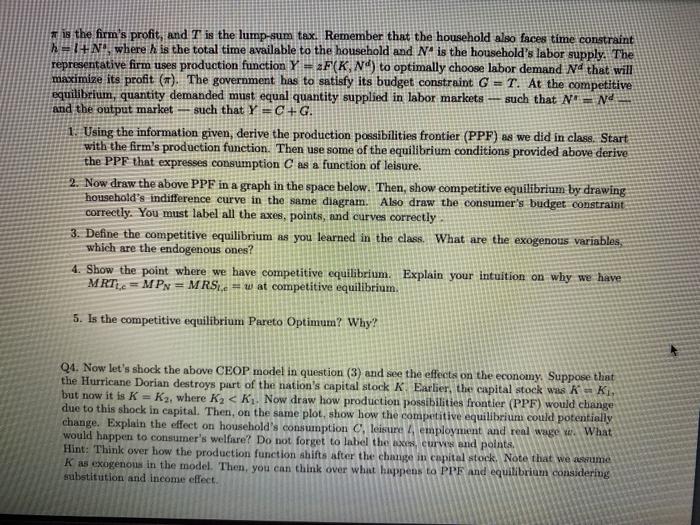
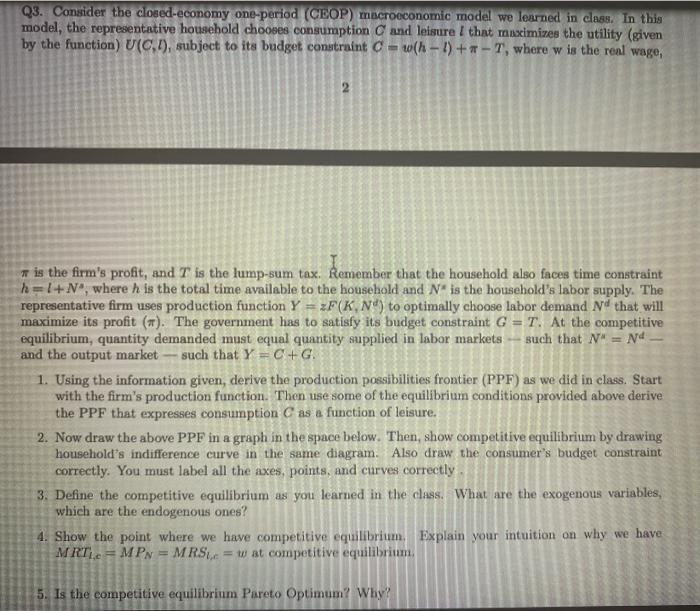
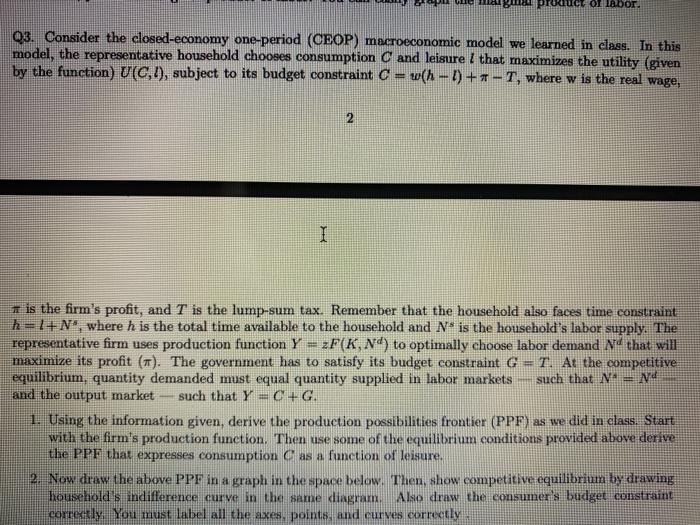
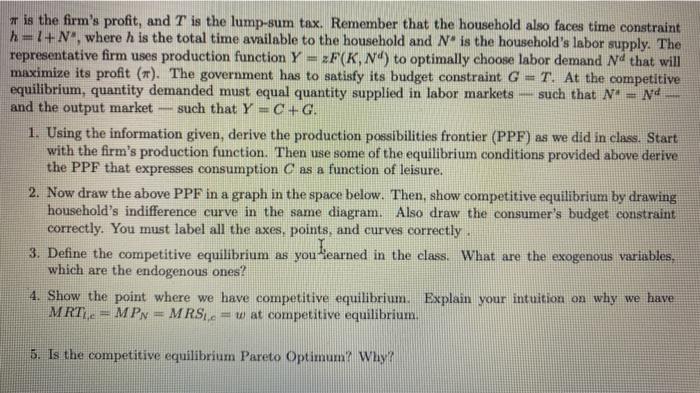
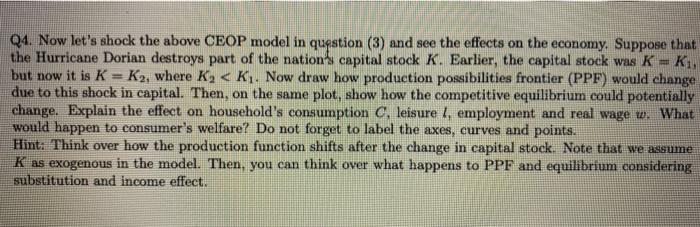
* is the firm's profit, and T is the lump-sum tax. Remember that the household also faces time constraint h-I+NA, where he is the total time available to the household and N' is the household's labor supply. The representative firm uses production function Y = 2F(K, Nd) to optimally choose labor demand Nd that will maximize its profit (). The government has to satisfy its budget constraint G = T. At the competitive equilibrium, quantity demanded must equal quantity supplied in labor markets --- such that N = Nd and the output market - such that Y=C+G. 1. Using the information given, derive the production possibilities frontier (PPF) as we did in class. Start with the firm's production function. Then use some of the equilibrium conditions provided above derive the PPF that expresses consumption C as a function of leisure. 2. Now draw the above PPF in a graph in the space below. Then, show competitive equilibrium by drawing household's indifference curve in the same diagram. Also draw the consumer's budget constraint correctly. You must label all the axes, points, and curves correctly 3. Define the competitive equilibrium as you learned in the class. What are the exogenous variables, which are the endogenous ones? 4. Show the point where we have competitive equilibrium. Explain your intuition on why we have MRTLE MPN = MRS.e = w at competitive equilibrium. 5. Is the competitive equilibrium Pareto Optimum? Why? Q4. Now let's shock the above CEOP model in question (3) and see the effects on the economy. Suppose that the Hurricane Dorian destroys part of the nation's capital stock K Earlier, the capital stock was K-K. but now it is K = K2, where K2
Step by Step Solution
There are 3 Steps involved in it

Get step-by-step solutions from verified subject matter experts