



Question: The Business Plan A business plan is a written document that describes in detail every aspect of a proposed business venture. Everything from raw material
The Business Plan
A business plan is a written document that describes in detail every aspect of a proposed business venture. Everything from raw material sources to a description of how a product will meet the specific needs of future customers is contained in the plan. The plan can range from ten to over pages in length, but most plans are about fifty pages. The ten key segments of the business plan for a manufacturing venture are listed below:
Summary. A summary of no more than three pages should capture the reader's interest by providing a clear and concise overview of the business.
Business Description. The business description includes a thorough definition of the new venture along with company and industry background information. Additionally, any competitive advantages possessed by the venture should be discussed.
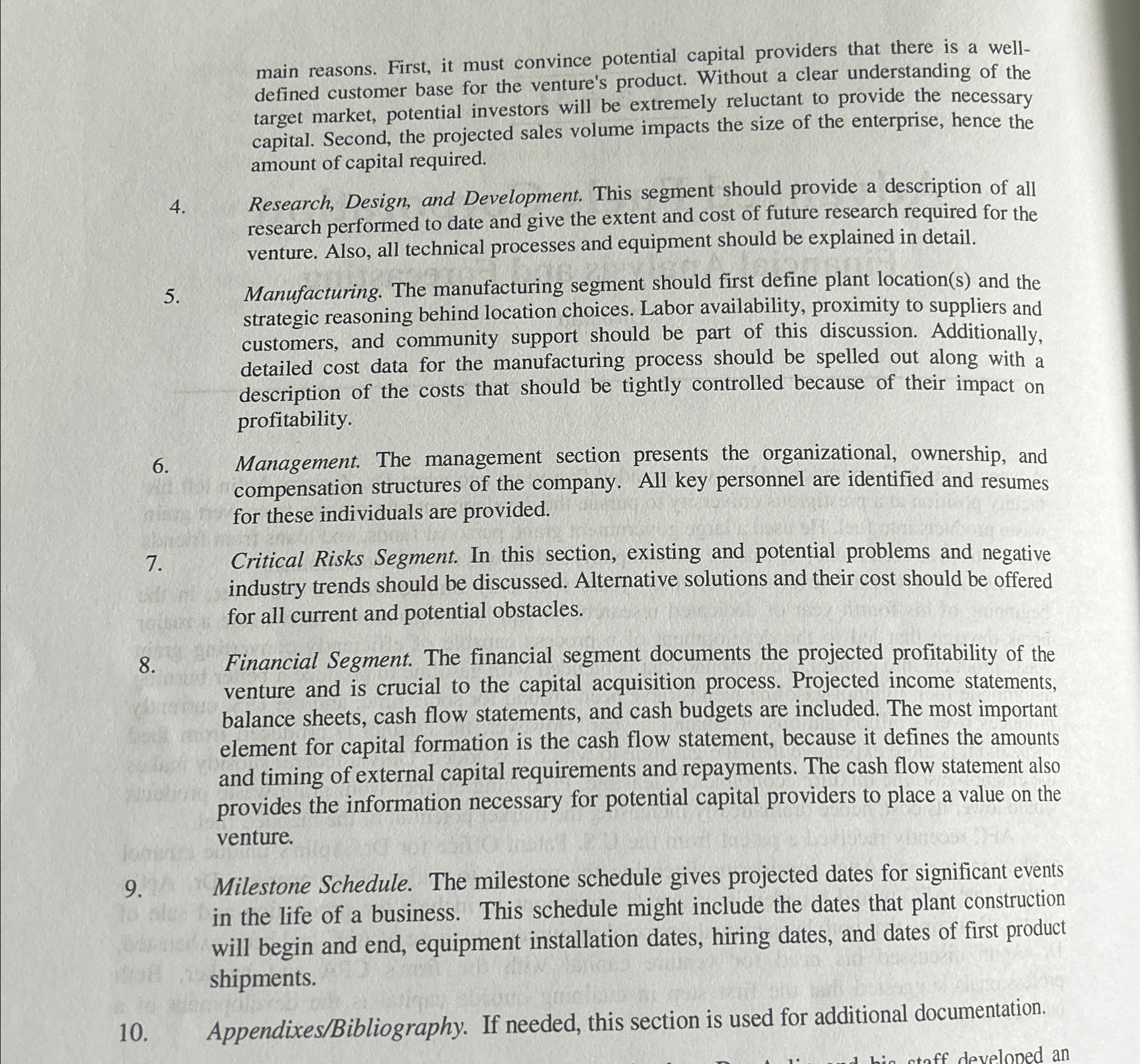
Marketing. Sales projections, supported by market research data, should be delineated in the marketing segment. This segment is a critical component of the business plan for two
main reasons. First, it must convince potential capital providers that there is a welldefined customer base for the venture's product. Without a clear understanding of the target market, potential investors will be extremely reluctant to provide the necessary capital. Second, the projected sales volume impacts the size of the enterprise, hence the amount of capital required.
Research, Design, and Development. This segment should provide a description of all research performed to date and give the extent and cost of future research required for the venture. Also, all technical processes and equipment should be explained in detail.
Manufacturing. The manufacturing segment should first define plant locations and the strategic reasoning behind location choices. Labor availability, proximity to suppliers and customers, and community support should be part of this discussion. Additionally, detailed cost data for the manufacturing process should be spelled out along with a description of the costs that should be tightly controlled because of their impact on profitability.
Management. The management section presents the organizational, ownership, and compensation structures of the company. All key personnel are identified and resumes for these individuals are provided.
Critical Risks Segment. In this section, existing and potential problems and negative industry trends should be discussed. Alternative solutions and their cost should be offered for all current and potential obstacles.
Financial Segment. The financial segment documents the projected profitability of the venture and is crucial to the capital acquisition process. Projected income statements, balance sheets, cash flow statements, and cash budgets are included. The most important element for capital formation is the cash flow statement, because it defines the amounts and timing of external capital requirements and repayments. The cash flow statement also provides the information necessary for potential capital providers to place a value on the venture.
Milestone Schedule. The milestone schedule gives projected dates for significant events in the life of a business. This schedule might include the dates that plant construction will begin and end, equipment installation dates, hiring dates, and dates of first product shipments.
AppendixesBibliography If needed, this section is used for additional documentation.
what are the two most important segments of a business plan. why?
Step by Step Solution
There are 3 Steps involved in it
1 Expert Approved Answer
Step: 1 Unlock

Question Has Been Solved by an Expert!
Get step-by-step solutions from verified subject matter experts
Step: 2 Unlock
Step: 3 Unlock