







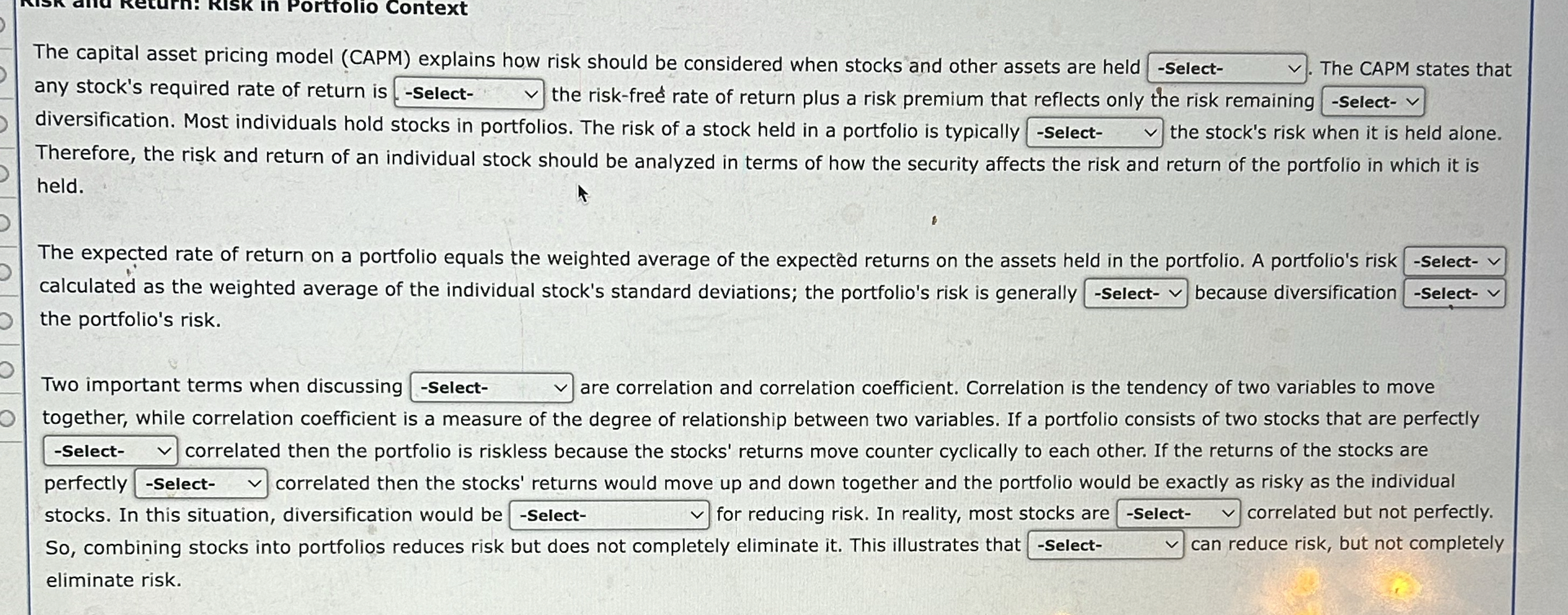
Question: The capital asset pricing model ( CAPM ) explains how risk should be considered when stocks and other assets are held . The CAPM states
The capital asset pricing model CAPM explains how risk should be considered when stocks and other assets are held
The CAPM states that
any stock's required rate of return is
the riskfree rate of return plus a risk premium that reflects only the risk remaining
diversification. Most individuals hold stocks in portfolios. The risk of a stock held in a portfolio is typically
the stock's risk when it is held alone.
Therefore, the risk and return of an individual stock should be analyzed in terms of how the security affects the risk and return of the portfolio in which it is
held.
The expected rate of return on a portfolio equals the weighted average of the expected returns on the assets held in the portfolio. A portfolio's risk
calculated as the weighted average of the individual stock's standard deviations; the portfolio's risk is generally
because diversification
the portfolio's risk.
Two important terms when discussing
are correlation and correlation coefficient. Correlation is the tendency of two variables to move
together, while correlation coefficient is a measure of the degree of relationship between two variables. If a portfolio consists of two stocks that are perfectly
correlated then the portfolio is riskless because the stocks' returns move counter cyclically to each other. If the returns of the stocks are
perfectly
correlated then the stocks' returns would move up and down together and the portfolio would be exactly as risky as the individual
stocks. In this situation, diversification would be
for reducing risk. In reality, most stocks are
correlated but not perfectly.
So combining stocks into portfolios reduces risk but does not completely eliminate it This illustrates that
can reduce risk, but not completely
eliminate risk.
Step by Step Solution
There are 3 Steps involved in it
1 Expert Approved Answer
Step: 1 Unlock

Question Has Been Solved by an Expert!
Get step-by-step solutions from verified subject matter experts
Step: 2 Unlock
Step: 3 Unlock
 Study Help