







Question: The Capital Asset Pricing Model shows that the expected return on a security is equal to the risk-free return plus a security risk premium. The
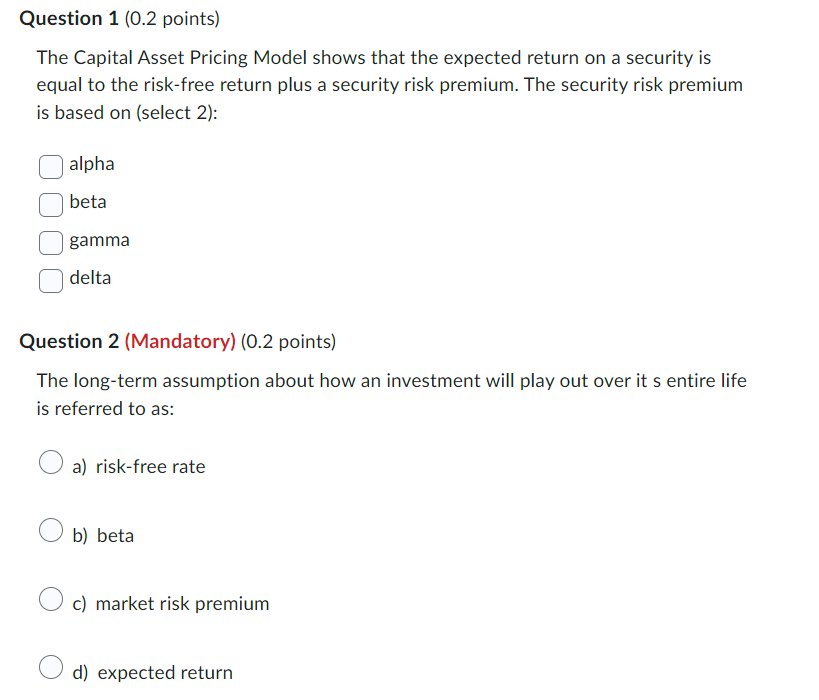
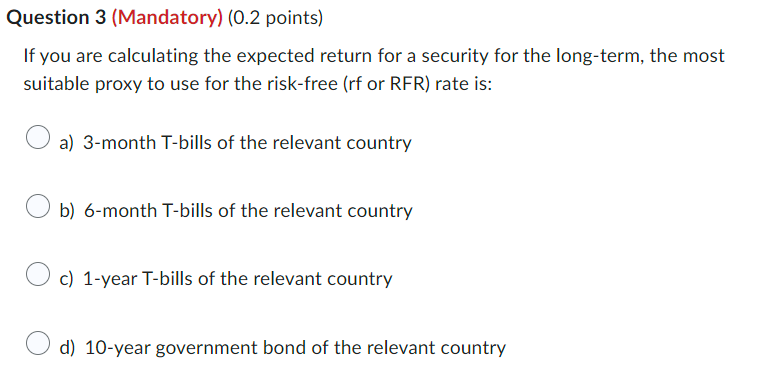
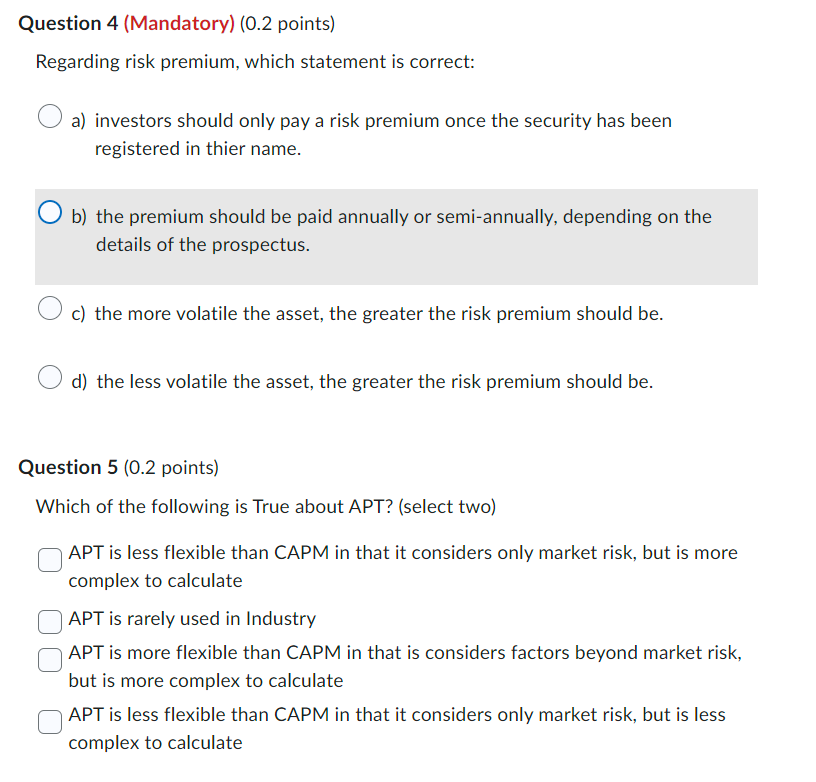
The Capital Asset Pricing Model shows that the expected return on a security is equal to the risk-free return plus a security risk premium. The security risk premium is based on (select 2): alpha beta gamma delta Question 2 (Mandatory) (0.2 points) The long-term assumption about how an investment will play out over it s entire life is referred to as: a) risk-free rate b) beta c) market risk premium d) expected return If you are calculating the expected return for a security for the long-term, the most suitable proxy to use for the risk-free (rf or RFR) rate is: a) 3-month T-bills of the relevant country b) 6-month T-bills of the relevant country c) 1-year T-bills of the relevant country d) 10-year government bond of the relevant country Regarding risk premium, which statement is correct: a) investors should only pay a risk premium once the security has been registered in thier name. b) the premium should be paid annually or semi-annually, depending on the details of the prospectus. c) the more volatile the asset, the greater the risk premium should be. d) the less volatile the asset, the greater the risk premium should be. Question 5 (0.2 points) Which of the following is True about APT? (select two) APT is less flexible than CAPM in that it considers only market risk, but is more complex to calculate APT is rarely used in Industry APT is more flexible than CAPM in that is considers factors beyond market risk, but is more complex to calculate APT is less flexible than CAPM in that it considers only market risk, but is less complex to calculate
Step by Step Solution
There are 3 Steps involved in it

Get step-by-step solutions from verified subject matter experts
 Study Help