







Question: The case study: Apples Tim Cook Leads Different. How did Tim Cook manage Apples human talent? Discuss the bases of power applied in Apple. To
 The case study: Apples Tim Cook Leads Different.
- How did Tim Cook manage Apples human talent? Discuss the bases of power applied in Apple.
- To what extent do you think Apple has sustainable competitive advantage, especially without Steve Jobs?
400 words to each question please, do not please copy paste.
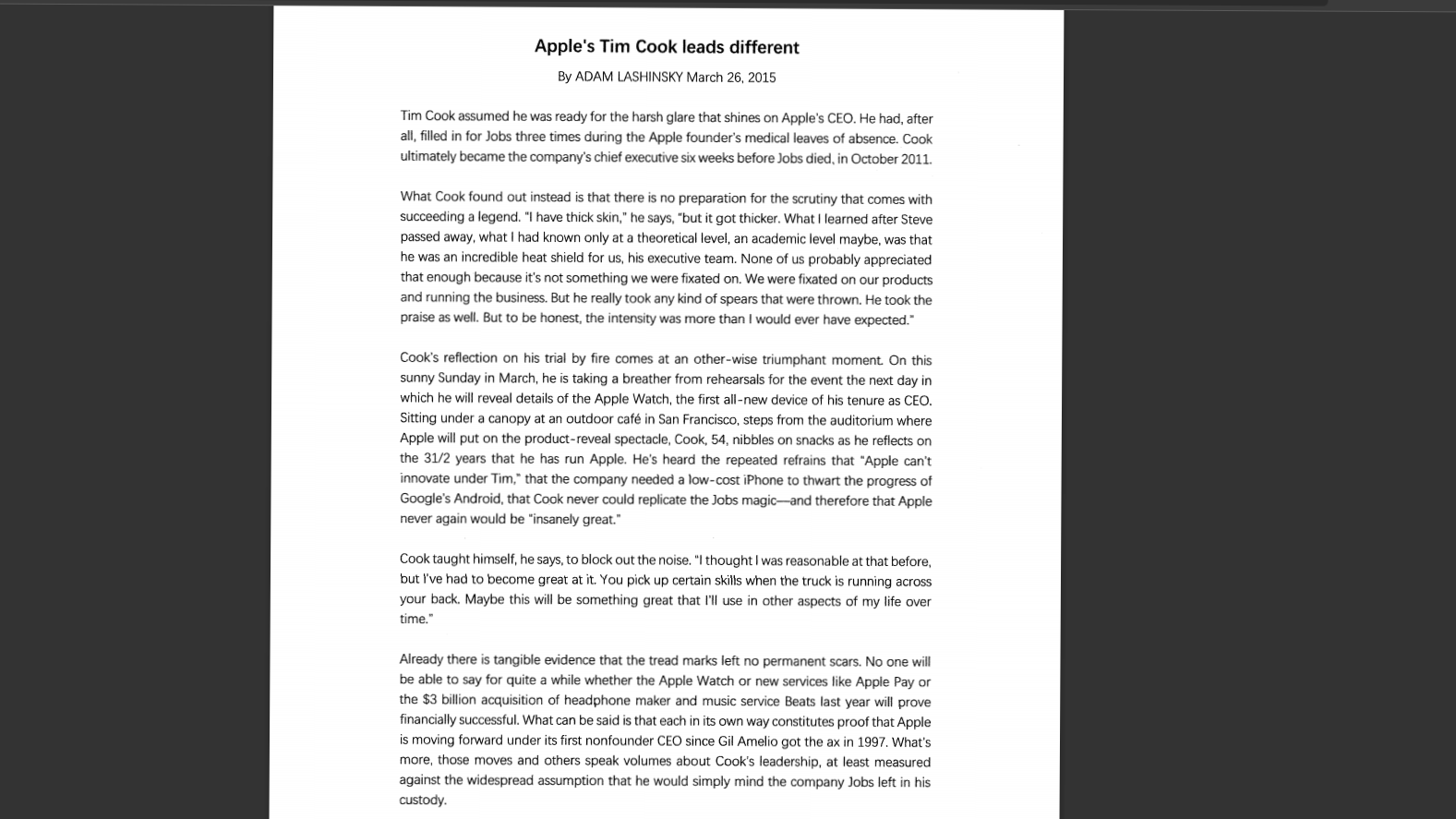
Apple's Tim Cook leads different By ADAM LASHINSKY March 26, 2015 Tim Cook assumed he was ready for the harsh glare that shines on Apple's CEO. He had, after all, filled in for Jobs three times during the Apple founder's medical leaves of absence. Cook ultimately became the company's chief executive six weeks before Jobs died in October 2011. What Cook found out instead is that there is no preparation for the scrutiny that comes with succeeding a legend. "I have thick skin," he says, "but it got thicker. What I learned after Steve passed away, what I had known only at a theoretical level, an academic level maybe, was that he was an incredible heat shield for us, his executive team. None of us probably appreciated that enough because it's not something we were fixated on. We were fixated on our products and running the business. But he really took any kind of spears that were thrown. He took the praise as well. But to be honest, the intensity was more than I would ever have expected." Cook's reflection on his trial by fire comes at an other-wise triumphant moment on this sunny Sunday in March, he is taking a breather from rehearsals for the event the next day in which he will reveal details of the Apple Watch, the first all-new device of his tenure as CEO. Sitting under a canopy at an outdoor caf in San Francisco, steps from the auditorium where Apple will put on the product-reveal spectacle, Cook, 54, nibbles on snacks as he reflects on the 31/2 years that he has run Apple. He's heard the repeated refrains that "Apple can't innovate under Tim," that the company needed a low-cost iPhone to thwart the progress of Google's Android, that Cook never could replicate the Jobs magic--and therefore that Apple never again would be "insanely great." Cook taught himself, he says, to block out the noise. "I thought I was reasonable at that before, but I've had to become great at it. You pick up certain skills when the truck is running across your back. Maybe this will be something great that I'll use in other aspects of my life over time." Already there is tangible evidence that the tread marks left no permanent scars. No one will be able to say for quite a while whether the Apple Watch or new services like Apple Pay or the $3 billion acquisition of headphone maker and music service Beats last year will prove financially successful. What can be said is that each in its own way constitutes proof that Apple is moving forward under its first nonfounder CEO since Gil Amelio got the ax in 1997. What's more, those moves and others speak volumes about Cook's leadership, at least measured against the widespread assumption that he would simply mind the company Jobs left in his custodyStep by Step Solution
There are 3 Steps involved in it
1 Expert Approved Answer
Step: 1 Unlock

Question Has Been Solved by an Expert!
Get step-by-step solutions from verified subject matter experts
Step: 2 Unlock
Step: 3 Unlock
 Study Help