







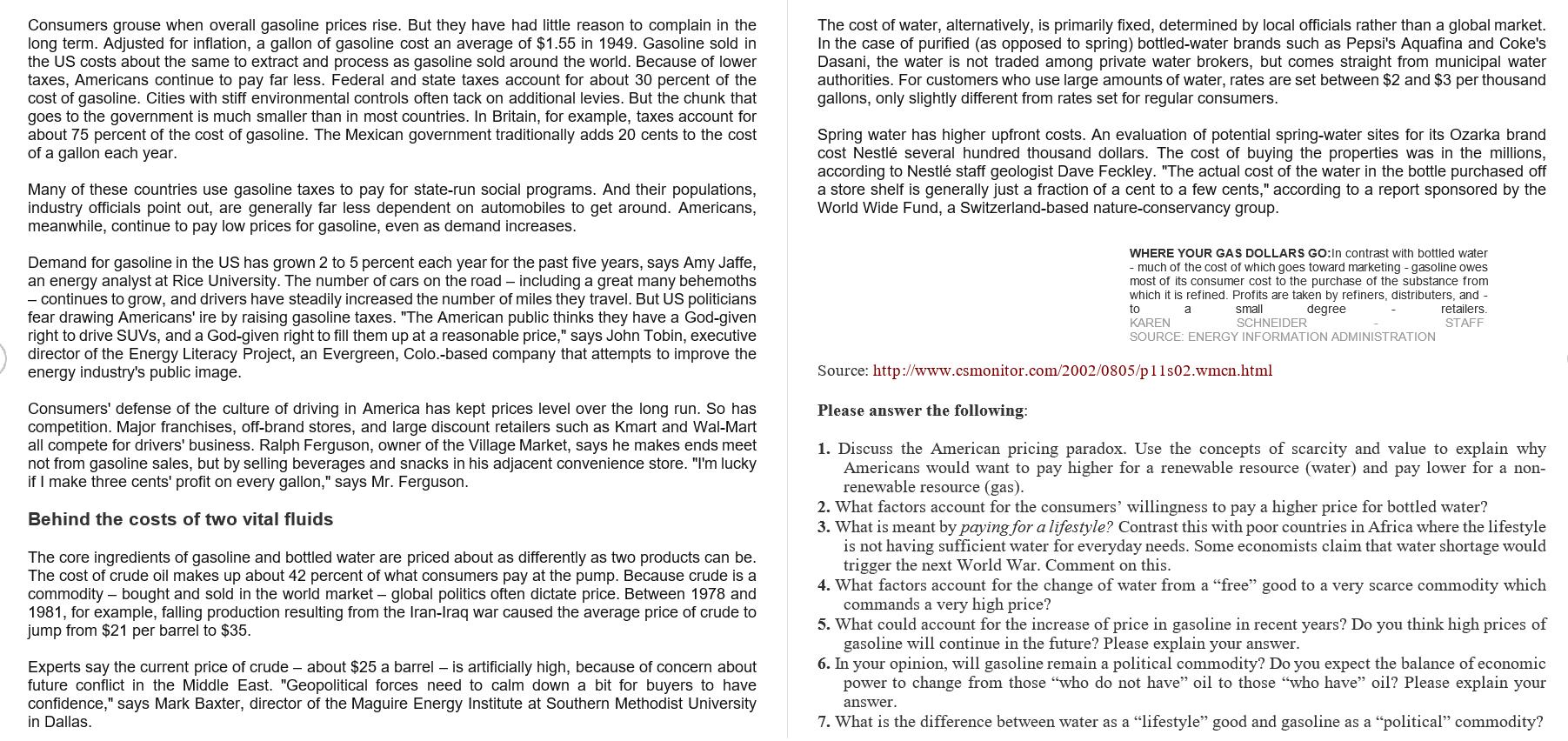
Question: The Case Study is in the Attached file Please answer the following: 1. Discuss the American pricing paradox. Use the concepts of scarcity and value
The Case Study is in the Attached file Please answer the following:
1. Discuss the American pricing paradox. Use the concepts of scarcity and value to explain why Americans would want to pay higher for a renewable resource (water) and pay lower for a non-renewable resource (gas).
2. What factors account for the consumers’ willingness to pay a higher price for bottled water?
3. What is meant by paying for a lifestyle? Contrast this with poor countries in Africa where the lifestyle is not having sufficient water for everyday needs. Some economists claim that water shortage would trigger the next World War. Comment on this.
4. What factors account for the change of water from a “free” good to a very scarce commodity which commands a very high price?
5. What could account for the increase of price in gasoline in recent years? Do you think high prices of gasoline will continue in the future? Please explain your answer.
6. In your opinion, will gasoline remain a political commodity? Do you expect the balance of economic power to change from those “who do not have” oil to those “who have” oil? Please explain your answer.
7. What is the difference between water as a “lifestyle” good and gasoline as a “political” commodity?
8. How much of the pricing paradox is explained by economics, lifestyle and politics?
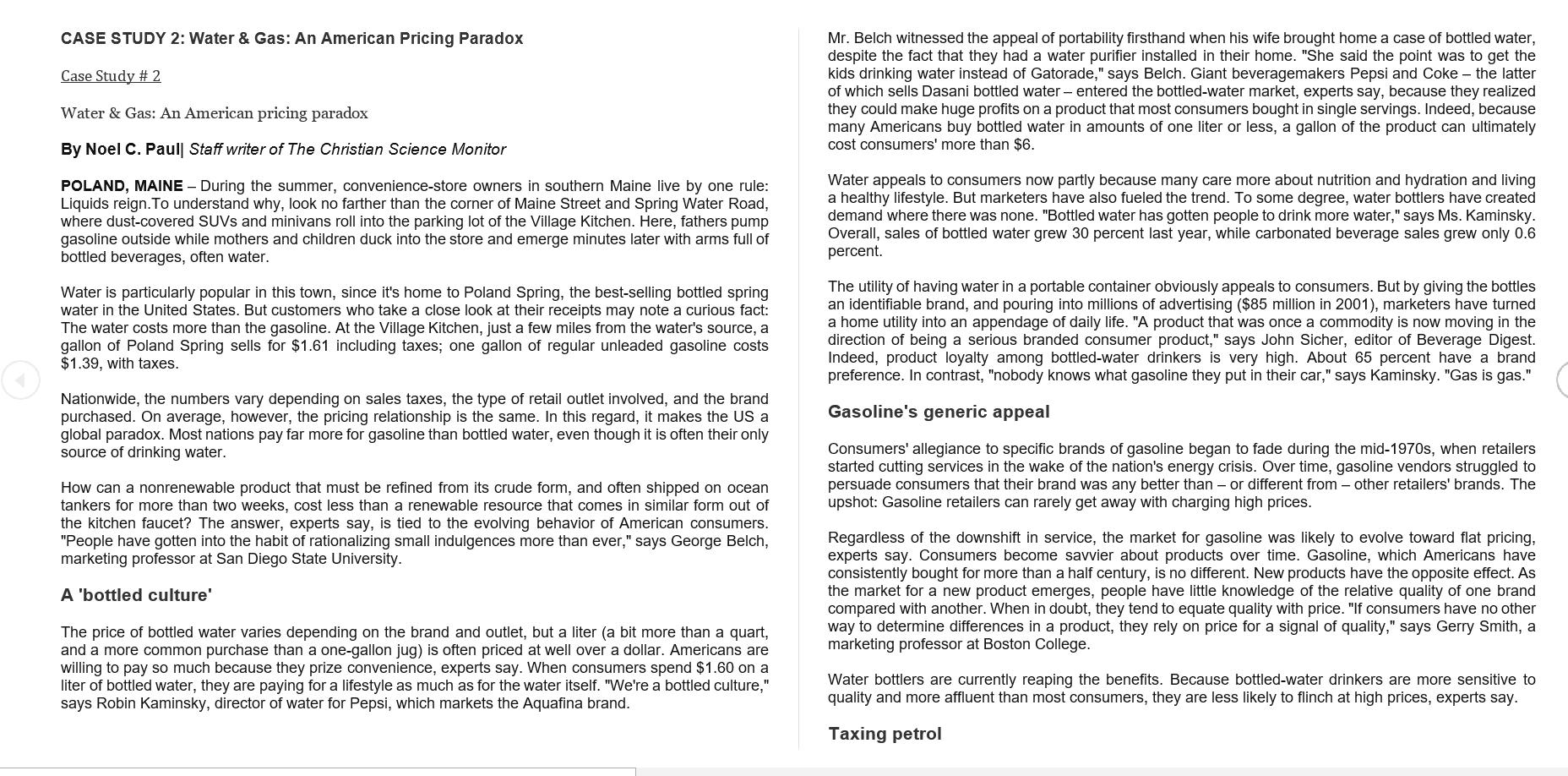
CASE STUDY 2: Water & Gas: An American Pricing Paradox Case Study # 2 Water & Gas: An American pricing paradox By Noel C. Paull Staff writer of The Christian Science Monitor POLAND, MAINE - During the summer, convenience-store owners in southern Maine live by one rule: Liquids reign. To understand why, look no farther than the corner of Maine Street and Spring Water Road, where dust-covered SUVs and minivans roll into the parking lot of the Village Kitchen. Here, fathers pump gasoline outside while mothers and children duck into the store and emerge minutes later with arms full of bottled beverages, often water. Water is particularly popular in this town, since it's home to Poland Spring, the best-selling bottled spring water in the United States. But customers who take a close look at their receipts may note a curious fact: The water costs more than the gasoline. At the Village Kitchen, just a few miles from the water's source, a gallon of Poland Spring sells for $1.61 including taxes; one gallon of regular unleaded gasoline costs $1.39, with taxes. Nationwide, the numbers vary depending on sales taxes, the type of retail outlet involved, and the brand purchased. On average, however, the pricing relationship is the same. In this regard, it makes the US a global paradox. Most nations pay far more for gasoline than bottled water, even though it is often their only source of drinking water. How can a nonrenewable product that must be refined from its crude form, and often shipped on ocean tankers for more than two weeks, cost less than a renewable resource that comes in similar form out of the kitchen faucet? The answer, experts say, is tied to the evolving behavior of American consumers. "People have gotten into the habit of rationalizing small indulgences more than ever," says George Belch, marketing professor at San Diego State University. A 'bottled culture' The price of bottled water varies depending on the brand and outlet, but a liter (a bit more than a quart, and a more common purchase than a one-gallon jug) is often priced at well over a dollar. Americans are willing to pay so much because they prize convenience, experts say. When consumers spend $1.60 on a liter of bottled water, they are paying for a lifestyle as much as for the water itself. "We're a bottled culture," says Robin Kaminsky, director of water for Pepsi, which markets the Aquafina brand. Mr. Belch witnessed the appeal of portability firsthand when his wife brought home a case of bottled water, despite the fact that they had a water purifier installed in their home. "She said the point was to get the kids drinking water instead of Gatorade," says Belch. Giant beveragemakers Pepsi and Coke - the latter of which sells Dasani bottled water - entered the bottled-water market, experts say, because they realized they could make huge profits on a product that most consumers bought in single servings. Indeed, because many Americans buy bottled water in amounts of one liter or less, a gallon of the product can ultimately cost consumers' more than $6. Water appeals to consumers now partly because many care more about nutrition and hydration and living a healthy lifestyle. But marketers have also fueled the trend. To some degree, water bottlers have created demand where there was none. "Bottled water has gotten people to drink more water," says Ms. Kaminsky. Overall, sales of bottled water grew 30 percent last year, while carbonated beverage sales grew only 0.6 percent. The utility of having water in a portable container obviously appeals to consumers. But by giving the bottles an identifiable brand, and pouring into millions of advertising ($85 million in 2001), marketers have turned a home utility into an appendage of daily life. "A product that was once a commodity is now moving in the direction of being a serious branded consumer product," says John Sicher, editor of Beverage Digest. Indeed, product loyalty among bottled-water drinkers is very high. About 65 percent have a brand preference. In contrast, "nobody knows what gasoline they put in their car," says Kaminsky. "Gas is gas." Gasoline's generic appeal Consumers' allegiance to specific brands of gasoline began to fade during the mid-1970s, when retailers started cutting services in the wake of the nation's energy crisis. Over time, gasoline vendors struggled to persuade consumers that their brand was any better than - or different from other retailers' brands. The upshot: Gasoline retailers can rarely get away with charging high prices. Regardless of the downshift in service, the market for gasoline was likely to evolve toward flat pricing, experts say. Consumers become savvier about products over time. Gasoline, which Americans have consistently bought for more than a half century, is no different. New products have the opposite effect. As the market for a new product emerges, people have little knowledge of the relative quality of one brand compared with another. When in doubt, they tend to equate quality with price. "If consumers have no other way to determine differences in a product, they rely on price for a signal of quality," says Gerry Smith, a marketing professor at Boston College. Water bottlers are currently reaping the benefits. Because bottled-water drinkers are more sensitive to quality and more affluent than most consumers, they are less likely to flinch at high prices, experts say. Taxing petrol
Step by Step Solution
3.45 Rating (164 Votes )
There are 3 Steps involved in it
1The American pricing paradox is that Americans would rather pay more for a renewable resource such as water than a nonrenewable resource such as gas The reason for this is that water is a scarce reso... View full answer

Get step-by-step solutions from verified subject matter experts
 Study Help