







Question: The Case Study Report This case study report is about the use of several functional area information systems by the Port Shipping Authority (P S
The Case Study Report
This case study report is about the use of several functional area information systems by the Port Shipping Authority (PSA) of Singapore. As Singapore is a transhipment hub for shippers, port operations are very demanding. Arriving containers destined for other port destinations have to be transferred to other ships or stacked at port warehouse (for later shipment), while containers destined for Singapore are also stored at port warehouse for local delivery. These operations have to be well-coordinated to minimise ship turnaround times. The business operations of PSA are handled by more than one business departments of PSA. Each department uses its own unique IT system in support of its business activities. A brief description of those systems are given below:
Port Arrival Department (PAD): Before a ship arrives in Singapore, the shipping company sendsa Ship Arrival Port Call to the PAD of PSA through the PortNet system. The shipping company indicates when the ship will be arriving and applies for berthing spaces at PSA. Information sent via PortNet includes such data as: name of ship, shipping company, how many containers are on the ship, how they are arranged, contents of the container, destination of such containers, and their promised arrival date. The PortNet system is a highly customised IT system that has been developed by the IT employees of PSA about a decade ago. Hence, PSA exercises a complete ownership of the source code of the PortNet system.
Once PAD receives a Ship Arrival Port Call from a shipping company, it then conducts security verification for the ship, its crew members, contents of containers, and destination of containers. Such a verification process involves determining whether there exists any international or US sanction imposed on the ship or any of its crew or contents of containers or destination of such containers. Such verification is done using an Online Ship Security System that has been developed by a US-based IT company, and is widely used by the port authorities of many countries of the world. The access to the source code is owned by the IT company alone. Hence, no alterations of the online ship security system can be done by PSA.
Port Operation Department (POD): Once satisfied with security clearance, PAD then advises the POD of PSA to undertake necessary arrangements for the ship. The managers of POD use the Computer Integrated Terminal Operations System (CITOS) to create plans for ship berthing and unloading containers. Such a system was developed and owned by an Australian IT company about seven years ago. At present, that IT company ceases to operate as its ownership has changed. Furthermore, the team members responsible for developing the CITOS system no longer work for that company.
Plans specify whether the container will be picked up from the terminal, transferred to another ship, or stacked for later shipment. The system handles imports/exports for the domestic market. When the ship arrives, it docks at a specified time at its assigned berth. A number of quay cranes are assigned to service the ship based on the number of containers to be unloaded/loaded. Prime movers (special trucks that carry two containers) move the containers from the ship to Singapore Port Warehouse.
Singapore Port Warehouse (SPW): PSA is the largest owner of warehouse space in Singapore which caters to a host of distribution operators, manufacturers, traders, and freight forwarders. With the warehouse business, PSA attempts to provide value added services to its traditional port operations, including the storage of goods and empty containers, labelling, repackaging, tagging, sampling and testing, quality control and billing. All the information about containers and the locations in SPW are handled by the online PortNet system which can also been accessed by the shipping company to find out the location of their containers stored at the warehouse.
The Chied Executive Officer (CEO) of PSA is however unhappy with the slow and inefficentbusiness operations of Singapore Port. After consulting with the CIO and managers of variousdepartments, the CEO recognises the lack of coordination among the departments in terms of sharing of complete, accurate and timely data as well as employee attitudes of variousdepartments are the root cause leading to the inefficiency of the port operations. He furtherrecognises that multiple legacy systems (some in-house developed while others developed by external IT vendors) are being used by various departments of the PSA of Singapore, and there isno electronic interconnection among them, and those systems store data in different format. The CEO is thus contemplating to consult an international IT consulting company to recommend a potential solution to address the inefficiency of the PSA.
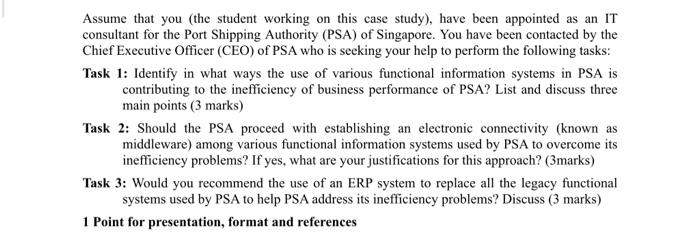
Assume that you (the student working on this case study), have been appointed as an IT consultant for the Port Shipping Authority (PSA) of Singapore. You have been contacted by the Chief Executive Officer (CEO) of PSA who is seeking your help to perform the following tasks: Task 1: Identify in what ways the use of various functional information systems in PSA is contributing to the inefficiency of business performance of PSA? List and discuss three main points ( 3 marks) Task 2: Should the PSA proceed with establishing an electronic connectivity (known as middleware) among various functional information systems used by PSA to overcome its inefficiency problems? If yes, what are your justifications for this approach? (3marks) Task 3: Would you recommend the use of an ERP system to replace all the legacy functional systems used by PSA to help PSA address its inefficiency problems? Discuss ( 3 marks) 1 Point for presentation, format and references
Step by Step Solution
There are 3 Steps involved in it

Get step-by-step solutions from verified subject matter experts
 Study Help