







Question: The Closeout Phase The scope implementation and closeout were closely monitored by Edelca, which ensured that the accomplishments and expenditures complied with the standards and
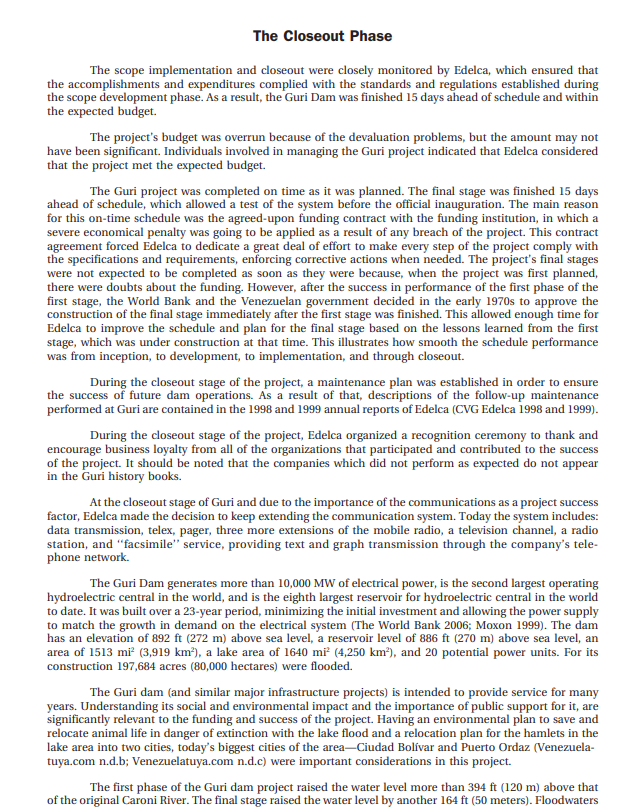
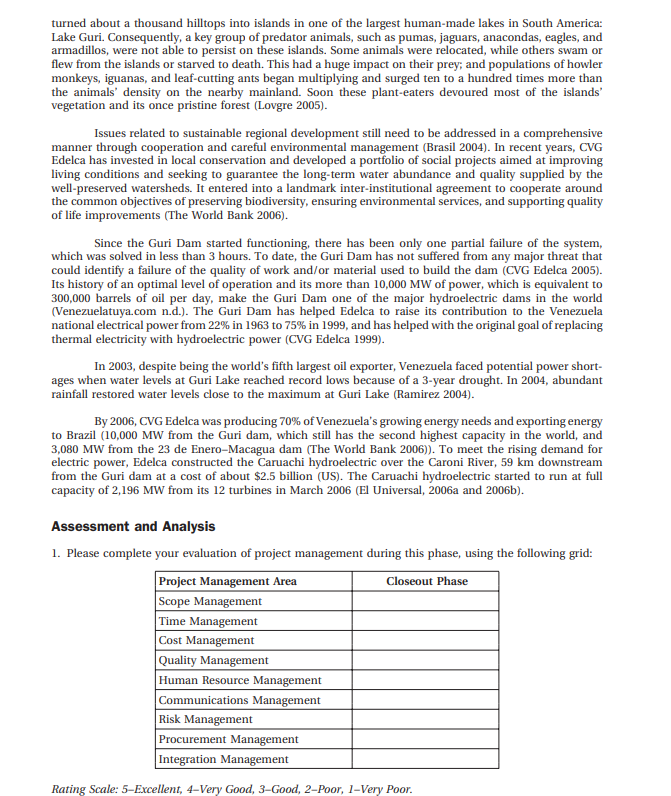
The Closeout Phase The scope implementation and closeout were closely monitored by Edelca, which ensured that the accomplishments and expenditures complied with the standards and regulations established during the scope development phase. As a result, the Guri Dam was finished 15 days ahead of schedule and within the expected budget. The project's budget was overrun because of the devaluation problems, but the amount may not have been significant. Individuals involved in managing the Guri project indicated that Edelca considered that the project met the expected budget. The Guri project was completed on time as it was planned. The final stage was finished 15 days ahead of schedule, which allowed a test of the system before the official inauguration. The main reason for this on-time schedule was the agreed-upon funding contract with the funding institution, in which a severe economical penalty was going to be applied as a result of any breach of the project. This contract agreement forced Edelca to dedicate a great deal of effort to make every step of the project comply with the specifications and requirements, enforcing corrective actions when needed. The project's final stages were not expected to be completed as soon as they were because, when the project was first planned, there were doubts about the funding. However, after the success in performance of the first phase of the first stage, the World Bank and the Venezuelan government decided in the early 1970s to approve the construction of the final stage immediately after the first stage was finished. This allowed enough time for Edelca to improve the schedule and plan for the final stage based on the lessons learned from the first stage, which was under construction at that time. This illustrates how smooth the schedule performance was from inception, to development, to implementation, and through closeout. During the closeout stage of the project, a maintenance plan was established in order to ensure the success of future dam operations. As a result of that, descriptions of the follow-up maintenance performed at Guri are contained in the 1998 and 1999 annual reports of Edelca (CVG Edelca 1998 and 1999). During the closeout stage of the project, Edelca organized a recognition ceremony to thank and encourage business loyalty from all of the organizations that participated and contributed to the success of the project. It should be noted that the companies which did not perform as expected do not appear in the Guri history books. At the closeout stage of Guri and due to the importance of the communications as a project success factor, Edelca made the decision to keep extending the communication system. Today the system includes: data transmission, telex, pager, three more extensions of the mobile radio, a television channel, a radio station, and "facsimile" service, providing text and graph transmission through the company's telephone network. The Guri Dam generates more than 10,000MW of electrical power, is the second largest operating hydroelectric central in the world, and is the eighth largest reservoir for hydroelectric central in the world to date. It was built over a 23-year period, minimizing the initial investment and allowing the power supply to match the growth in demand on the electrical system (The World Bank 2006; Moxon 1999). The dam has an elevation of 892ft(272m) above sea level, a reservoir level of 886ft(270m) above sea level, an area of 1513mi2(3,919km2), a lake area of 1640mi2(4,250km2), and 20 potential power units. For its construction 197,684 acres ( 80,000 hectares) were flooded. The Guri dam (and similar major infrastructure projects) is intended to provide service for many years. Understanding its social and environmental impact and the importance of public support for it, are significantly relevant to the funding and success of the project. Having an environmental plan to save and relocate animal life in danger of extinction with the lake flood and a relocation plan for the hamlets in the lake area into two cities, today's biggest cities of the area-Ciudad Bolivar and Puerto Ordaz (Venezuelatuya.com n.d.b; Venezuelatuya.com n.d.c) were important considerations in this project. The first phase of the Guri dam project raised the water level more than 394ft(120m) above that of the original Caroni River. The final stage raised the water level by another 164ft ( 50 meters). Floodwaters Lake Guri. Consequently, a key group of predator animals, such as pumas, jaguars, anacondas, eagles, and armadillos, were not able to persist on these islands. Some animals were relocated, while others swam or flew from the islands or starved to death. This had a huge impact on their prey; and populations of howler monkeys, iguanas, and leaf-cutting ants began multiplying and surged ten to a hundred times more than the animals' density on the nearby mainland. Soon these plant-eaters devoured most of the islands' vegetation and its once pristine forest (Lovgre 2005). Issues related to sustainable regional development still need to be addressed in a comprehensive manner through cooperation and careful environmental management (Brasil 2004). In recent years, CVG Edelca has invested in local conservation and developed a portfolio of social projects aimed at improving living conditions and seeking to guarantee the long-term water abundance and quality supplied by the well-preserved watersheds. It entered into a landmark inter-institutional agreement to cooperate around the common objectives of preserving biodiversity, ensuring environmental services, and supporting quality of life improvements (The World Bank 2006). Since the Guri Dam started functioning, there has been only one partial failure of the system, which was solved in less than 3 hours. To date, the Guri Dam has not suffered from any major threat that could identify a failure of the quality of work and/or material used to build the dam (CVG Edelca 2005). Its history of an optimal level of operation and its more than 10,000 MW of power, which is equivalent to 300,000 barrels of oil per day, make the Guri Dam one of the major hydroelectric dams in the world (Venezuelatuya.com n.d.). The Guri Dam has helped Edelca to raise its contribution to the Venezuela national electrical power from 22% in 1963 to 75% in 1999, and has helped with the original goal of replacing thermal electricity with hydroelectric power (CVG Edelca 1999). In 2003, despite being the world's fifth largest oil exporter, Venezuela faced potential power shortages when water levels at Guri Lake reached record lows because of a 3-year drought. In 2004, abundant rainfall restored water levels close to the maximum at Guri Lake (Ramirez 2004). By 2006, CVG Edelca was producing 70% of Venezuela's growing energy needs and exporting energy to Brazil (10,000 MW from the Guri dam, which still has the second highest capacity in the world, and 3,080 MW from the 23 de Enero-Macagua dam (The World Bank 2006)). To meet the rising demand for electric power, Edelca constructed the Caruachi hydroelectric over the Caroni River, 59km downstream from the Guri dam at a cost of about $2.5 billion (US). The Caruachi hydroelectric started to run at full capacity of 2,196 MW from its 12 turbines in March 2006 (El Universal, 2006a and 2006b). Assessment and Analysis 1. Please complete your evaluation of project management during this phase, using the following grid: The Guri Dam 2. Please highlight the major areas of strength in the management of this phase of the project: 3. Please highlight the major opportunities for improvement in the management of this phase of the project
Step by Step Solution
There are 3 Steps involved in it

Get step-by-step solutions from verified subject matter experts
 Study Help