







Question: The code below provides a training data set containing six observations, three predictors, and one qualitative response variable. # 12345 ## 11030Red ##22200 Red ##3013
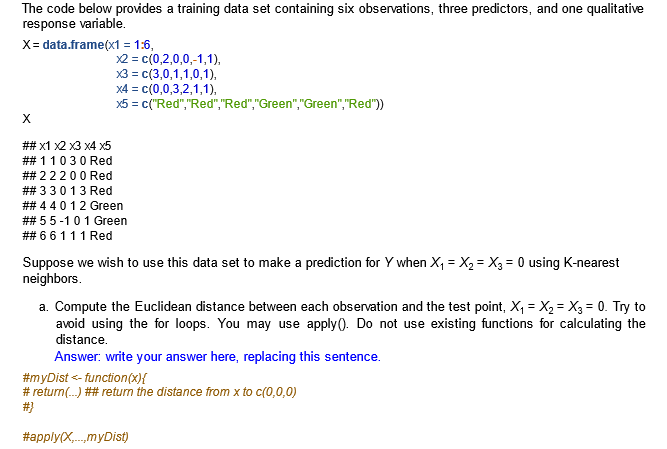
The code below provides a training data set containing six observations, three predictors, and one qualitative response variable. \# 12345 \#\# 11030Red \#\#22200 Red \#\#3013 Red \#\# 44012 Green \#\# 55-101 Green \#\# 66111Red Suppose we wish to use this data set to make a prediction for Y when X1=X2=X3=0 using K-nearest neighbors. a. Compute the Euclidean distance between each observation and the test point, X1=X2=X3=0. Try to avoid using the for loops. You may use apply(). Do not use existing functions for calculating the distance. Answer: write your answer here, replacing this sentence. #myDist (x) I # return(...) \#\# return the distance from x to c(0,0,0) \#\} The code below provides a training data set containing six observations, three predictors, and one qualitative response variable. \# 12345 \#\# 11030Red \#\#22200 Red \#\#3013 Red \#\# 44012 Green \#\# 55-101 Green \#\# 66111Red Suppose we wish to use this data set to make a prediction for Y when X1=X2=X3=0 using K-nearest neighbors. a. Compute the Euclidean distance between each observation and the test point, X1=X2=X3=0. Try to avoid using the for loops. You may use apply(). Do not use existing functions for calculating the distance. Answer: write your answer here, replacing this sentence. #myDist (x) I # return(...) \#\# return the distance from x to c(0,0,0) \#\}
Step by Step Solution
There are 3 Steps involved in it

Get step-by-step solutions from verified subject matter experts
 Study Help