







Question: The Constitution Act 1982: Select one: O a divides legislative power between the federal and provincial governments. b. can only be amended by the British
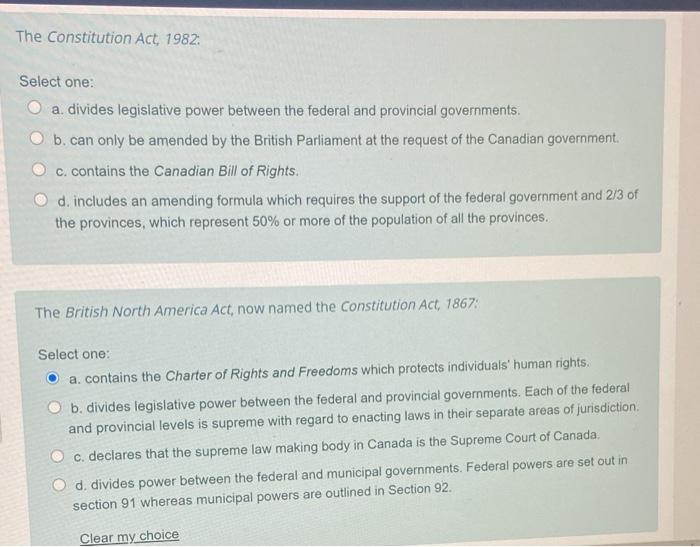
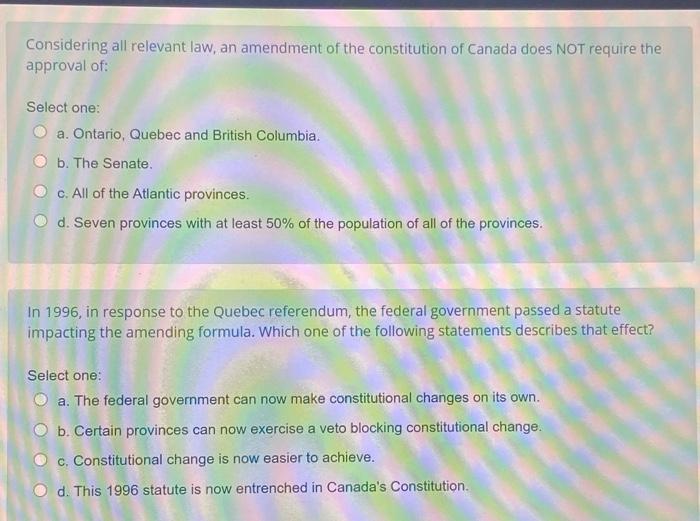
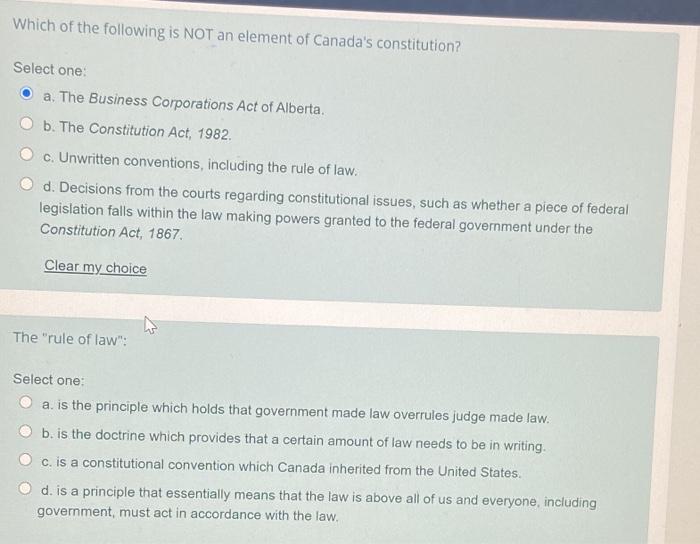
The Constitution Act 1982: Select one: O a divides legislative power between the federal and provincial governments. b. can only be amended by the British Parliament at the request of the Canadian government O c. contains the Canadian Bill of Rights. d. includes an amending formula which requires the support of the federal government and 2/3 of the provinces, which represent 50% or more of the population of all the provinces. The British North America Act, now named the Constitution Act, 1867: Select one: a. contains the Charter of Rights and Freedoms which protects individuals' human rights. O b. divides legislative power between the federal and provincial governments. Each of the federal and provincial levels is supreme with regard to enacting laws in their separate areas of jurisdiction. c. declares that the supreme law making body in Canada is the Supreme Court of Canada d. divides power between the federal and municipal governments. Federal powers are set out in section 91 whereas municipal powers are outlined in Section 92. Clear my choice Considering all relevant law, an amendment of the constitution of Canada does NOT require the approval of: Select one: a. Ontario, Quebec and British Columbia. b. The Senate. c. All of the Atlantic provinces. d. Seven provinces with at least 50% of the population of all of the provinces. In 1996, in response to the Quebec referendum, the federal government passed a statute impacting the amending formula. Which one of the following statements describes that effect? Select one: O a. The federal government can now make constitutional changes on its own. O b. Certain provinces can now exercise a veto blocking constitutional change. c. Constitutional change is now easier to achieve. O d. This 1996 statute is now entrenched in Canada's Constitution. Which of the following is NOT an element of Canada's constitution? Select one: a. The Business Corporations Act of Alberta. b. The Constitution Act, 1982. c. Unwritten conventions, including the rule of law. d. Decisions from the courts regarding constitutional issues, such as whether a piece of federal legislation falls within the law making powers granted to the federal government under the Constitution Act, 1867, Clear my choice The "rule of law": Select one: a. is the principle which holds that government made law overrules judge made law. b. is the doctrine which provides that a certain amount of law needs to be in writing. c. is a constitutional convention which Canada inherited from the United States d. is a principle that essentially means that the law is above all of us and everyone, including government, must act in accordance with the law
Step by Step Solution
There are 3 Steps involved in it

Get step-by-step solutions from verified subject matter experts
 Study Help