







Question: The convolution of two functions g and fis the function g *f defined by vf (v)du The aim of this project is to show
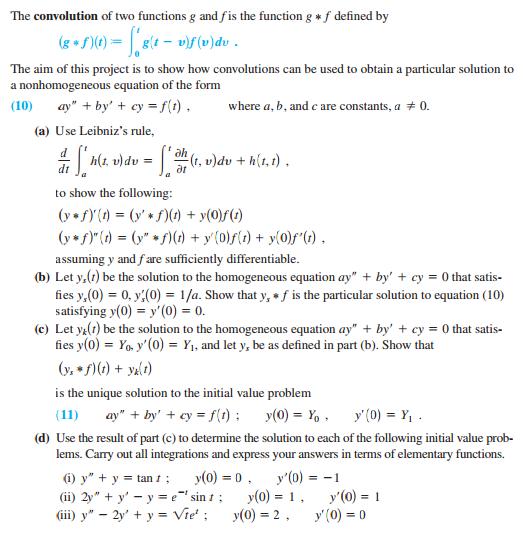
The convolution of two functions g and fis the function g *f defined by vf (v)du The aim of this project is to show how convolutions can be used to obtain a particular solution to a nonhomogeneous equation of the form ay by' ey f() (10) where a, b, and c are constants, a 0. (a) Use Leibniz's rule, d ht v)dv dt ah (r, v)dv+ht,) to show the following: (yf((y'f0 + y(0)f() (yf))(yf) +y(o)f)yo)f () assuming y and fare sufficiently differentiable (b) Let y,(r) be the solution to the homogeneous equation ay" + by' cy 0 that satis- fies y,(0) 0, y(0) 1/a. Show that y, f is the particular solution to equation (10) satisfying y(0) y'(0) 0 (c) Let y) be the solution to the homogeneous equation ay" by' +cy 0 that satis- fies y(0) Yo y'(0) Yi, and let y, be as defined in part (b). Show that (y, f)y + is the unique solution to the initial value problem ay" by ey ft) (0) Y (D) Y (11) (d) Use the result of part (c) to determine the solution to each of the following initial value prob- lems. Carry out all integrations and express your answers in terms of elementary functions. y(0) 0 y(0) 1 y(0) 2 ) y" ytan (ii) 2y" y'-y = e' sin t (ii) y" 2y'yVie y'(0) = -1 y'(o) y(0) 0
Step by Step Solution
3.33 Rating (147 Votes )
There are 3 Steps involved in it
To solve the given tasks lets proceed step by step Part a Objective Use Leibnizs rule to show the given results involving convolution Leibnizs Rule fr... View full answer

Get step-by-step solutions from verified subject matter experts
 Study Help