







Question: The Coombs method is a voting system that is similar to the plurality with elimination method. The only difference is that in each round of
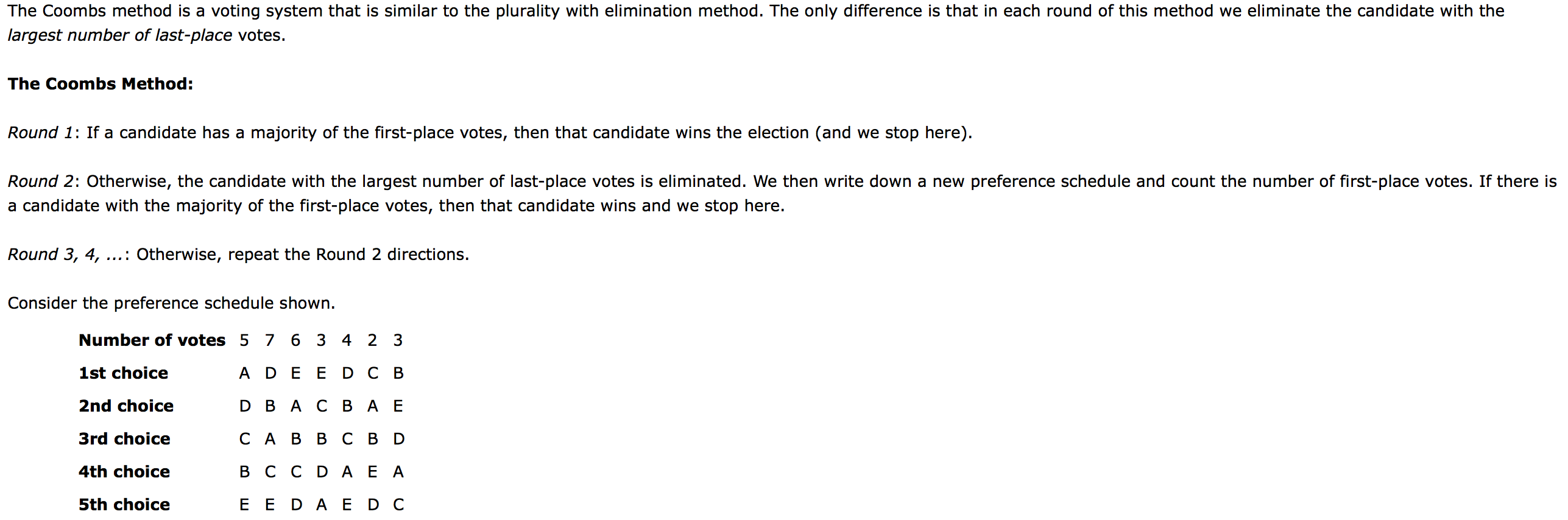
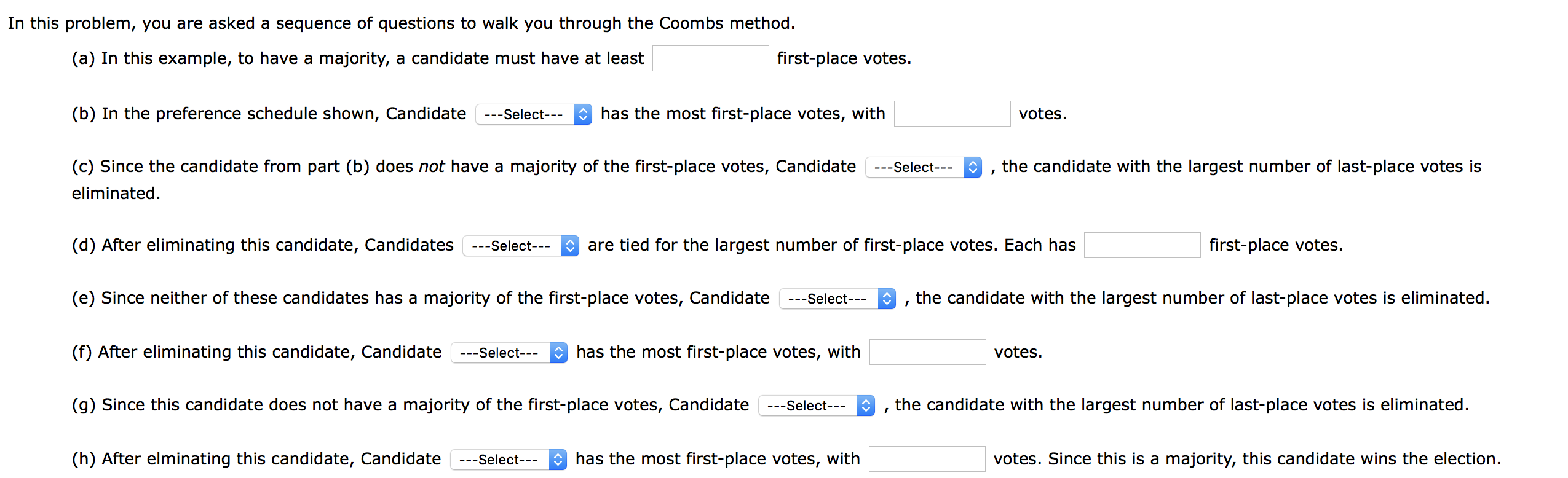
The Coombs method is a voting system that is similar to the plurality with elimination method. The only difference is that in each round of this method we eliminate the candidate with the largest number of last-place votes. The Coombs Method: Round 1: If a candidate has a majority of the first-place votes, then that candidate wins the election (and we stop here). Round 2: Otherwise, the candidate with the largest number of last-place votes is eliminated. We then write down a new preference schedule and count the number of first-place votes. If there is a candidate with the majority of the first-place votes, then that candidate wins and we stop here. Round 3, 4, ...: Otherwise, repeat the Round 2 directions. Consider the preference schedule shown. Number of votes 5 7 6 3 4 2 3 1st choice ADE E D C B 2nd choice D B A C B A E 3rd choice CAB BC BD 4th choice B C C D A E A 5th choice E E D A E DC In this problem, you are asked a sequence of questions to walk you through the Coombs method. (a) In this example, to have a majority, a candidate must have at least first-place votes. (b) In the preference schedule shown, Candidate ---Select--- has the most first-place votes, with votes. ---Select--- the candidate with the largest number of last-place votes is (C) Since the candidate from part (b) does not have a majority of the first-place votes, Candidate eliminated. (d) After eliminating this candidate, Candidates ---Select--- are tied for the largest number of first-place votes. Each has first-place votes. (e) Since neither of these candidates has a majority of the first-place votes, Candidate ---Select--- the candidate with the largest number of last-place votes is eliminated. (f) After eliminating this candidate, Candidate ---Select--- has the most first-place votes, with votes. (9) Since this candidate does not have a majority of the first-place votes, Candidate ---Select--- the candidate with the largest number of last-place votes is eliminated. (h) After elminating this candidate, Candidate ---Select--- has the most first-place votes, with votes. Since this is a majority, this candidate wins the election. The Coombs method is a voting system that is similar to the plurality with elimination method. The only difference is that in each round of this method we eliminate the candidate with the largest number of last-place votes. The Coombs Method: Round 1: If a candidate has a majority of the first-place votes, then that candidate wins the election (and we stop here). Round 2: Otherwise, the candidate with the largest number of last-place votes is eliminated. We then write down a new preference schedule and count the number of first-place votes. If there is a candidate with the majority of the first-place votes, then that candidate wins and we stop here. Round 3, 4, ...: Otherwise, repeat the Round 2 directions. Consider the preference schedule shown. Number of votes 5 7 6 3 4 2 3 1st choice ADE E D C B 2nd choice D B A C B A E 3rd choice CAB BC BD 4th choice B C C D A E A 5th choice E E D A E DC In this problem, you are asked a sequence of questions to walk you through the Coombs method. (a) In this example, to have a majority, a candidate must have at least first-place votes. (b) In the preference schedule shown, Candidate ---Select--- has the most first-place votes, with votes. ---Select--- the candidate with the largest number of last-place votes is (C) Since the candidate from part (b) does not have a majority of the first-place votes, Candidate eliminated. (d) After eliminating this candidate, Candidates ---Select--- are tied for the largest number of first-place votes. Each has first-place votes. (e) Since neither of these candidates has a majority of the first-place votes, Candidate ---Select--- the candidate with the largest number of last-place votes is eliminated. (f) After eliminating this candidate, Candidate ---Select--- has the most first-place votes, with votes. (9) Since this candidate does not have a majority of the first-place votes, Candidate ---Select--- the candidate with the largest number of last-place votes is eliminated. (h) After elminating this candidate, Candidate ---Select--- has the most first-place votes, with votes. Since this is a majority, this candidate wins the election
Step by Step Solution
There are 3 Steps involved in it

Get step-by-step solutions from verified subject matter experts
 Study Help