







Question: The correct answer is 0.47m/s. Please show steps The assembly shown below consists of a very long stationary outer cylinder surrounding a collar of length
The correct answer is 0.47m/s. Please show steps
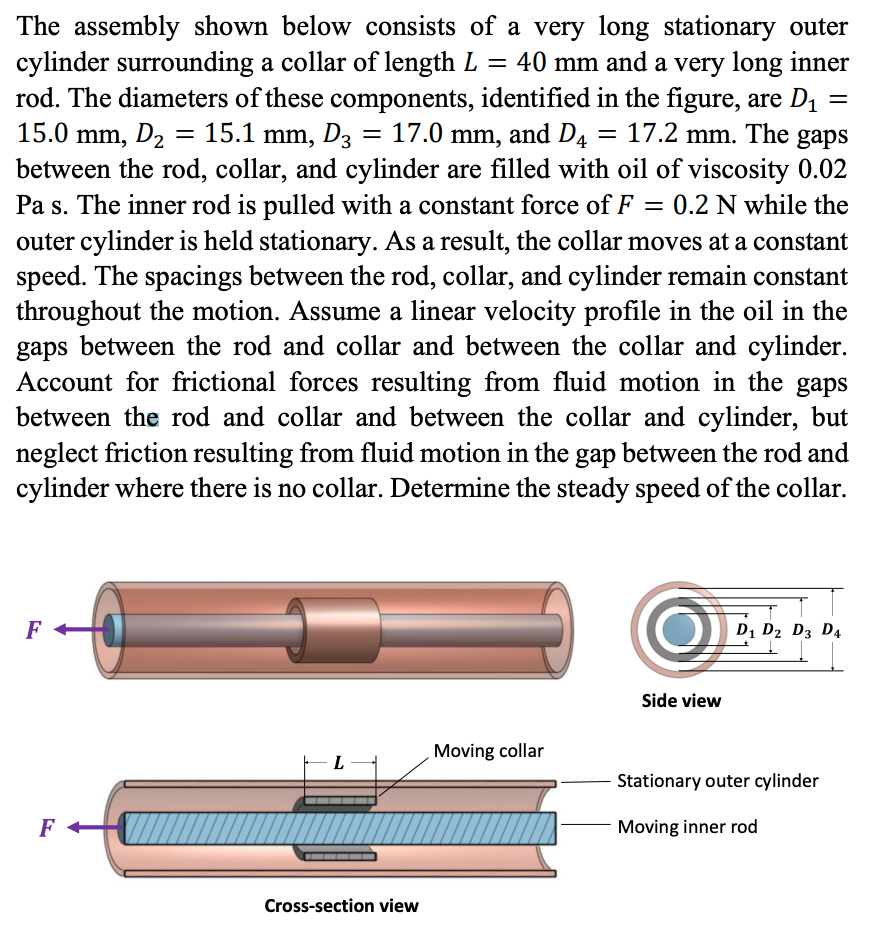
The assembly shown below consists of a very long stationary outer cylinder surrounding a collar of length L=40mm and a very long inner rod. The diameters of these components, identified in the figure, are D1= 15.0mm,D2=15.1mm,D3=17.0mm, and D4=17.2mm. The gaps between the rod, collar, and cylinder are filled with oil of viscosity 0.02 Pa s. The inner rod is pulled with a constant force of F=0.2N while the outer cylinder is held stationary. As a result, the collar moves at a constant speed. The spacings between the rod, collar, and cylinder remain constant throughout the motion. Assume a linear velocity profile in the oil in the gaps between the rod and collar and between the collar and cylinder. Account for frictional forces resulting from fluid motion in the gaps between the rod and collar and between the collar and cylinder, but neglect friction resulting from fluid motion in the gap between the rod and cylinder where there is no collar. Determine the steady speed of the collar. Side view The assembly shown below consists of a very long stationary outer cylinder surrounding a collar of length L=40mm and a very long inner rod. The diameters of these components, identified in the figure, are D1= 15.0mm,D2=15.1mm,D3=17.0mm, and D4=17.2mm. The gaps between the rod, collar, and cylinder are filled with oil of viscosity 0.02 Pa s. The inner rod is pulled with a constant force of F=0.2N while the outer cylinder is held stationary. As a result, the collar moves at a constant speed. The spacings between the rod, collar, and cylinder remain constant throughout the motion. Assume a linear velocity profile in the oil in the gaps between the rod and collar and between the collar and cylinder. Account for frictional forces resulting from fluid motion in the gaps between the rod and collar and between the collar and cylinder, but neglect friction resulting from fluid motion in the gap between the rod and cylinder where there is no collar. Determine the steady speed of the collar. Side view
Step by Step Solution
There are 3 Steps involved in it

Get step-by-step solutions from verified subject matter experts
 Study Help