







Question: The correct answer is a), but not sure to get that value. Please give a step by step explanation. Thank you! [22] Laboratory furnaces sometimes
The correct answer is a), but not sure to get that value. Please give a step by step explanation.
Thank you!
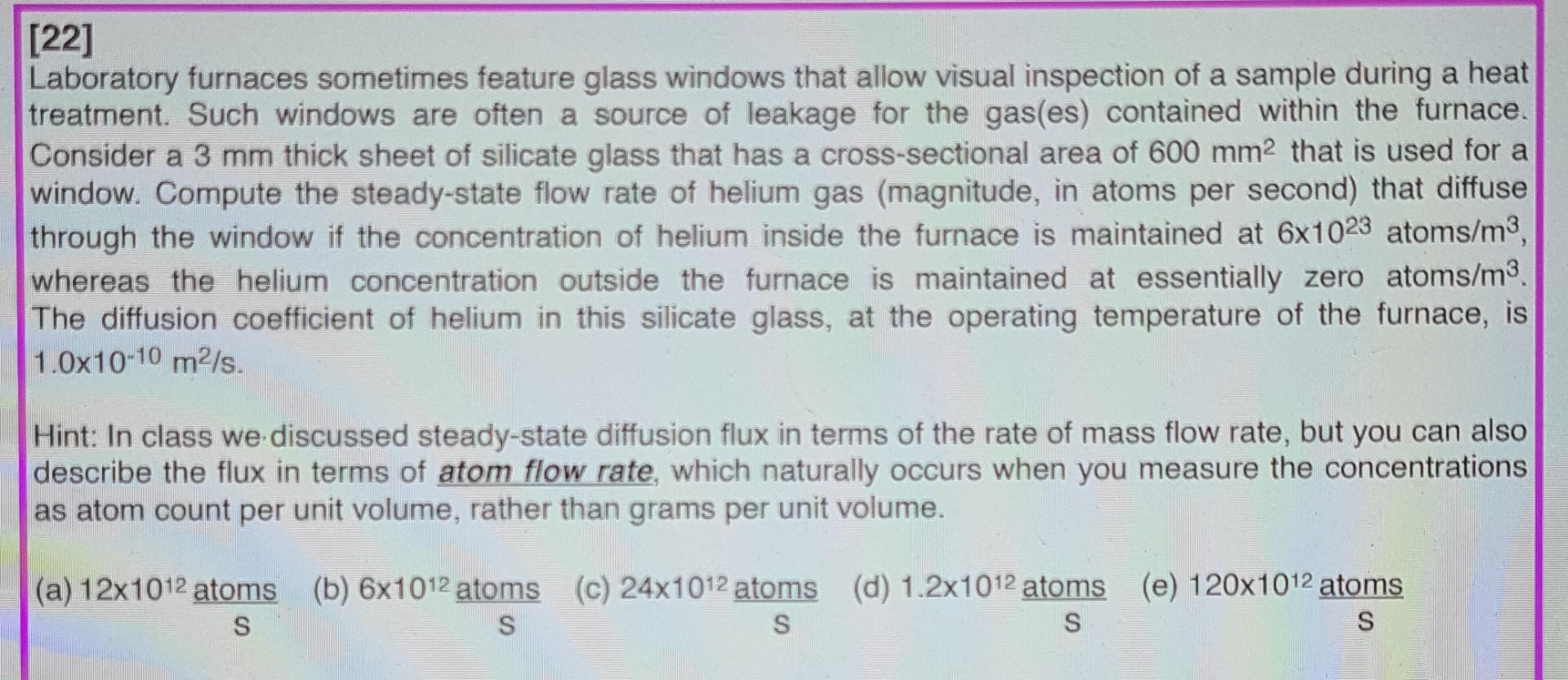
[22] Laboratory furnaces sometimes feature glass windows that allow visual inspection of a sample during a heat treatment. Such windows are often a source of leakage for the gas(es) contained within the furnace. Consider a 3 mm thick sheet of silicate glass that has a cross-sectional area of 600 mm2 that is used for a window. Compute the steady-state flow rate of helium gas (magnitude, in atoms per second) that diffuse through the window if the concentration of helium inside the furnace is maintained at 6x10²³ atoms/m3, whereas the helium concentration outside the furnace is maintained at essentially zero atoms/m. The diffusion coefficient of helium in this silicate glass, at the operating temperature of the furnace, is 1.0x10⁻¹⁰ m/s. Hint: In class we discussed steady-state diffusion flux in terms of the rate of mass flow rate, but you can also describe the flux in terms of atom flow rate, which naturally occurs when you measure the concentrations as atom count per unit volume, rather than grams per unit volume. (a) 12x1012 atoms (b) 6x10¹² atoms (c) 24x1012 atoms (d) 1.2x10¹² atoms (e) 120x1012 atoms S S S S S
Step by Step Solution
There are 3 Steps involved in it

Get step-by-step solutions from verified subject matter experts
 Study Help