







Question: THE CORRECT ANSWER IS: standard flowrate = 6260 scfm ; actual flowrate = 10200 acfm Please show all steps to get correct answer to get
THE CORRECT ANSWER IS: standard flowrate = 6260 scfm ; actual flowrate = 10200 acfm
Please show all steps to get correct answer to get upvote
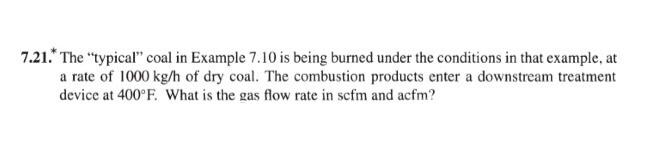
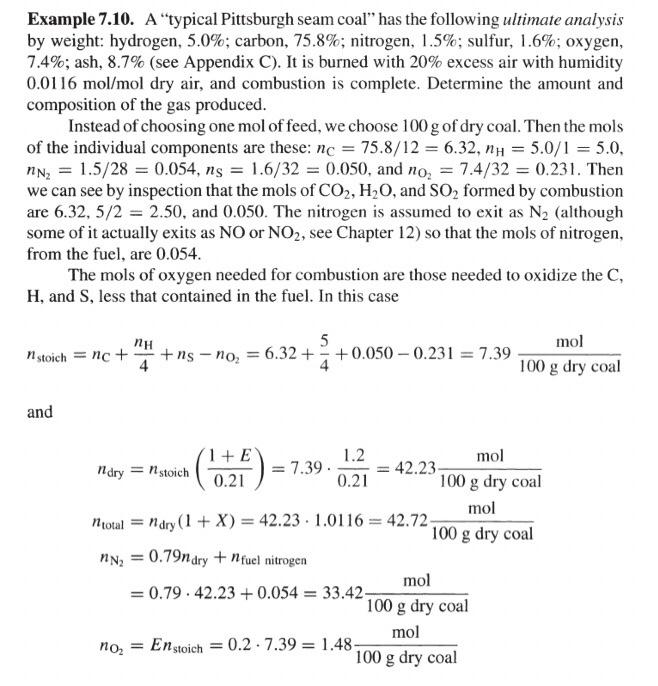
7.21.* The "typical" coal in Example 7.10 is being burned under the conditions in that example, at a rate of 1000 kg/h of dry coal. The combustion products enter a downstream treatment device at 400F. What is the gas flow rate in scfm and acfm? Example 7.10. A typical Pittsburgh seam coal" has the following ultimate analysis by weight: hydrogen, 5.0%; carbon, 75.8%; nitrogen, 1.5%; sulfur, 1.6%; oxygen, 7.4%; ash, 8.7% (see Appendix C). It is burned with 20% excess air with humidity 0.0116 mol/mol dry air, and combustion is complete. Determine the amount and composition of the gas produced. Instead of choosing one mol of feed, we choose 100 g of dry coal. Then the mols of the individual components are these: nc = 75.8/12 = 6.32, ny = 5.0/1 = 5.0, nN= 1.5/28 = 0.054, ns = 1.6/32 = 0.050, and no: = 7.4/32 = 0.231. Then we can see by inspection that the mols of CO2, H2O, and SO2 formed by combustion are 6.32, 5/2 = 2.50, and 0.050. The nitrogen is assumed to exit as N2 (although some of it actually exits as NO or NO2, see Chapter 12) so that the mols of nitrogen, from the fuel, are 0.054. The mols of oxygen needed for combustion are those needed to oxidize the C, H, and S, less that contained in the fuel. In this case n stoich = nc + 4 5 mol + ns - no, = 6.32+ +0.050 - 0.231 = 7.39 100 g dry coal and 1 + E 1.2 mol ndry = n stoich = 7.39 = 42.23 0.21 0.21 100 g dry coal mol Mtotal = n dry(1 + X) = 42.23. 1.0116 = 42.72 100 g dry coal nn = 0.79n dry + n fuel nitrogen mol = 0.79.42.23 +0.054 = 33.42 100 g dry coal mol Enstoich = 0.2 7.39 = 1.48 100 g dry coal no, =
Step by Step Solution
There are 3 Steps involved in it

Get step-by-step solutions from verified subject matter experts
 Study Help