Question: The correct answer TALE 6. A drop in demand causes price to fall, but the lower price causes an increase in demand, thus raising price
The correct answer
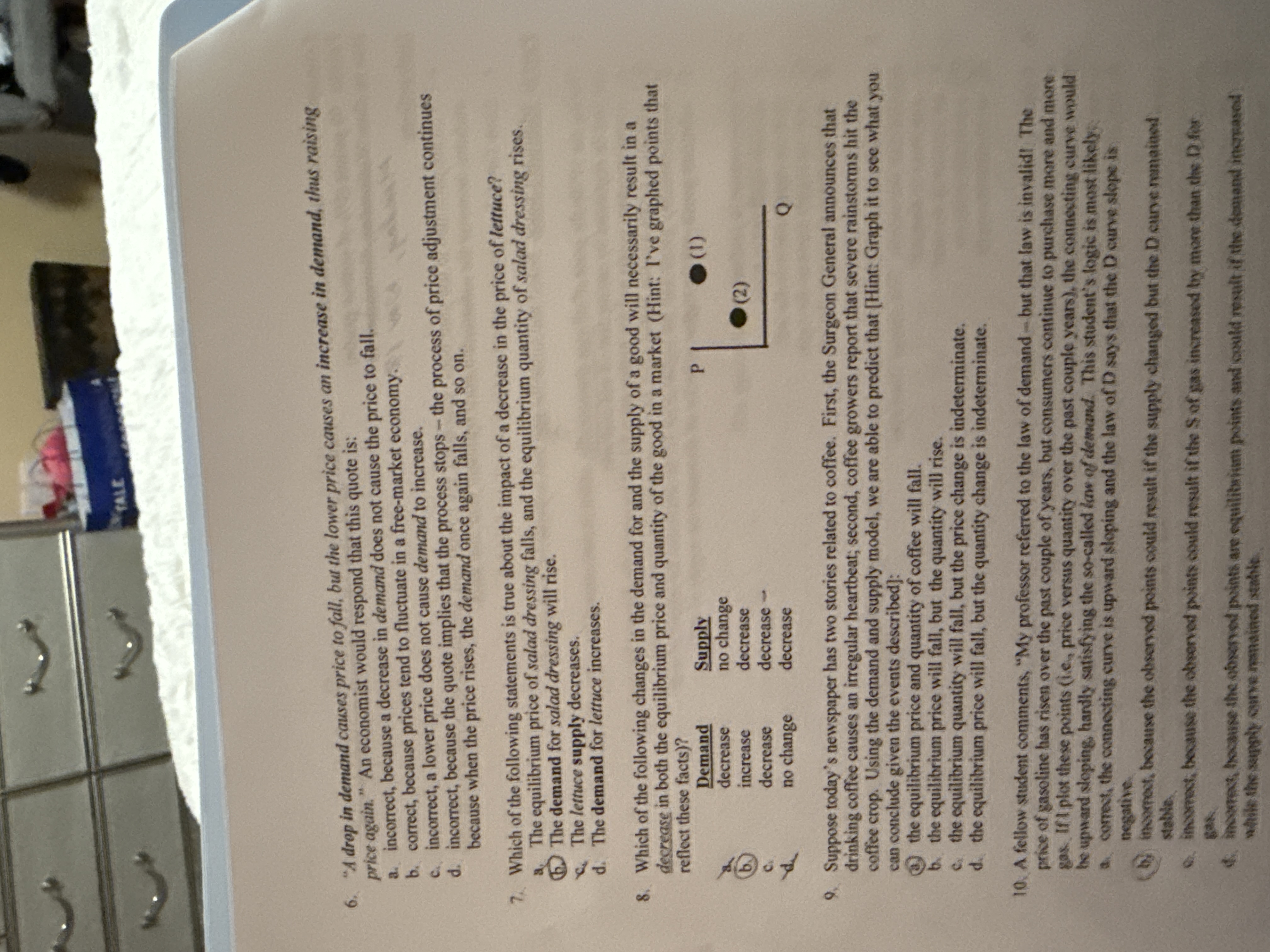
TALE 6. "A drop in demand causes price to fall, but the lower price causes an increase in demand, thus raising price again. " An economist would respond that this quote is: a. incorrect, because a decrease in demand does not cause the price to fall. b. correct, because prices tend to fluctuate in a free-market economy. C. incorrect, a lower price does not cause demand to increase. d. incorrect, because the quote implies that the process stops - the process of price adjustment continues because when the price rises, the demand once again falls, and so on. 7, Which of the following statements is true about the impact of a decrease in the price of lettuce? The equilibrium price of salad dressing falls, and the equilibrium quantity of salad dressing rises. The demand for salad dressing will rise. The lettuce supply decreases. d. The demand for lettuce increases. 8. Which of the following changes in the demand for and the supply of a good will necessarily result in a decrease in both the equilibrium price and quantity of the good in a market (Hint: I've graphed points that reflect these facts)? Demand Supply D (1) decrease no change increase decrease (2) decrease decrease - no change decrease 9. Suppose today's newspaper has two stories related to coffee. First, the Surgeon General announces that drinking coffee causes an irregular heartbeat; second, coffee growers report that severe rainstorms hit the coffee crop. Using the demand and supply model, we are able to predict that [Hint: Graph it to see what you can conclude given the events described]: the equilibrium price and quantity of coffee will fall. by the equilibrium price will fall, but the quantity will rise. c. the equilibrium quantity will fall, but the price change is indeterminate. d. the equilibrium price will fall, but the quantity change is indeterminate. 10. A fellow student comments, "My professor referred to the law of demand - but that law is invalid! The price of gasoline has risen over the past couple of years, but consumers continue to purchase more and more gas If I plot these points (ie, price versus quantity over the past couple years), the connecting curve would be upward sloping, hardly satisfying the so-called lane of demand. This student's logic is most likely a correct, the connecting curve is upward sloping and the law of D says that the D curve slope is negative incorrect, because the observed points could result if the supply changed but the D curve mmained stable incorrect, because the observed points could result if the $ of gas increased by more than the D for interest because the observed points are equilibrium points and could result if the demand increased while the supply couve remained stable









 Study Help