







Question: The cumulative exponential probability distribution describes the probability P(t) that a particular radioactive atom will decay within t minutes. It is given by P(t) =
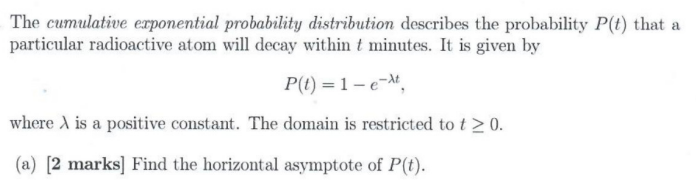


![domain is restricted to t > 0. (a) [2 marks] Find the](https://s3.amazonaws.com/si.experts.images/answers/2024/06/666562a0121af_4156665629fdd125.jpg)
![horizontal asymptote of P(t).\f(c) [3 marks] Draw a large sketch of the](https://s3.amazonaws.com/si.experts.images/answers/2024/06/666562a05b703_416666562a03efec.jpg)

![the previous parts of this question.(d) [3 marks] The half-life of a](https://s3.amazonaws.com/si.experts.images/answers/2024/06/666562a0f2234_416666562a0da78c.jpg)

The cumulative exponential probability distribution describes the probability P(t) that a particular radioactive atom will decay within t minutes. It is given by P(t) = 1 - e-At where A is a positive constant. The domain is restricted to t > 0. (a) [2 marks] Find the horizontal asymptote of P(t).\f(c) [3 marks] Draw a large sketch of the graph of P(t) on the axes below, using the information determined in the previous parts of this question.(d) [3 marks] The half-life of a radioactive isotope is the time taken for a sample of the isotope to decay to half of its original mass. It is equal to the time by which the probability of decay of an individual atom is ,. What is the half-life of the isotope whose atoms have the cumulative exponential probability distribution described above
Step by Step Solution
There are 3 Steps involved in it

Get step-by-step solutions from verified subject matter experts
 Study Help