







Question: The current selected programming language is C. We emphasize the submission of a fully working code over partially correct but efficient code. Once submitted,
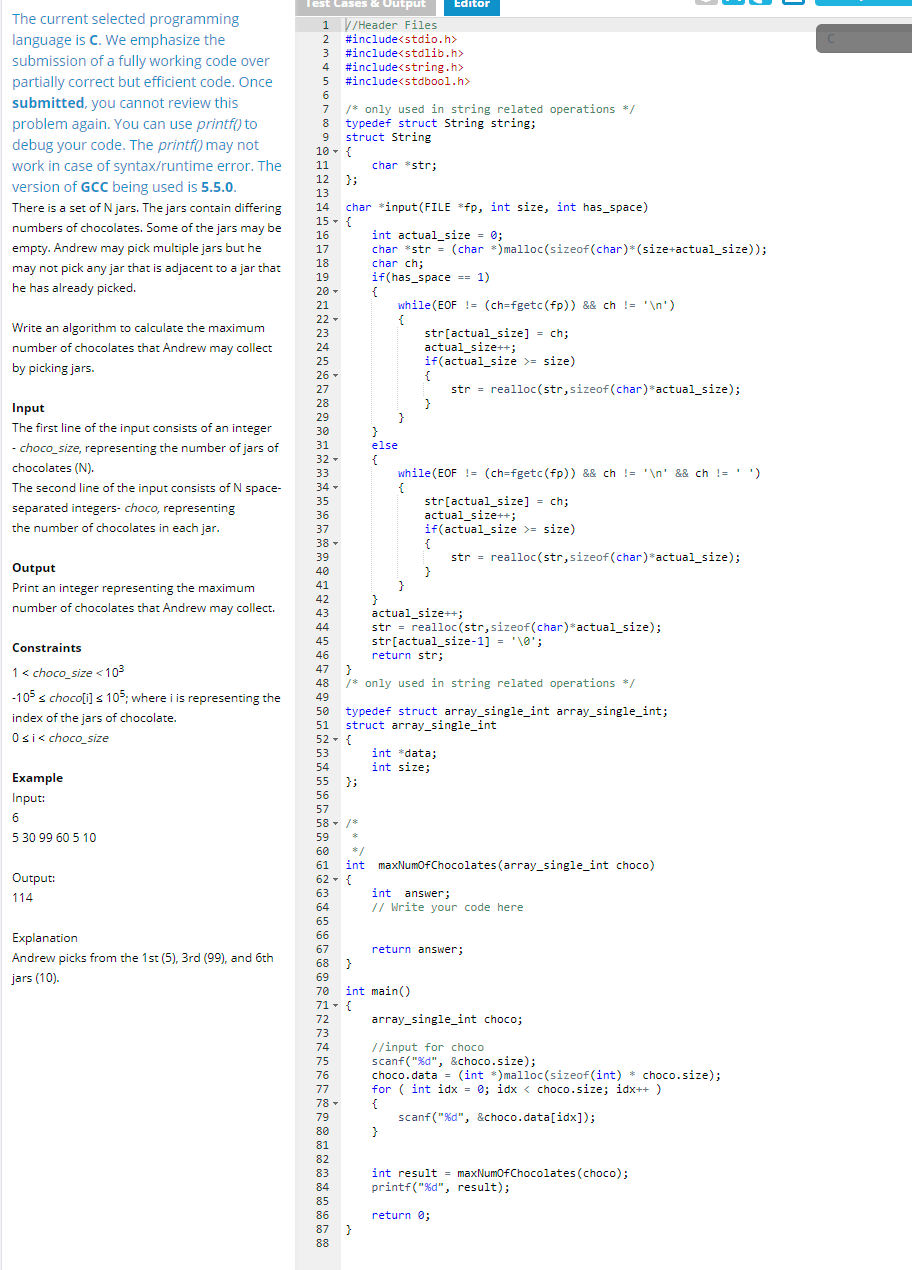
The current selected programming language is C. We emphasize the submission of a fully working code over partially correct but efficient code. Once submitted, you cannot review this problem again. You can use printf() to debug your code. The printf() may not work in case of syntax/runtime error. The version of GCC being used is 5.5.0. There is a set of N jars. The jars contain differing numbers of chocolates. Some of the jars may be empty. Andrew may pick multiple jars but he may not pick any jar that is adjacent to a jar that he has already picked. Write an algorithm to calculate the maximum number of chocolates that Andrew may collect by picking jars. Input The first line of the input consists of an integer - choco_size, representing the number of jars of chocolates (N). The second line of the input consists of N space- separated integers- choco, representing the number of chocolates in each jar. Output Print an integer representing the maximum number of chocolates that Andrew may collect. Constraints 1 < choco_size = size) str = realloc(str, sizeof (char)sactual_size); } else } Editor { } while (EOF != (ch-fgetc (fp)) && ch != ' ' && ch != ' ') { = } /* only used in string related operations */ 67 68 } 69 70 int main() */ 61 int maxNumOfChocolates (array_single_int choco) 62 - { 63 64 str[actual size] = ch; actual size++; if(actual size >= size) str = realloc(str,sizeof(char)*actual_size); { } actual size++; str realloc(str,sizeof(char)*actual_size); str[actual_size-1] = '\0'; return str; int *data; int size; int answer; // Write your code here return answer; array_single_int choco; //input for choco scanf("%d", &choco.size); choco.data = (int *)malloc (sizeof(int) * choco.size); for (int idx = 0; idx < choco.size; idx++) { scanf ("%d", &choco.data[idx]); } int result = maxNumOfChocolates (choco); printf("%d", result); return 0; The current selected programming language is C. We emphasize the submission of a fully working code over partially correct but efficient code. Once submitted, you cannot review this problem again. You can use printf() to debug your code. The printf() may not work in case of syntax/runtime error. The version of GCC being used is 5.5.0. There is a set of N jars. The jars contain differing numbers of chocolates. Some of the jars may be empty. Andrew may pick multiple jars but he may not pick any jar that is adjacent to a jar that he has already picked. Write an algorithm to calculate the maximum number of chocolates that Andrew may collect by picking jars. Input The first line of the input consists of an integer - choco_size, representing the number of jars of chocolates (N). The second line of the input consists of N space- separated integers- choco, representing the number of chocolates in each jar. Output Print an integer representing the maximum number of chocolates that Andrew may collect. Constraints 1 < choco_size = size) str = realloc(str, sizeof(char)sactual_size); } else } Editor } /* only used in string related operations */ { } while(EOF != (ch-fgetc (fp)) && ch != ' ' && ch != ' ') { str[actual_size] = ch; actual size++; if(actual size >= size) str = realloc(str,sizeof(char)*actual_size); = */ 61 int maxNumOfChocolates (array_single_int choco) 62 - { 63 64 67 68 } 69 70 int main() { } actual size++; str realloc(str, sizeof(char)*actual_size); str[actual_size-1] = '\0'; return str; int *data; int size; int answer; // Write your code here return answer; array_single_int choco; //input for choco scanf("%d", &choco.size); choco.data = (int *)malloc(sizeof(int) choco.size); for (int idx = 0; idx < choco.size; idx++) { scanf("%d", &choco.data[idx]); } int result = maxNumOfChocolates (choco); printf("%d", result); return 0;
Step by Step Solution
3.37 Rating (172 Votes )
There are 3 Steps involved in it
Here is an algorithm to calculate the maximum number of chocolates that Andrew may collect by pickin... View full answer

Get step-by-step solutions from verified subject matter experts
 Study Help