







Question: The data show the bug chirps per minute at different temperatures. Find the regression equation, letting the first variable be the independent (x) variable. Find
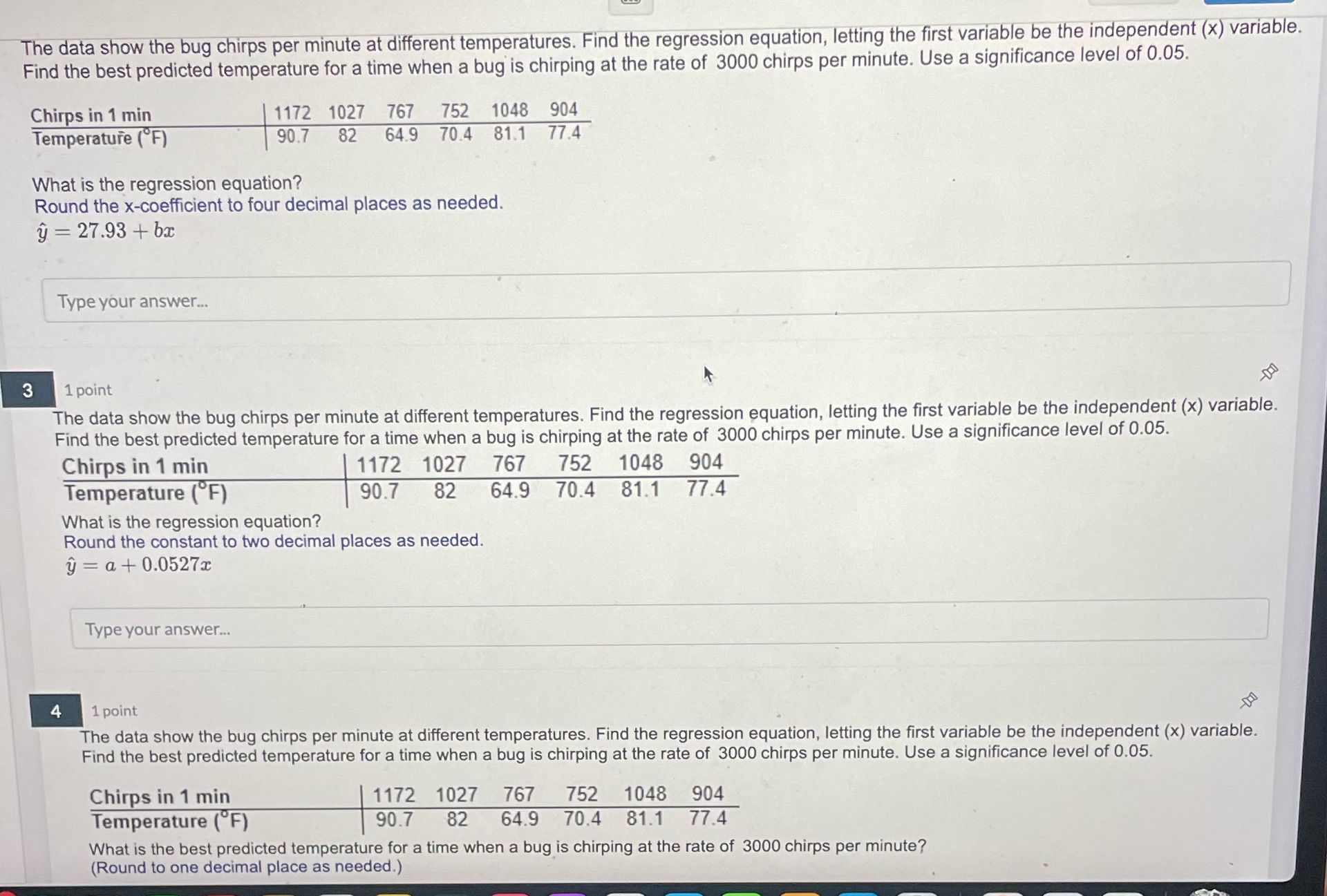
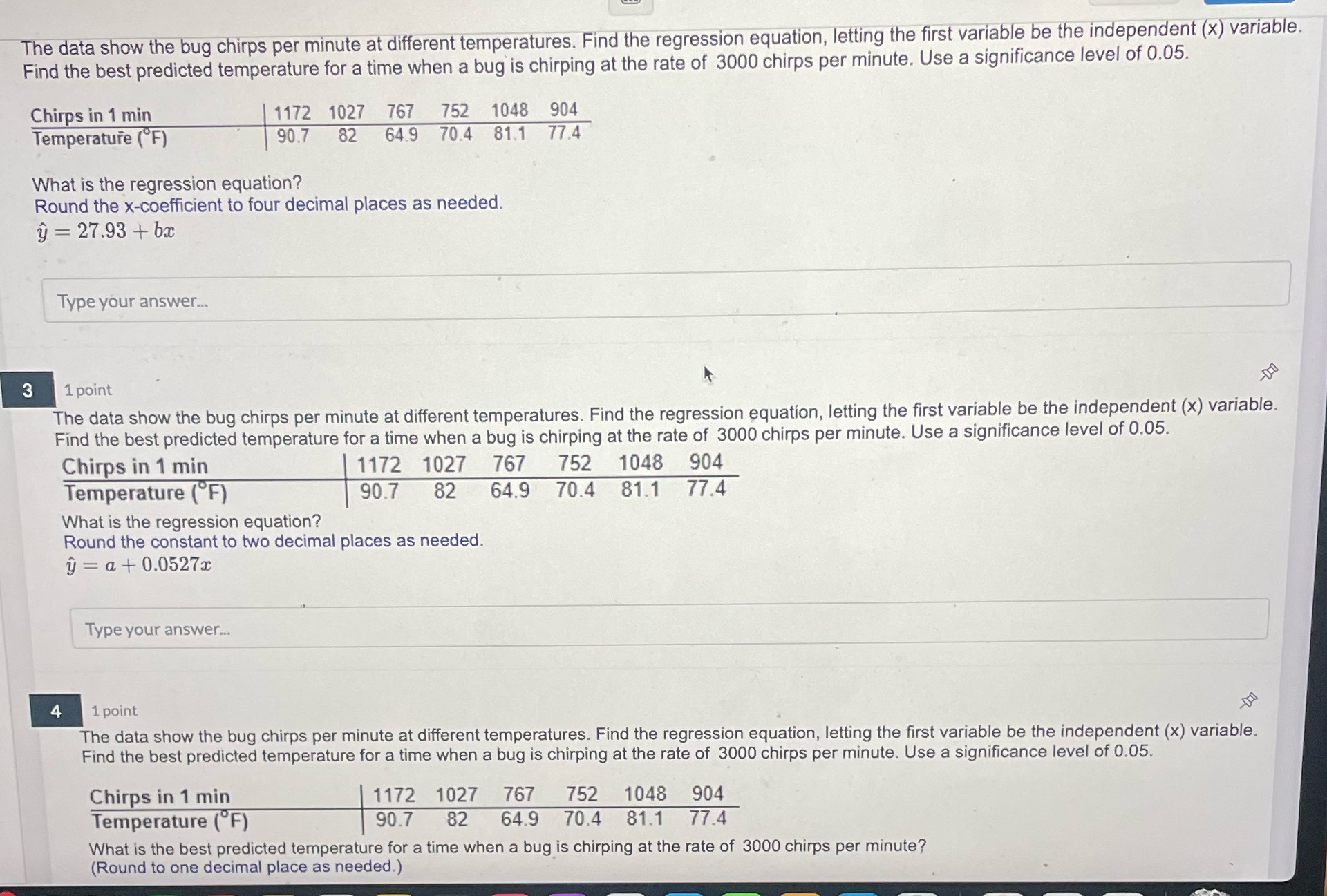
The data show the bug chirps per minute at different temperatures. Find the regression equation, letting the first variable be the independent (x) variable. Find the best predicted temperature for a time when a bug is chirping at the rate of 3000 chirps per minute. Use a significance level of 0.05. Chirps in 1 min 1172 1027 767 752 1048 904 Temperature (OF) 90.7 82 64.9 70.4 81.1 77.4 What is the regression equation? Round the x-coefficient to four decimal places as needed. y = 27.93 + bx Type your answer.. 3 1 point The data show the bug chirps per minute at different temperatures. Find the regression equation, letting the first variable be the independent (x) variable. Find the best predicted temperature for a time when a bug is chirping at the rate of 3000 chirps per minute. Use a significance level of 0.05. Chirps in 1 min 1172 1027 767 752 1048 904 Temperature (OF) 90.7 82 64.9 70.4 81.1 77.4 What is the regression equation? Round the constant to two decimal places as needed. y = a + 0.0527x Type your answer.. 4 1 point The data show the bug chirps per minute at different temperatures. Find the regression equation, letting the first variable be the independent (x) variable. Find the best predicted temperature for a time when a bug is chirping at the rate of 3000 chirps per minute. Use a significance level of 0.05. Chirps in 1 min 1172 1027 767 752 1048 904 Temperature (OF) 90.7 82 64.9 70.4 81.1 77.4 What is the best predicted temperature for a time when a bug is chirping at the rate of 3000 chirps per minute? (Round to one decimal place as needed.)
Step by Step Solution
There are 3 Steps involved in it

Get step-by-step solutions from verified subject matter experts
 Study Help