







Question: The difference between absorption costing net operating Income and variable costing net operating Income can be explained by the way these two methods account for
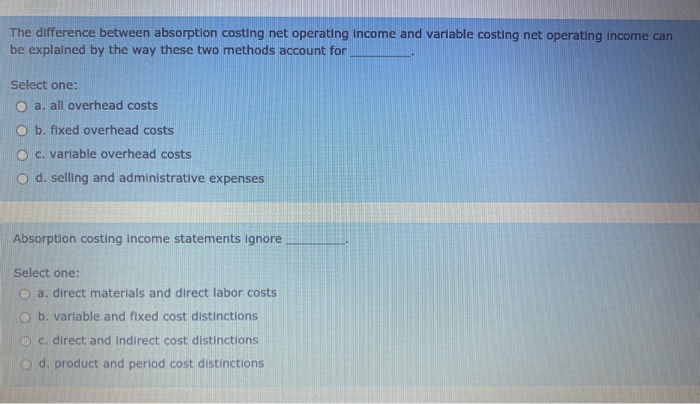
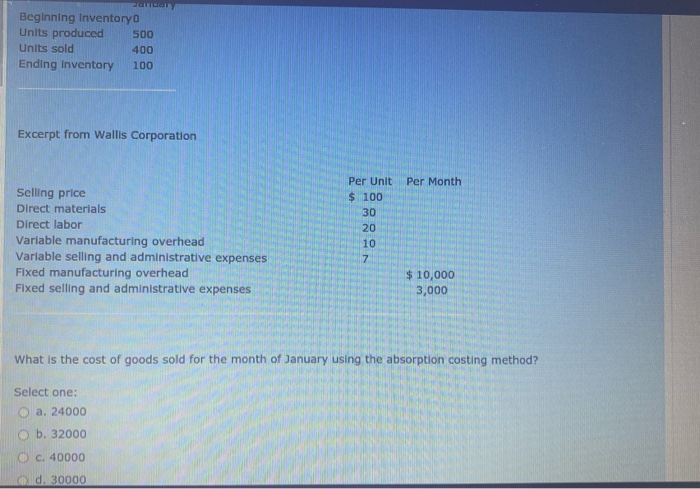
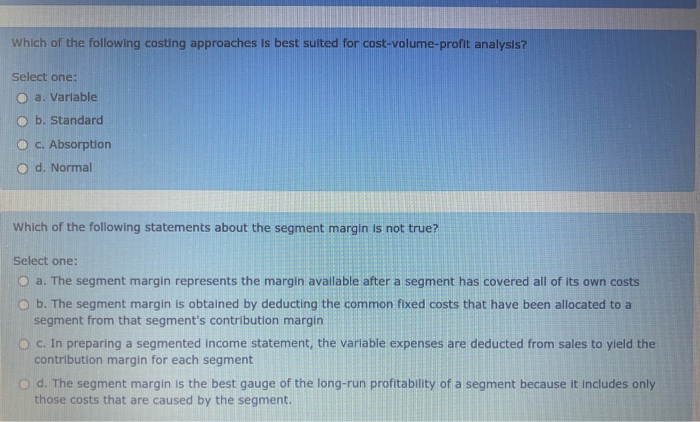
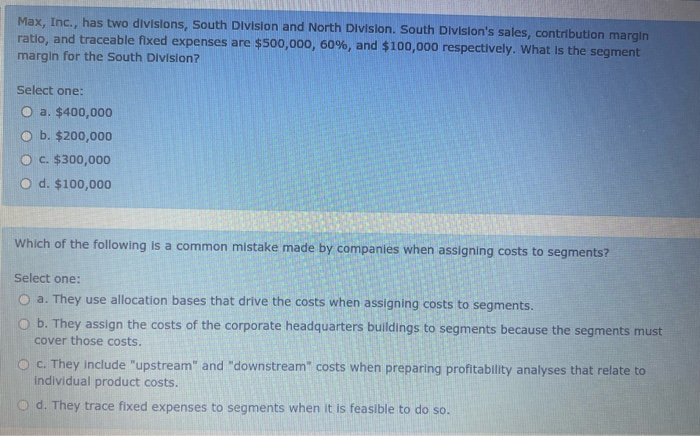
The difference between absorption costing net operating Income and variable costing net operating Income can be explained by the way these two methods account for Select one: O a. all overhead costs b. fixed overhead costs c. variable overhead costs O d. selling and administrative expenses Absorption costing Income statements Ignore Select one: a. direct materials and direct labor costs O b. variable and fixed cost distinctions O c. direct and Indirect cost distinctions d. product and period cost distinctions ody Beginning Inventory Units produced 500 Units sold 400 Ending Inventory 100 Excerpt from Wallis Corporation Per Month Per Unit $ 100 30 Selling price Direct materials Direct labor Variable manufacturing overhead Variable selling and administrative expenses Fixed manufacturing overhead Fixed selling and administrative expenses 20 10 7 $ 10,000 3,000 What is the cost of goods sold for the month of January using the absorption costing method? Select one: a. 24000 b. 32000 0 C. 40000 d. 30000 Which of the following costing approaches is best suited for cost-volume-profit analysis? Select one: a. Variable b. Standard O c. Absorption d. Normal Which of the following statements about the segment margin is not true? Select one: O a. The segment margin represents the margin available after a segment has covered all of its own costs O b. The segment margin is obtained by deducting the common fixed costs that have been allocated to a segment from that segment's contribution margin O c. In preparing a segmented income statement, the variable expenses are deducted from sales to yield the contribution margin for each segment O d. The segment margin is the best gauge of the long-run profitability of a segment because it includes only those costs that are caused by the segment. Max, Inc., has two divisions, South Division and North Division. South Division's sales, contribution margin ratio, and traceable fixed expenses are $500,000, 60%, and $100,000 respectively. What is the segment margin for the South Division? Select one: O a. $400,000 O b. $200,000 O c. $300,000 O d. $100,000 Which of the following is a common mistake made by companies when assigning costs to segments? Select one: O a. They use allocation bases that drive the costs when assigning costs to segments. O b. They assign the costs of the corporate headquarters buildings to segments because the segments must cover those costs. O c. They include "upstream" and "downstream" costs when preparing profitability analyses that relate to individual product costs. Od. They trace fixed expenses to segments when it is feasible to do so
Step by Step Solution
There are 3 Steps involved in it

Get step-by-step solutions from verified subject matter experts
 Study Help