







Question: The difficulty in finding the velocity after 3 seconds is that we are dealing with a single instant of time (t = 3), so
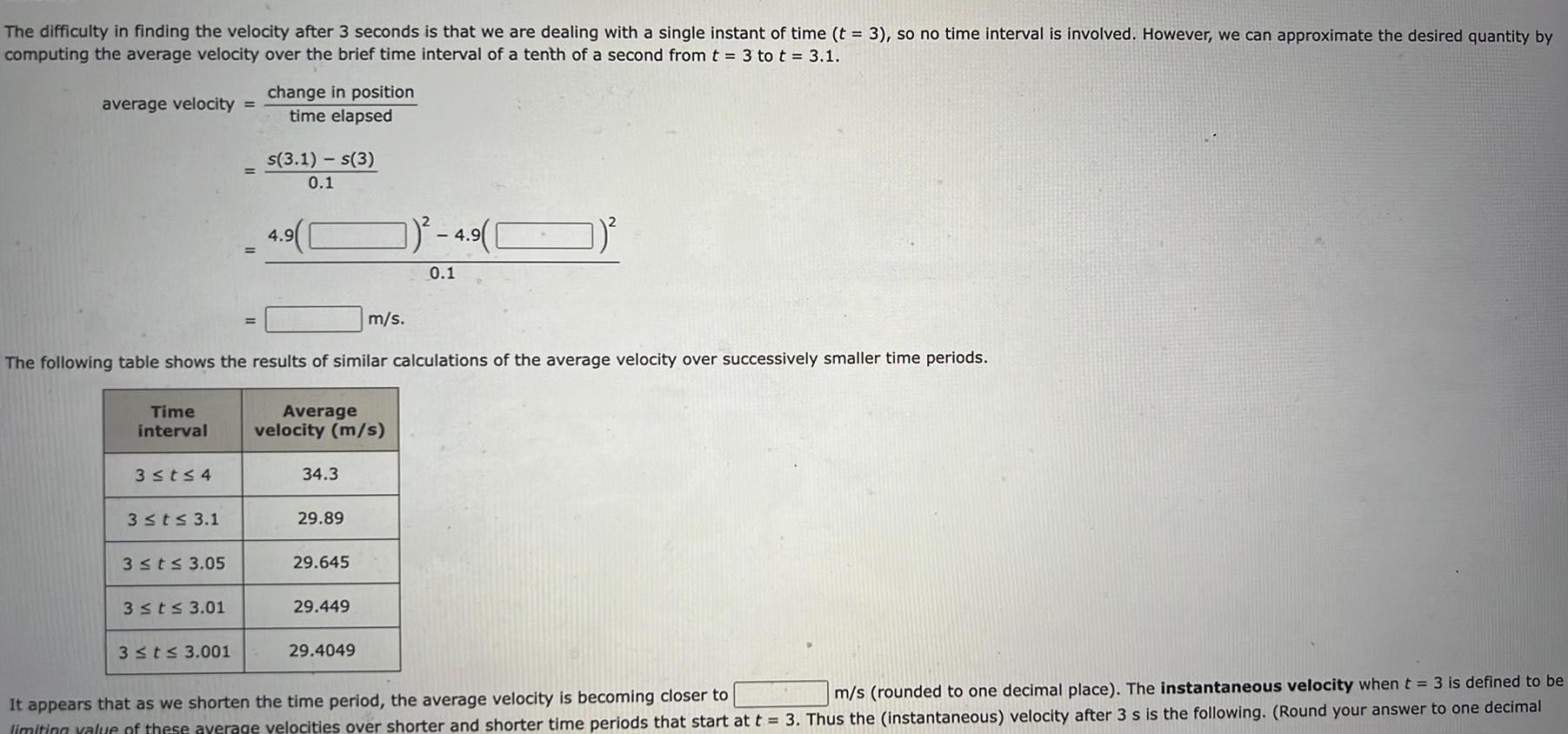
The difficulty in finding the velocity after 3 seconds is that we are dealing with a single instant of time (t = 3), so no time interval is involved. However, we can approximate the desired quantity by computing the average velocity over the brief time interval of a tenth of a second from t = 3 to t = 3.1. change in position average velocity = time elapsed s(3.1) - s(3) 0.1 4.9 m/s. 0.1 4.9 The following table shows the results of similar calculations of the average velocity over successively smaller time periods. Time interval 3 st4 Average velocity (m/s) 34.3 3 st 3.1 29.89 3 st 3.05 29.645 3 st 3.01 29.449 3 st 3.001 29.4049 It appears that as we shorten the time period, the average velocity is becoming closer to m/s (rounded to one decimal place). The instantaneous velocity when t = 3 is defined to be limiting value of these average velocities over shorter and shorter time periods that start at t = 3. Thus the (instantaneous) velocity after 3 s is the following. (Round your answer to one decimal
Step by Step Solution
There are 3 Steps involved in it

Get step-by-step solutions from verified subject matter experts
 Study Help