



Question: The direct labor efficiency (quantity) variance is a. $3, 364.20 F b. $1, 121.40 F c. $1, 011.00 F d. $919.80 F The direct materials
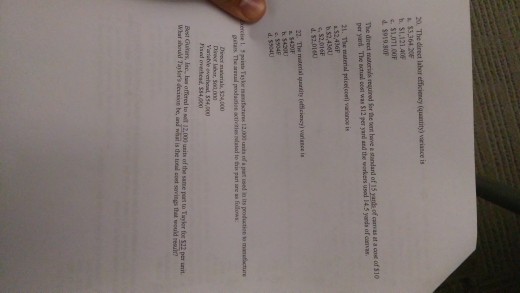
The direct labor efficiency (quantity) variance is a. $3, 364.20 F b. $1, 121.40 F c. $1, 011.00 F d. $919.80 F The direct materials required for the have a standard of 15 yards of at a cost of $10 per yard. The actual cost was $12 per yard and the workers used 14.5 yards of canvas. a. $2, 436 F b. $2, 436 U c. $2, 016 F d. $2, 018 U The material quantity (efficiency) variance is a. $ 420 F b. $ 420 U c. $ 504 F d. $ 504 U Taylor manufactures 12,000 units of a used in its production to manufacture The annual productive activities to this part are as follows: Direct materials $24,000 Direct labor $60,000 Variable overhead $54,000 Fixed overhead $54,000 Best Gluers has offered to 12,000 units of the same part to Taylor for $22 per unit. What should Taylor's decision be, and what is the cost savings that would result? The direct labor efficiency (quantity) variance is a. $3, 364.20 F b. $1, 121.40 F c. $1, 011.00 F d. $919.80 F The direct materials required for the have a standard of 15 yards of at a cost of $10 per yard. The actual cost was $12 per yard and the workers used 14.5 yards of canvas. a. $2, 436 F b. $2, 436 U c. $2, 016 F d. $2, 018 U The material quantity (efficiency) variance is a. $ 420 F b. $ 420 U c. $ 504 F d. $ 504 U Taylor manufactures 12,000 units of a used in its production to manufacture The annual productive activities to this part are as follows: Direct materials $24,000 Direct labor $60,000 Variable overhead $54,000 Fixed overhead $54,000 Best Gluers has offered to 12,000 units of the same part to Taylor for $22 per unit. What should Taylor's decision be, and what is the cost savings that would result
Step by Step Solution
There are 3 Steps involved in it

Get step-by-step solutions from verified subject matter experts