







Question: The direct materials quantity standard should A) exclude unavoidable waste B) exclude quality considerations C) allow for normal spoilage D) always be expressed as an
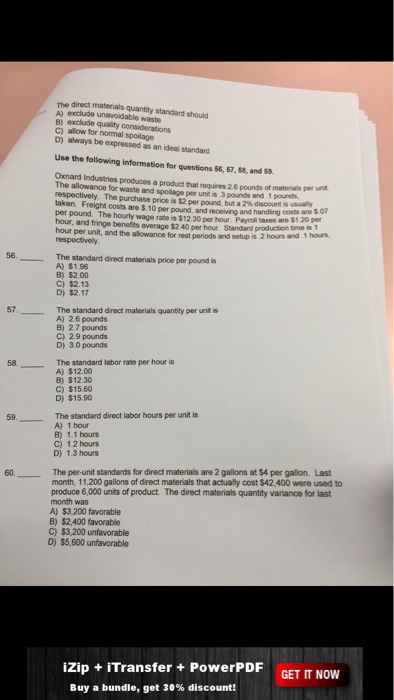
The direct materials quantity standard should A) exclude unavoidable waste B) exclude quality considerations C) allow for normal spoilage D) always be expressed as an ideal standard Use the following information for questions 56, 57, 58, and 59. Oxnard Industries produces a product that requires 2.6 pounds of materials per units. The allowance for waste and spoilage per unit is 3 pounds and 1 pounds respectively. The purchase price is $2 per pound, but a 2% discounts is usually taken. Freight costs are $.10 per pound, and receiving and handling costs are $.07 per pound. The hourly wage rate is $12.30 per hour. Payroll taxes are $1.20 per hour, and fringe benefits average $2.40 per hour. Standard production time is 1 hour per unit, and the allowance for rest periods and setup is 2 hours and 1 hours, respectively. The standard direct materials price per pound is A) $1.96 B) $2.00 C) $2.13 D) $2.17 The standard direct materials quantity per unit is A) 2.6 pounds B) 2.7 pounds C) 2.9 pounds D) 3.0 pounds The standard labor rate per hour is A) $12.00 B) $12.30 C) $15.60 D) $15.90 The standard direct labor hours per unit is A) 1 hour B) 1.1 hours C) 1.2 hours D) 1.3 hours The per-unit standards for direct material's are 2 gallons at $4 per gallon. Last month, 11, 200 gallons of direct materials that actually cost $42, 400 were used to produce 6, 000 units of product. The direct materials quantity variance for last month was A) $3, 200 favorable B) $2, 400 favorable C) $3, 200 unfavorable D) $5, 600 unfavorable
Step by Step Solution
There are 3 Steps involved in it

Get step-by-step solutions from verified subject matter experts
 Study Help