







Question: The discrete cosine transform (DCT) is a technique for decomposing a vector into a linear combi- nation of sine functions with different frequencies. The idea
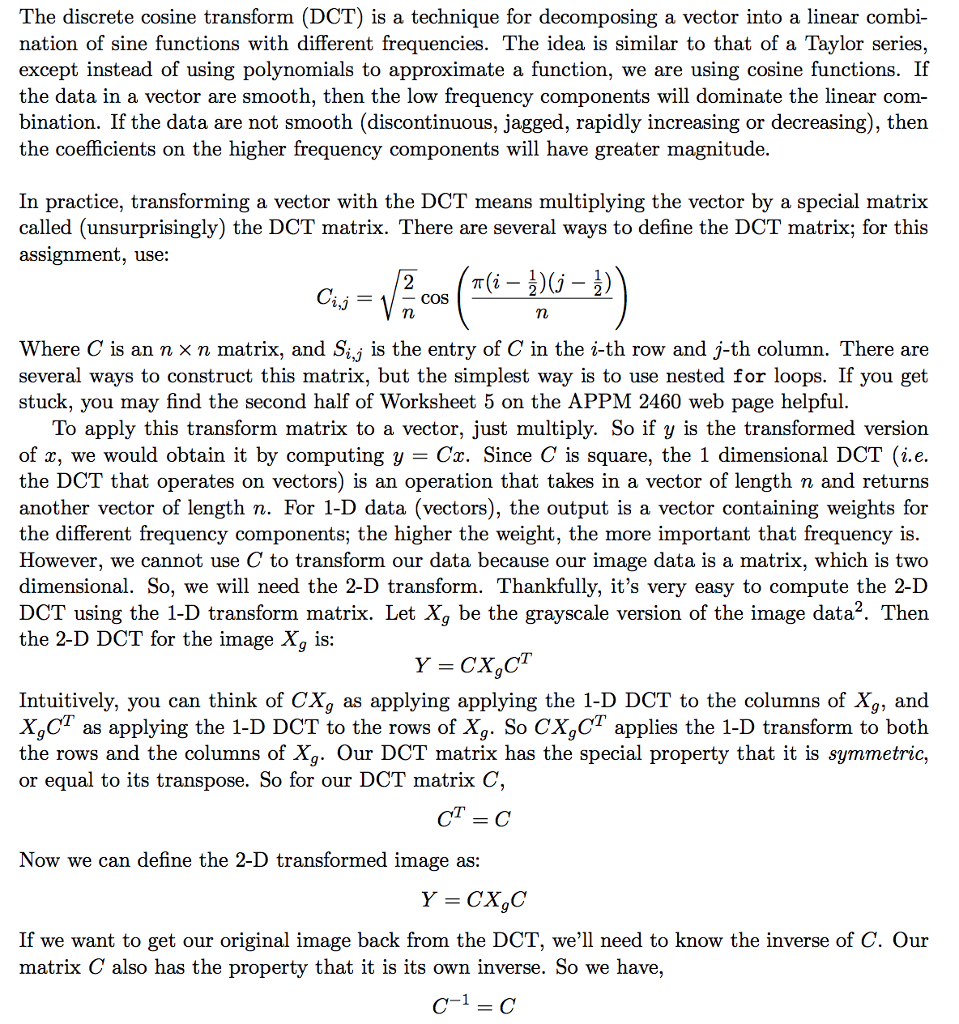
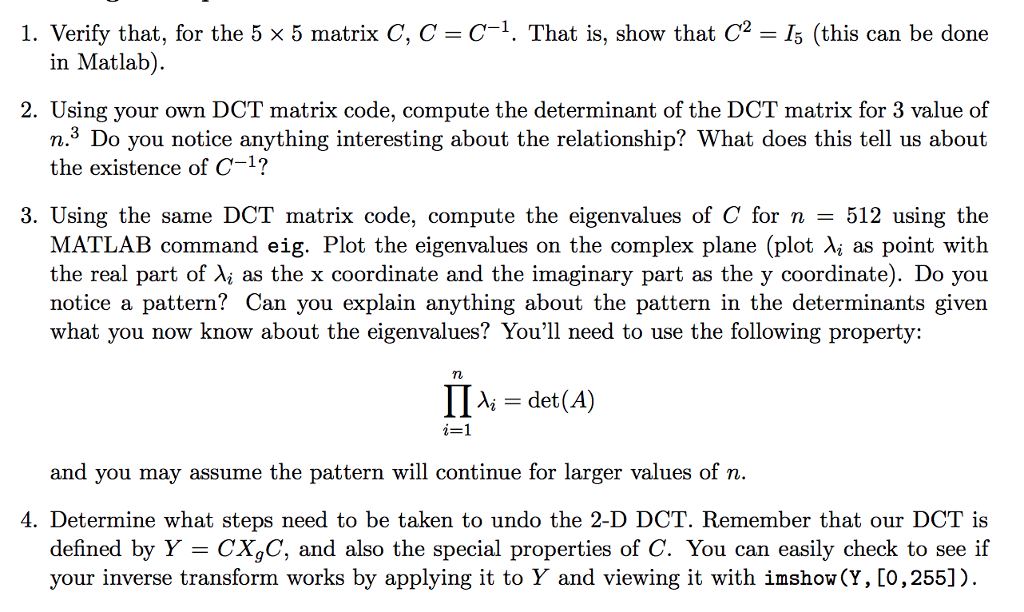
The discrete cosine transform (DCT) is a technique for decomposing a vector into a linear combi- nation of sine functions with different frequencies. The idea is similar to that of a Taylor series except instead of using polynomials to approximate a function, we are using cosine functions. If the data in a vector are smooth, then the low frequency components will dominate the linear com bination. If the data are not smooth (discontinuous, jagged, rapidly increasing or decreasing), then the coefficients on the higher frequency components will have greater magnitude. In practice, transforming a vector with the DCT means multiplying the vector by a special matrix called (unsurprisingly) the DCT matrix. There are several ways to define the DCT matrix; for this assignment, use: Where C is an n n matrix, and SLJ is the entry of C in the i-th row and j-th column. There are several ways to construct this matrix, but the simplest way is to use nested for loops. If you get stuck, you may find the second half of Worksheet 5 on the APPM 2460 web page helpful To apply this transform matrix to a vector, just multiply. So if y is the transformed version of x, we would obtain it by computing y-Cx. Since C is square, the 1 dimensional DCT (i.e. the DCT that operates on vectors) is an operation that takes in a vector of length n and return:s another vector of length n. For 1-D data (vectors), the output is a vector containing weights for the different frequency components; the higher the weight, the more important that frequency is However, we cannot use C to transform our data because our image data is a matrix, wh dimensional. So, we will need the 2-D transform. Thankfully, it's very easy to compute the 2-D DCT using the 1-D transform matrix. Let Xg be the grayscale version of the image data2. Then the 2-D DCT for the image Xg is: Intuitively, you can think of CXg as applying applying the 1-D DCT to the columns of Xg, and XgCT as applying the 1-D DCT to the rows of Xg. So CXgCT applies the 1-D transform to both the rows and the columns of ,. Our DCT matrix has the special property that it is symmetric, or equal to its transpose. So for our DCT matrix C, C" =C Now we can define the 2-D transformed image as If we want to get our original image back from the DCT, we'll need to know the inverse of C. Our matrix C also has the property that it is its own inverse. So we have The discrete cosine transform (DCT) is a technique for decomposing a vector into a linear combi- nation of sine functions with different frequencies. The idea is similar to that of a Taylor series except instead of using polynomials to approximate a function, we are using cosine functions. If the data in a vector are smooth, then the low frequency components will dominate the linear com bination. If the data are not smooth (discontinuous, jagged, rapidly increasing or decreasing), then the coefficients on the higher frequency components will have greater magnitude. In practice, transforming a vector with the DCT means multiplying the vector by a special matrix called (unsurprisingly) the DCT matrix. There are several ways to define the DCT matrix; for this assignment, use: Where C is an n n matrix, and SLJ is the entry of C in the i-th row and j-th column. There are several ways to construct this matrix, but the simplest way is to use nested for loops. If you get stuck, you may find the second half of Worksheet 5 on the APPM 2460 web page helpful To apply this transform matrix to a vector, just multiply. So if y is the transformed version of x, we would obtain it by computing y-Cx. Since C is square, the 1 dimensional DCT (i.e. the DCT that operates on vectors) is an operation that takes in a vector of length n and return:s another vector of length n. For 1-D data (vectors), the output is a vector containing weights for the different frequency components; the higher the weight, the more important that frequency is However, we cannot use C to transform our data because our image data is a matrix, wh dimensional. So, we will need the 2-D transform. Thankfully, it's very easy to compute the 2-D DCT using the 1-D transform matrix. Let Xg be the grayscale version of the image data2. Then the 2-D DCT for the image Xg is: Intuitively, you can think of CXg as applying applying the 1-D DCT to the columns of Xg, and XgCT as applying the 1-D DCT to the rows of Xg. So CXgCT applies the 1-D transform to both the rows and the columns of ,. Our DCT matrix has the special property that it is symmetric, or equal to its transpose. So for our DCT matrix C, C" =C Now we can define the 2-D transformed image as If we want to get our original image back from the DCT, we'll need to know the inverse of C. Our matrix C also has the property that it is its own inverse. So we have
Step by Step Solution
There are 3 Steps involved in it

Get step-by-step solutions from verified subject matter experts
 Study Help