



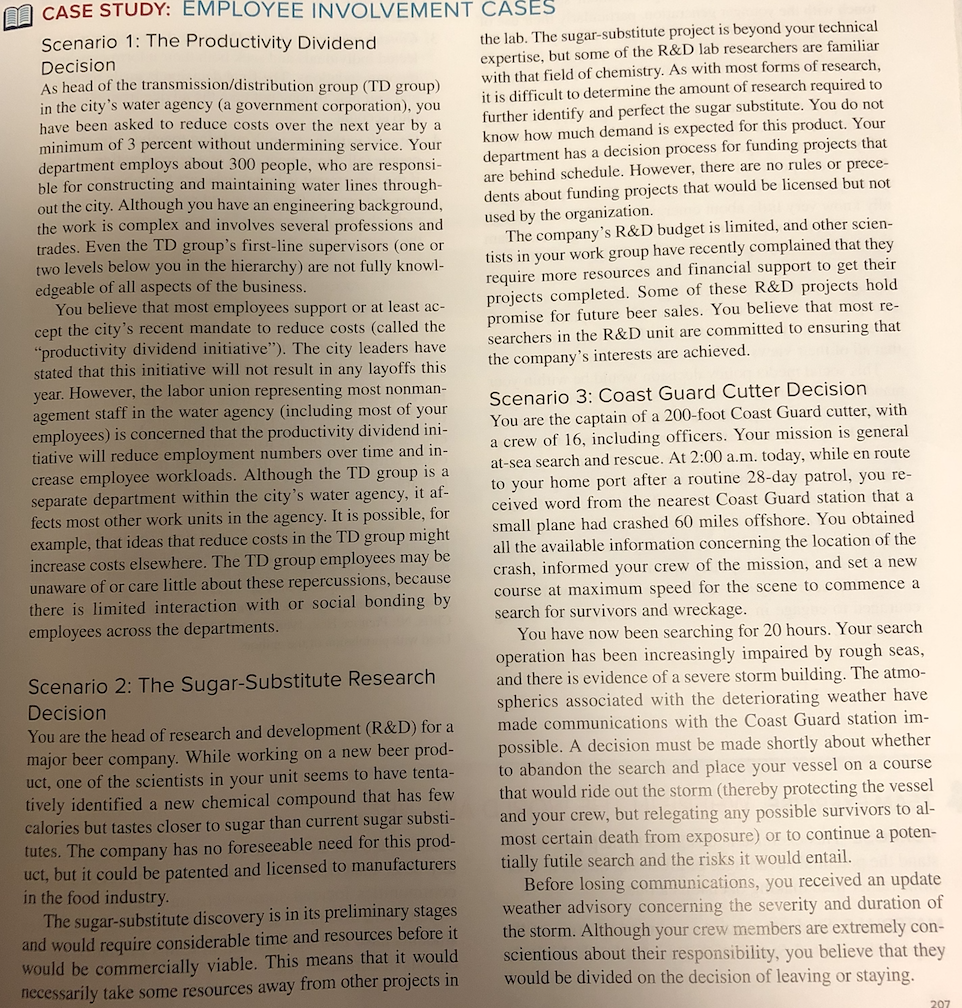
Question: The discussion questions for this case study that are listed in the picture above. M CASE STUDY: EMPLOYEE INVOLVEMENT CASES Scenario 1: The Productivity Dividend
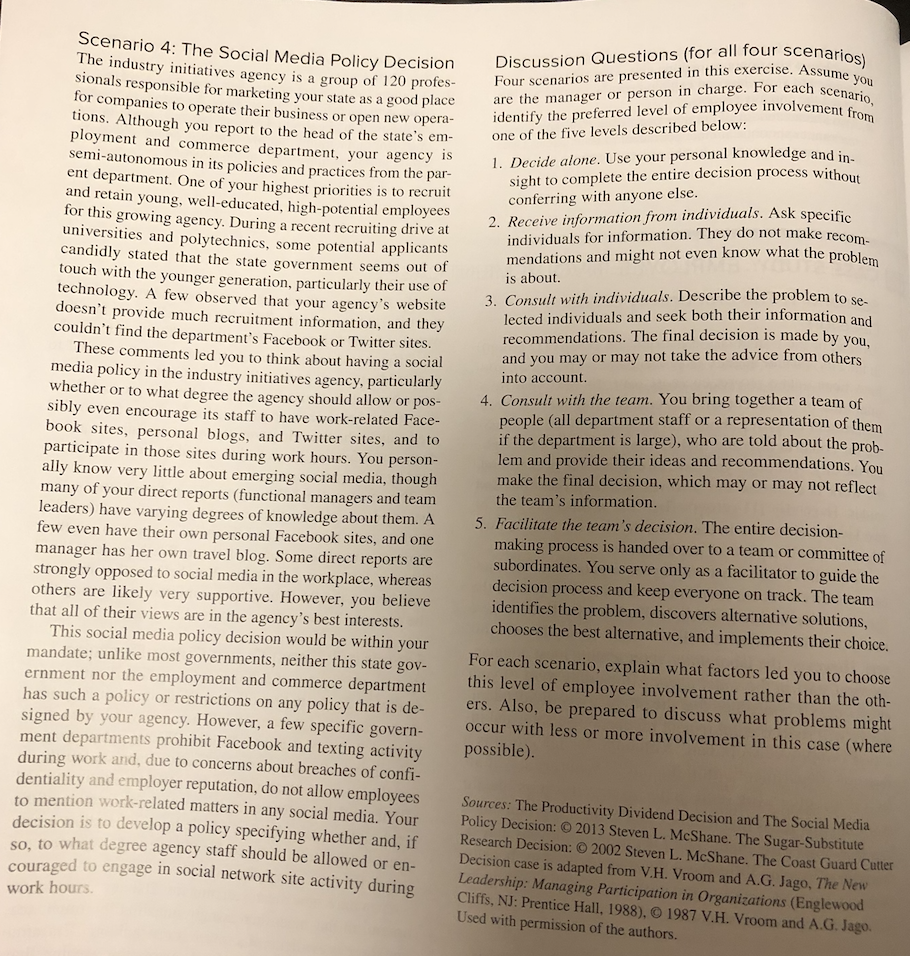
The discussion questions for this case study that are listed in the picture above.
M CASE STUDY: EMPLOYEE INVOLVEMENT CASES Scenario 1: The Productivity Dividend the lab. The sugar-substitute project is beyond your technical Decision expertise, but some of the R&D lab researchers are familiar As head of the transmission/distribution group (TD group) with that field of chemistry. As with most forms of research, in the city's water agency (a government corporation), you it is difficult to determine the amount of research required to have been asked to reduce costs over the next year by a further identify and perfect the sugar substitute. You do not minimum of 3 percent without undermining service. Your know how much demand is expected for this product. Your department employs about 300 people, who are responsi- department has a decision process for funding projects that ble for constructing and maintaining water lines through- are behind schedule. However, there are no rules or prece- out the city. Although you have an engineering background, dents about funding projects that would be licensed but not the work is complex and involves several professions and used by the organization. trades. Even the TD group's first-line supervisors (one or The company's R&D budget is limited, and other scien- two levels below you in the hierarchy) are not fully knowl- tists in your work group have recently complained that they edgeable of all aspects of the business. require more resources and financial support to get their You believe that most employees support or at least ac- projects completed. Some of these R&D projects hold cept the city's recent mandate to reduce costs (called the promise for future beer sales. You believe that most re- "productivity dividend initiative"). The city leaders have searchers in the R&D unit are committed to ensuring that stated that this initiative will not result in any layoffs this the company's interests are achieved. year. However, the labor union representing most nonman- agement staff in the water agency (including most of your Scenario 3: Coast Guard Cutter Decision employees) is concerned that the productivity dividend ini- You are the captain of a 200-foot Coast Guard cutter, with a crew of 16, including officers. Your mission is general tiative will reduce employment numbers over time and in- crease employee workloads. Although the TD group is a at-sea search and rescue. At 2:00 a.m. today, while en route separate department within the city's water agency, it af- to your home port after a routine 28-day patrol, you re- ceived word from the nearest Coast Guard station that a fects most other work units in the agency. It is possible, for small plane had crashed 60 miles offshore. You obtained example, that ideas that reduce costs in the TD group might all the available information concerning the location of the increase costs elsewhere. The TD group employees may be crash, informed your crew of the mission, and set a new unaware of or care little about these repercussions, because course at maximum speed for the scene to commence a there is limited interaction with or social bonding by search for survivors and wreckage. employees across the departments. You have now been searching for 20 hours. Your search operation has been increasingly impaired by rough seas, Scenario 2: The Sugar-Substitute Research and there is evidence of a severe storm building. The atmo- Decision spherics associated with the deteriorating weather have You are the head of research and development (R&D) for a made communications with the Coast Guard station im- major beer company. While working on a new beer prod possible. A decision must be made shortly about whether uct, one of the scientists in your unit seems to have tenta to abandon the search and place your vessel on a course tively identified a new chemical compound that has few that would ride out the storm (thereby protecting the vessel calories but tastes closer to sugar than current sugar substi and your crew, but relegating any possible survivors to al- tutes. The company has no foreseeable need for this prod most certain death from exposure) or to continue a poten- uct, but it could be patented and licensed to manufacturers tially futile search and the risks it would entail. in the food industry. Before losing communications, you received an update The sugar-substitute discovery is in its preliminary stages weather advisory concerning the severity and duration of and would require considerable time and resources before it the storm. Although your crew members are extremely con- would be commercially viable. This means that it would scientious about their responsibility, you believe that they necessarily take some resources away from other projects in would be divided on the decision of leaving or staying. 297 Discussion Questions (for all four scenario Four scenarios are presented in this exercise. Assum are the manager or person in charge. For each so identify the preferred level of employee involvemer one of the five levels described below: cenarios) Assume you ach scenario, volvement from Scenario 4: The Social Media Policy Decision The industry initiatives agency is a group of 120 profes- sionals responsible for marketing your state as a good place for companies to operate their business or open new opera- tions. Although you report to the head of the state's em- ployment and commerce department, your agency is semi-autonomous in its policies and practices from the par- ent department. One of your highest priorities is to recruit and retain young, well-educated, high-potential employees for this growing agency. During a recent recruiting drive at universities and polytechnics, some potential applicants candidly stated that the state government seems out of touch with the younger generation, particularly their use of technology. A few observed that your agency's website doesn't provide much recruitment information, and they couldn't find the department's Facebook or Twitter sites. These comments led you to think about having a social media policy in the industry initiatives agency, particularly whether or to what degree the agency should allow or pos- sibly even encourage its staff to have work-related Face- book sites, personal blogs, and Twitter sites, and to participate in those sites during work hours. You person- ally know very little about emerging social media, though many of your direct reports (functional managers and team leaders) have varying degrees of knowledge about them. A few even have their own personal Facebook sites, and one manager has her own travel blog. Some direct reports are strongly opposed to social media in the workplace, whereas others are likely very supportive. However, you believe that all of their views are in the agency's best interests. This social media policy decision would be within your mandate; unlike most governments, neither this state gov- ernment nor the employment and commerce department has such a policy or restrictions on any policy that is de- signed by your agency. However, a few specific govern- ment departments prohibit Facebook and texting activity during work and, due to concerns about breaches of confi- dentiality and employer reputation, do not allow employees to mention work-related matters in any social media. Your decision is to develop a policy specifying whether and, if So, to what degree agency staff should be allowed or en- couraged to engage in social network site activity during work hours 1. Decide alone. Use your personal knowledge and in sight to complete the entire decision process without conferring with anyone else. 2. Receive information from individuals. Ask specific individuals for information. They do not make rece mendations and might not even know what the problem is about 3. Consult with individuals. Describe the problem to se lected individuals and seek both their information and recommendations. The final decision is made by you and you may or may not take the advice from others into account. 4. Consult with the team. You bring together a team of people (all department staff or a representation of them if the department is large), who are told about the prob- lem and provide their ideas and recommendations. You make the final decision, which may or may not reflect the team's information. 5. Facilitate the team's decision. The entire decision- making process is handed over to a team or committee of subordinates. You serve only as a facilitator to guide the decision process and keep everyone on track. The team identifies the problem, discovers alternative solutions, chooses the best alternative, and implements their choice. For each scenario, explain what factors led you to choose this level of employee involvement rather than the oth- ers. Also, be prepared to discuss what problems might occur with less or more involvement in this case (where possible) Sources: The Productivity Dividend Decision and The Social Media Policy Decision: 2013 Steven L. McShane. The Sugar-Substitute Research Decision: 2002 Steven L. McShane. The Coast Guard Cutter Decision case is adapted from V.H. Vroom and A.G. Jago, The New Leadership: Managing Participation in Organizations (Englewood Cliffs, NJ: Prentice Hall, 1988). 1987 V.H. Vroom and A.G. Jago. Used with permission of the authorsStep by Step Solution
There are 3 Steps involved in it
1 Expert Approved Answer
Step: 1 Unlock

Question Has Been Solved by an Expert!
Get step-by-step solutions from verified subject matter experts
Step: 2 Unlock
Step: 3 Unlock