







Question: The dissolution process can be altered by varying these parameters, such as by increasing or decreasing the temperature or by reducing the particle size of
The dissolution process can be altered by varying these parameters, such as by increasing or decreasing the temperature or by reducing the particle size of the solute. dissolution of
NaClin water compared to the initial preparation if the dissolution process is endothermic.\ Drag the appropriate items to their respective bins.\ Finely powdered
NaClsalt is added to water:\ A large piece of
NaClsalt is added to water
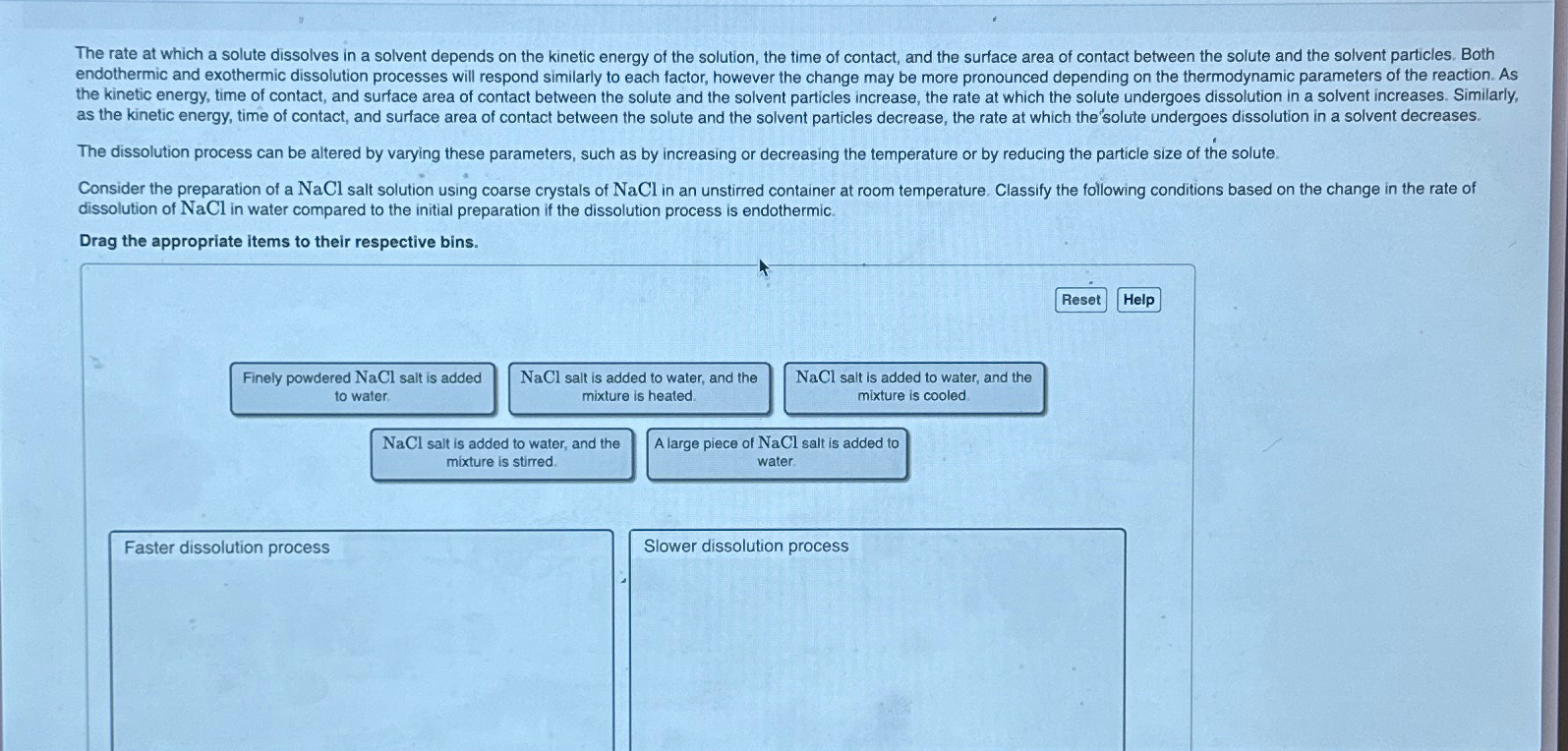
The rate at which a solute dissolves in a solvent depends on the kinetic energy of the solution, the time of contact, and the surface area of contact between the solute and the solvent particles. Both endothermic and exothermic dissolution processes will respond similarly to each factor, however the change may be more pronounced depending on the thermodynamic parameters of the reaction. As the kinetic energy, time of contact, and surface area of contact between the solute and the solvent particles increase, the rate at which the solute undergoes dissolution in a solvent increases. Similarly, as the kinetic energy, time of contact, and surface area of contact between the solute and the solvent particles decrease, the rate at which the'solute undergoes dissolution in a solvent decreases. The dissolution process can be altered by varying these parameters, such as by increasing or decreasing the temperature or by reducing the particle size of the solute. Consider the preparation of NaCl salt solution using coarse crystals of NaCl in an unstirred container at room temperature. Classify the following conditions based on the change in the rate of dissolution of NaCl in water compared to the initial preparation if the dissolution process is endothermic
Step by Step Solution
There are 3 Steps involved in it

Get step-by-step solutions from verified subject matter experts
 Study Help