







Question: The Economic Order Quantity (EOQ) model is a classical model used for controlling inventory and satisfying demand. Costs included in the model are holding cost
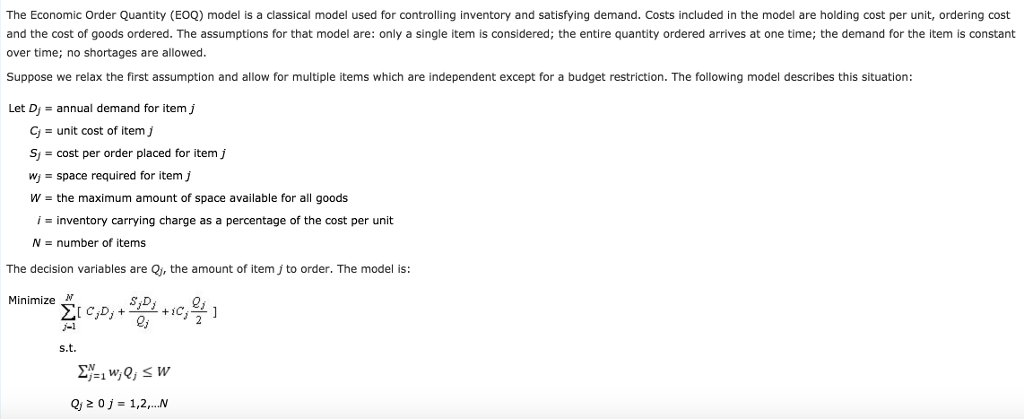
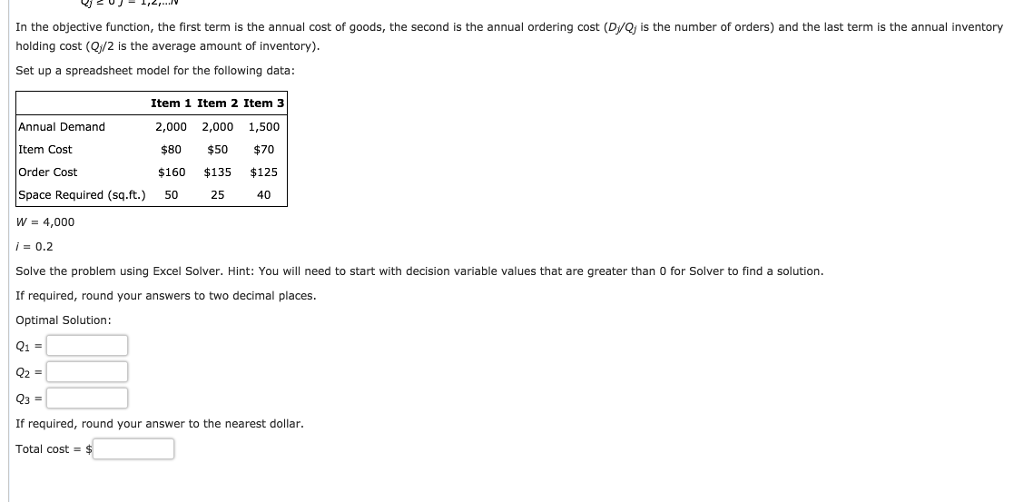
The Economic Order Quantity (EOQ) model is a classical model used for controlling inventory and satisfying demand. Costs included in the model are holding cost per unit, ordering cost and the cost of goods ordered. The assumptions for that model are: only a single item is considered; the entire quantity ordered arrives at one time; the demand for the item is constant over time; no shortages are allowed. Suppose we relax the first assumption and allow for multiple items which are independent except for a budget restriction. The following model describes this situation Let Dj = annual demand for item j Cjunit cost of item j Sj cost per order placed for item j = space required for item j W- the maximum amount of space available for all goods iinventory carrying charge as a percentage of the cost per unit N- number of items The decision variables are Qj, the amount of item j to order. The model is: Minimize 2, s.t. Qjt 0 j = 1,2,..N In the objective function, the first term is the annual cost of goods, the second is the annual ordering cost (Dyis the number of orders) and the last term is the annual inventory holding cost (Q/2 is the average amount of inventory) Set up a spreadsheet model for the following data Annual Demand Item Cost Order Cost Space Required (sq.ft 50 25 40 W-4,000 Item 1 Item 2 Item 3 2,000 2,000 1,500 $80$50 $70 $160 $135 $125 0.2 Solve the problem using Excel Solver. Hint: You will need to start with decision variable values that are greater than 0 for Solver to find a solution. If required, round your answers to two decimal places. Optimal Solution: 21 23 If required, round your answer to the nearest dollar. Total cost$ The Economic Order Quantity (EOQ) model is a classical model used for controlling inventory and satisfying demand. Costs included in the model are holding cost per unit, ordering cost and the cost of goods ordered. The assumptions for that model are: only a single item is considered; the entire quantity ordered arrives at one time; the demand for the item is constant over time; no shortages are allowed. Suppose we relax the first assumption and allow for multiple items which are independent except for a budget restriction. The following model describes this situation Let Dj = annual demand for item j Cjunit cost of item j Sj cost per order placed for item j = space required for item j W- the maximum amount of space available for all goods iinventory carrying charge as a percentage of the cost per unit N- number of items The decision variables are Qj, the amount of item j to order. The model is: Minimize 2, s.t. Qjt 0 j = 1,2,..N In the objective function, the first term is the annual cost of goods, the second is the annual ordering cost (Dyis the number of orders) and the last term is the annual inventory holding cost (Q/2 is the average amount of inventory) Set up a spreadsheet model for the following data Annual Demand Item Cost Order Cost Space Required (sq.ft 50 25 40 W-4,000 Item 1 Item 2 Item 3 2,000 2,000 1,500 $80$50 $70 $160 $135 $125 0.2 Solve the problem using Excel Solver. Hint: You will need to start with decision variable values that are greater than 0 for Solver to find a solution. If required, round your answers to two decimal places. Optimal Solution: 21 23 If required, round your answer to the nearest dollar. Total cost$
Step by Step Solution
There are 3 Steps involved in it

Get step-by-step solutions from verified subject matter experts
 Study Help