Question: THE EDEN GARDEN TOOLS Introducing the running case study: The Eden Garden Tools Company Ltd The Eden Garden Tools Company Ltd is a gardening tools
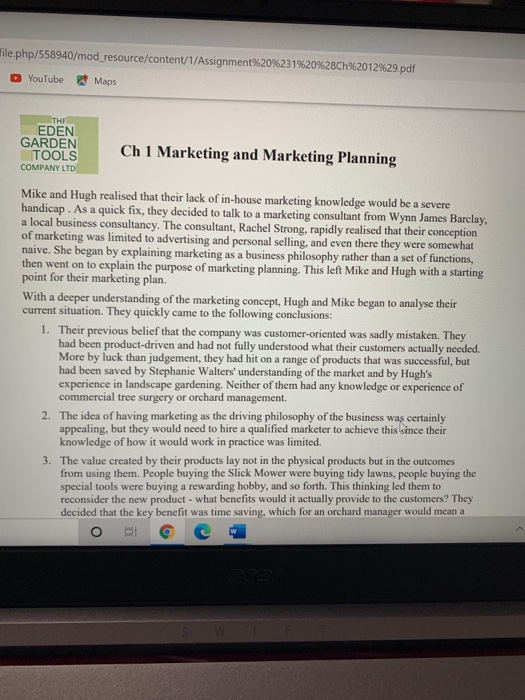
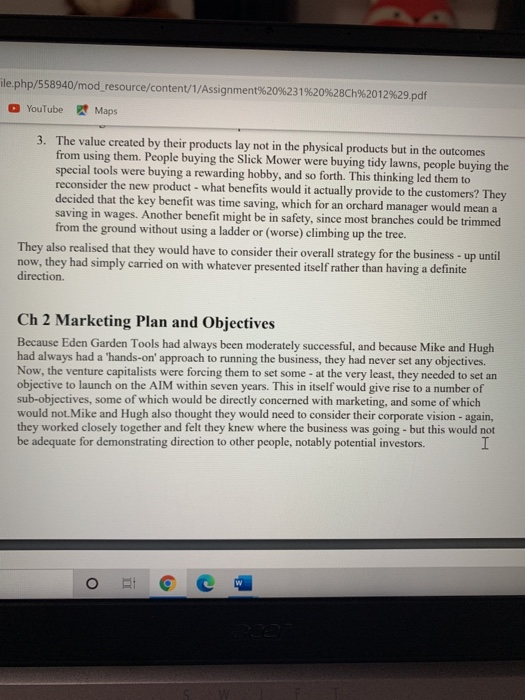
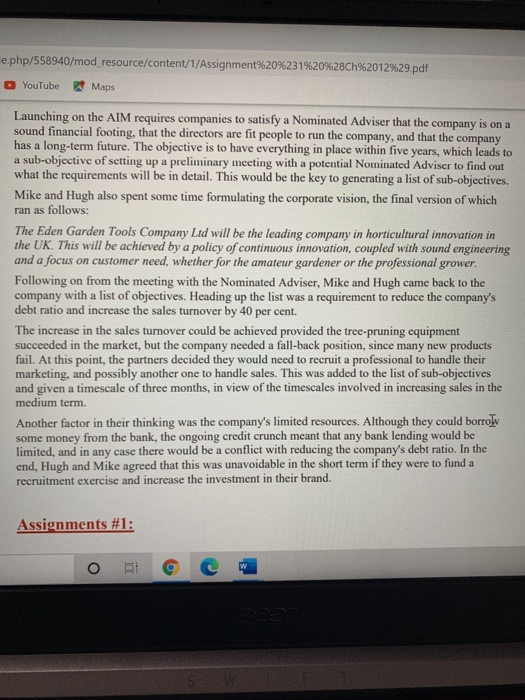
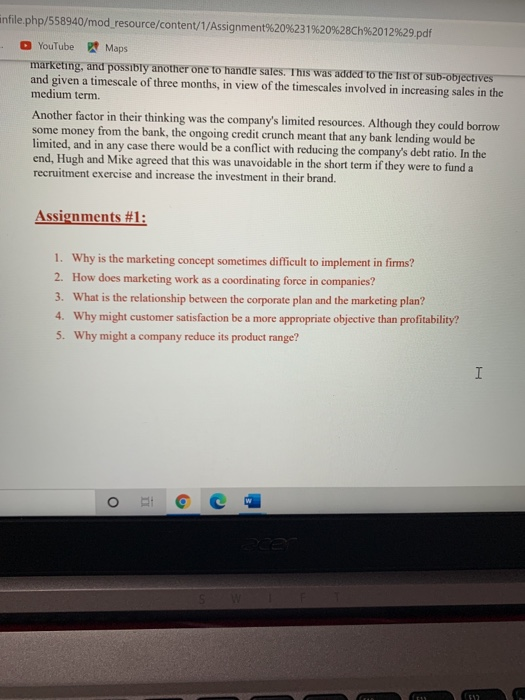
THE EDEN GARDEN TOOLS Introducing the running case study: The Eden Garden Tools Company Ltd The Eden Garden Tools Company Ltd is a gardening tools manufacturer based in Coventry. The company has a relatively short but highly successful history. It was started in 1994 by two friends, Mike Winton and Hugh Parris, after they graduated from university. Mike left with an engineering degree, gained as a mature student; previously he had worked for his family's agricultural equipment company and thus had a great deal of experience in engineering but no form qualifications. Hugh was also a mature student, having decided to take a liberal arts degree after having had a somewhat aimless existence in his 20s. Hugh's experience labouring for a landscape gardening company had given him several ideas for improving gardening tools - in particular, lawnmowers had proved to have major drawbacks when used on uneven or odd-shaped lawns. The lack of any qualifications or experience for what I was planning to do didn't hold me back in the least,' he once said in a TV interview. 'All I had to do was get Mike to do everything. Hugh outlined the lawnmower problem to Mike, who worked out a design for a mower that could cut evenly on the type of uneven lawns that many people have. The Slick Mower was the first of several innovative products the company introduced. The new company found it difficult to get financing, but Mike's family contributed 150,000 in seed capital in exchange for 50 per cent of the firm, which was to be held by the family business. Mike and Hugh kept the remaining shares, holding 25 per cent each. In 1995, the fledgling company began manufacture and hired Stephanie Walters as marketing manager. Stephanie's background was in marketing for DIY and gardening chain f&Q. She had also worked for Sainsbury's, with responsibility for the Homebase brand, immediately after graduating from Warwick Business School in 1987. Stephanie stayed with the company for almost to var hutlen following dinnerrements shout the senne of marketing within the firm Since Case: -pluginfile.php/558940/mod_resource/content/1/Assignment%20%231%20%28Ch%2012%29.pdf YouTube Maps VERY MSRP TUS OY HINS VERY VERY In 1995, the fledgling company began manufacture and hired Stephanie Walters as marketing manager. Stephanie's background was in marketing for DIY and gardening chain B&Q. She had also worked for Sainsbury's, with responsibility for the Homebase brand, immediately after graduating from Warwick Business School in 1987. Stephanie stayed with the company for almost two years, but left following disagreements about the scope of marketing within the firm. Since then Hugh has taken on responsibility for marketing, which in the case of Eden Garden Tools Company Ltd essentially means selling to major DIY and garden companies such as B&Q, Homebase and large garden centres. This takes up a substantial part of his time. The company sells more than just lawnmowers, of course. During Stephanie Walters' time at the company, Eden Garden Tools developed a range of hand tools for women, for example spades and forks with handles designed to minimise skin chafing, and ergonomically designed to minimise the muscular strength needed to use them. Tools for the disabled or elderly had also been a success story - special trowels designed to eliminate bending over and a patented planting device that can be used from a standing position or from a wheelchair also proved to be big sellers, even among able-bodied (but lazy) gardeners. The 2008 recession had a considerable effect on the company, but it was saved because it has a solid export market: the weaker pound made Eden Garden Tool's products more competitive in the Eurozone, which helped compensate for lower demand in the UK. In 2009, the company's sales began to recover from the recession, and Hugh and Mike started to consider new products to add to the range. One product idea that had been around for some time was an electric tree-pruning saw. This would consist of a long pole with an electric reciprocating saw on the end. The pole would need a gripper to hold the saw blade in position in the branch, and the saw blade would move backwards and forwards to cut through. Such a tool would be of more use to a professional gardener, tree surgeon or farmer, since an amateur gardener would not have enough use for such a I a W + luginfile.php/558940/mod_resource/content/1/Assignment%20%231%20%28Ch%2012%29.pdf ase... YouTube Maps product to justify the outlay. Amateur gardeners might well want to hire one, though, so it would be an item that many tool hire companies would buy, and even some garden centers might want one. There would be approximately 4,000 people within the UK who would have a use for such a machine, and around 35,000 in the European Union as a whole world sales could potentially be in the hundreds of thousands. From the viewpoint of Eden Garden Tools the product presented some problems, however. The electric power packs would be a new venture for the company, as would the small electric motors, but these were engineering problems and could be overcome by outsourcing the components. A more serious problem was a financial one. Following the recession, the company's cash reserves were gone, and although the firm remained liquid, sales were still stagnant and there would be little money to invest in developing and launching a new product. Mike's family were equally unable to help - the agricultural equipment business had been hit hard by the recession, since farmers can always make their machinery last another couple of years, and agricultural prices had fallen during 2009, leaving them short of cash for buying new equipment. But perhaps the most serious problem was that they would be entering a new market Up until now, they had been selling mainly to amateur gardeners, whereas the new product would be mainly selling in a business-to-business market. Also, it would rely heavily on gaining an export market in order to maximize the economies of scale needed to bring down the costs of manufacture. Global sales were therefore an essential factor for the company, at least regarding this specific product. Mike and Hugh called a meeting of the shareholders to discuss the way forward. At the meeting were Mike, Hugh, one of Mike's brothers and his father to represent the family business). They agreed to look for capital outside the company, and to bring in venture capitalists rather than reduce the company's liquidity by borrowing from a bank (even if a bank could be found that would be willing to lend). This would mean diluting the shareholdings of the existing shareholders, but the four agreed that this would be worth it in the long run since the overall value of the company would rise. infile.php/558940/mod_resource/content/1/Assignment%20%231%20%28Ch%2012%29.pdf YouTube Maps rise. Preliminary talks with a venture capital company flagged up a number of issues. First, the venture capitalists wanted to see Eden Garden Tool's business plan, which of course did not exist since Hugh and Mike had always operated on an ad-hoc basis. Second, the venture capitalists were concerned that Hugh was handling all the marketing himself, without any qualifications or experience outside the firm: they saw this as a real weakness. Third, they indicated that they would want around one-third of the company's shares in exchange for funding, and they would want to see an exit strategy in place for five to seven years down the line. Normally this would be a launch on the Alternative Investments Market (AIM), or possibly a full-blown stock market placement. Fourth, they would expect to appoint a non-executive director to the board of Eden Garden Tools to bring some much-needed business discipline to the company. Mike and Hugh came away from the meeting feeling somewhat daunted. However, they quickly realized that the venture capital company was actually laying out a negotiating position - if they could develop a good enough corporate and marketing plan, they could probably negotiate from a stronger position, perhaps giving away less of the company or removing the need for an extra director (who would, of course, have to be paid. The pair knew that they would be on a steep learning curve. I THE EDEN GARDEN Ch1 Marketing and Marketing Planning file.php/558940/mod_resource/content/1/Assignment%20%231%20%28Ch%2012%29.pdf D YouTube Maps THE EDEN GARDEN TOOLS Ch 1 Marketing and Marketing Planning COMPANY LTD Mike and Hugh realised that their lack of in-house marketing knowledge would be a severe handicap. As a quick fix, they decided to talk to a marketing consultant from Wynn James Barclay, a local business consultancy. The consultant, Rachel Strong, rapidly realised that their conception of marketing was limited to advertising and personal selling, and even there they were somewhat naive. She began by explaining marketing as a business philosophy rather than a set of functions, then went on to explain the purpose of marketing planning. This left Mike and Hugh with a starting point for their marketing plan. With a deeper understanding of the marketing concept, Hugh and Mike began to analyse their current situation. They quickly came to the following conclusions: 1. Their previous belief that the company was customer-oriented was sadly mistaken. They had been product-driven and had not fully understood what their customers actually needed. More by luck than judgement, they had hit on a range of products that was successful, but had been saved by Stephanie Walters' understanding of the market and by Hugh's experience in landscape gardening. Neither of them had any knowledge or experience of commercial tree surgery or orchard management. 2. The idea of having marketing as the driving philosophy of the business was certainly appealing, but they would need to hire a qualified marketer to achieve this since their knowledge of how it would work in practice was limited. 3. The value created by their products lay not in the physical products but in the outcomes from using them. People buying the Slick Mower were buying tidy lawns, people buying the special tools were buying a rewarding hobby, and so forth. This thinking led them to reconsider the new product - what benefits would it actually provide to the customers? They decided that the key benefit was time saving, which for an orchard manager would mean a ile.php/558940/mod_resource/content/1/Assignment%20%231%20%28Ch%2012%29.pdf YouTube Maps 3. The value created by their products lay not in the physical products but in the outcomes from using them. People buying the Slick Mower were buying tidy lawns, people buying the special tools were buying a rewarding hobby, and so forth. This thinking led them to reconsider the new product - what benefits would it actually provide to the customers? They decided that the key benefit was time saving, which for an orchard manager would mean a saving in wages. Another benefit might be in safety, since most branches could be trimmed from the ground without using a ladder or (worse) climbing up the tree. They also realised that they would have to consider their overall strategy for the business - up until now, they had simply carried on with whatever presented itself rather than having a definite direction. Ch 2 Marketing Plan and Objectives Because Eden Garden Tools had always been moderately successful, and because Mike and Hugh had always had a 'hands-on approach to running the business, they had never set any objectives. Now, the venture capitalists were forcing them to set some - at the very least, they needed to set an objective to launch on the AIM within seven years. This in itself would give rise to a number of sub-objectives, some of which would be directly concerned with marketing, and some of which would not. Mike and Hugh also thought they would need to consider their corporate vision - again, they worked closely together and felt they knew where the business was going - but this would not be adequate for demonstrating direction to other people, notably potential investors. I o TI G le.php/558940/mod_resource/content/1/Assignment%20%231%20%28Ch%2012%29.pdf YouTube Maps Launching on the AIM requires companies to satisfy a Nominated Adviser that the company is on a sound financial footing, that the directors are fit people to run the company, and that the company has a long-term future. The objective is to have everything in place within five years, which leads to a sub-objective of setting up a preliminary meeting with a potential Nominated Adviser to find out what the requirements will be in detail. This would be the key to generating a list of sub-objectives. Mike and Hugh also spent some time formulating the corporate vision, the final version of which ran as follows: The Eden Garden Tools Company Ltd will be the leading company in horticultural innovation in the UK. This will be achieved by a policy of continuous innovation, coupled with sound engineering and a focus on customer need, whether for the amateur gardener or the professional grower. Following on from the meeting with the Nominated Adviser, Mike and Hugh came back to the company with a list of objectives. Heading up the list was a requirement to reduce the company's debt ratio and increase the sales turnover by 40 per cent. The increase in the sales turnover could be achieved provided the tree-pruning equipment succeeded in the market, but the company needed a fall-back position, since many new products fail. At this point, the partners decided they would need to recruit a professional to handle their marketing, and possibly another one to handle sales. This was added to the list of sub-objectives and given a timescale of three months, in view of the timescales involved in increasing sales in the medium term. Another factor in their thinking was the company's limited resources. Although they could borro some money from the bank, the ongoing credit crunch meant that any bank lending would be limited, and in any case there would be a conflict with reducing the company's debt ratio. In the end, Hugh and Mike agreed that this was unavoidable in the short term if they were to fund a recruitment exercise and increase the investment in their brand. Assignments #1: O a anfile.php/558940/mod_resource/content/1/Assignment%20%231%20%28Ch%2012%29.pdf YouTube Maps marketing, and possibly another one to handle sales. This was added to the list of sub-objectives and given a timescale of three months, in view of the timescales involved in increasing sales in the medium term. Another factor in their thinking was the company's limited resources. Although they could borrow some money from the bank, the ongoing credit crunch meant that any bank lending would be limited, and in any case there would be a conflict with reducing the company's debt ratio. In the end, Hugh and Mike agreed that this was unavoidable in the short term if they were to fund a recruitment exercise and increase the investment in their brand. Assignments #1: 1. Why is the marketing concept sometimes difficult to implement in firms? 2. How does marketing work as a coordinating force in companies? 3. What is the relationship between the corporate plan and the marketing plan? 4. Why might customer satisfaction be a more appropriate objective than profitability? 5. Why might a company reduce its product range? I O THE EDEN GARDEN TOOLS Introducing the running case study: The Eden Garden Tools Company Ltd The Eden Garden Tools Company Ltd is a gardening tools manufacturer based in Coventry. The company has a relatively short but highly successful history. It was started in 1994 by two friends, Mike Winton and Hugh Parris, after they graduated from university. Mike left with an engineering degree, gained as a mature student; previously he had worked for his family's agricultural equipment company and thus had a great deal of experience in engineering but no form qualifications. Hugh was also a mature student, having decided to take a liberal arts degree after having had a somewhat aimless existence in his 20s. Hugh's experience labouring for a landscape gardening company had given him several ideas for improving gardening tools - in particular, lawnmowers had proved to have major drawbacks when used on uneven or odd-shaped lawns. The lack of any qualifications or experience for what I was planning to do didn't hold me back in the least,' he once said in a TV interview. 'All I had to do was get Mike to do everything. Hugh outlined the lawnmower problem to Mike, who worked out a design for a mower that could cut evenly on the type of uneven lawns that many people have. The Slick Mower was the first of several innovative products the company introduced. The new company found it difficult to get financing, but Mike's family contributed 150,000 in seed capital in exchange for 50 per cent of the firm, which was to be held by the family business. Mike and Hugh kept the remaining shares, holding 25 per cent each. In 1995, the fledgling company began manufacture and hired Stephanie Walters as marketing manager. Stephanie's background was in marketing for DIY and gardening chain f&Q. She had also worked for Sainsbury's, with responsibility for the Homebase brand, immediately after graduating from Warwick Business School in 1987. Stephanie stayed with the company for almost to var hutlen following dinnerrements shout the senne of marketing within the firm Since Case: -pluginfile.php/558940/mod_resource/content/1/Assignment%20%231%20%28Ch%2012%29.pdf YouTube Maps VERY MSRP TUS OY HINS VERY VERY In 1995, the fledgling company began manufacture and hired Stephanie Walters as marketing manager. Stephanie's background was in marketing for DIY and gardening chain B&Q. She had also worked for Sainsbury's, with responsibility for the Homebase brand, immediately after graduating from Warwick Business School in 1987. Stephanie stayed with the company for almost two years, but left following disagreements about the scope of marketing within the firm. Since then Hugh has taken on responsibility for marketing, which in the case of Eden Garden Tools Company Ltd essentially means selling to major DIY and garden companies such as B&Q, Homebase and large garden centres. This takes up a substantial part of his time. The company sells more than just lawnmowers, of course. During Stephanie Walters' time at the company, Eden Garden Tools developed a range of hand tools for women, for example spades and forks with handles designed to minimise skin chafing, and ergonomically designed to minimise the muscular strength needed to use them. Tools for the disabled or elderly had also been a success story - special trowels designed to eliminate bending over and a patented planting device that can be used from a standing position or from a wheelchair also proved to be big sellers, even among able-bodied (but lazy) gardeners. The 2008 recession had a considerable effect on the company, but it was saved because it has a solid export market: the weaker pound made Eden Garden Tool's products more competitive in the Eurozone, which helped compensate for lower demand in the UK. In 2009, the company's sales began to recover from the recession, and Hugh and Mike started to consider new products to add to the range. One product idea that had been around for some time was an electric tree-pruning saw. This would consist of a long pole with an electric reciprocating saw on the end. The pole would need a gripper to hold the saw blade in position in the branch, and the saw blade would move backwards and forwards to cut through. Such a tool would be of more use to a professional gardener, tree surgeon or farmer, since an amateur gardener would not have enough use for such a I a W + luginfile.php/558940/mod_resource/content/1/Assignment%20%231%20%28Ch%2012%29.pdf ase... YouTube Maps product to justify the outlay. Amateur gardeners might well want to hire one, though, so it would be an item that many tool hire companies would buy, and even some garden centers might want one. There would be approximately 4,000 people within the UK who would have a use for such a machine, and around 35,000 in the European Union as a whole world sales could potentially be in the hundreds of thousands. From the viewpoint of Eden Garden Tools the product presented some problems, however. The electric power packs would be a new venture for the company, as would the small electric motors, but these were engineering problems and could be overcome by outsourcing the components. A more serious problem was a financial one. Following the recession, the company's cash reserves were gone, and although the firm remained liquid, sales were still stagnant and there would be little money to invest in developing and launching a new product. Mike's family were equally unable to help - the agricultural equipment business had been hit hard by the recession, since farmers can always make their machinery last another couple of years, and agricultural prices had fallen during 2009, leaving them short of cash for buying new equipment. But perhaps the most serious problem was that they would be entering a new market Up until now, they had been selling mainly to amateur gardeners, whereas the new product would be mainly selling in a business-to-business market. Also, it would rely heavily on gaining an export market in order to maximize the economies of scale needed to bring down the costs of manufacture. Global sales were therefore an essential factor for the company, at least regarding this specific product. Mike and Hugh called a meeting of the shareholders to discuss the way forward. At the meeting were Mike, Hugh, one of Mike's brothers and his father to represent the family business). They agreed to look for capital outside the company, and to bring in venture capitalists rather than reduce the company's liquidity by borrowing from a bank (even if a bank could be found that would be willing to lend). This would mean diluting the shareholdings of the existing shareholders, but the four agreed that this would be worth it in the long run since the overall value of the company would rise. infile.php/558940/mod_resource/content/1/Assignment%20%231%20%28Ch%2012%29.pdf YouTube Maps rise. Preliminary talks with a venture capital company flagged up a number of issues. First, the venture capitalists wanted to see Eden Garden Tool's business plan, which of course did not exist since Hugh and Mike had always operated on an ad-hoc basis. Second, the venture capitalists were concerned that Hugh was handling all the marketing himself, without any qualifications or experience outside the firm: they saw this as a real weakness. Third, they indicated that they would want around one-third of the company's shares in exchange for funding, and they would want to see an exit strategy in place for five to seven years down the line. Normally this would be a launch on the Alternative Investments Market (AIM), or possibly a full-blown stock market placement. Fourth, they would expect to appoint a non-executive director to the board of Eden Garden Tools to bring some much-needed business discipline to the company. Mike and Hugh came away from the meeting feeling somewhat daunted. However, they quickly realized that the venture capital company was actually laying out a negotiating position - if they could develop a good enough corporate and marketing plan, they could probably negotiate from a stronger position, perhaps giving away less of the company or removing the need for an extra director (who would, of course, have to be paid. The pair knew that they would be on a steep learning curve. I THE EDEN GARDEN Ch1 Marketing and Marketing Planning file.php/558940/mod_resource/content/1/Assignment%20%231%20%28Ch%2012%29.pdf D YouTube Maps THE EDEN GARDEN TOOLS Ch 1 Marketing and Marketing Planning COMPANY LTD Mike and Hugh realised that their lack of in-house marketing knowledge would be a severe handicap. As a quick fix, they decided to talk to a marketing consultant from Wynn James Barclay, a local business consultancy. The consultant, Rachel Strong, rapidly realised that their conception of marketing was limited to advertising and personal selling, and even there they were somewhat naive. She began by explaining marketing as a business philosophy rather than a set of functions, then went on to explain the purpose of marketing planning. This left Mike and Hugh with a starting point for their marketing plan. With a deeper understanding of the marketing concept, Hugh and Mike began to analyse their current situation. They quickly came to the following conclusions: 1. Their previous belief that the company was customer-oriented was sadly mistaken. They had been product-driven and had not fully understood what their customers actually needed. More by luck than judgement, they had hit on a range of products that was successful, but had been saved by Stephanie Walters' understanding of the market and by Hugh's experience in landscape gardening. Neither of them had any knowledge or experience of commercial tree surgery or orchard management. 2. The idea of having marketing as the driving philosophy of the business was certainly appealing, but they would need to hire a qualified marketer to achieve this since their knowledge of how it would work in practice was limited. 3. The value created by their products lay not in the physical products but in the outcomes from using them. People buying the Slick Mower were buying tidy lawns, people buying the special tools were buying a rewarding hobby, and so forth. This thinking led them to reconsider the new product - what benefits would it actually provide to the customers? They decided that the key benefit was time saving, which for an orchard manager would mean a ile.php/558940/mod_resource/content/1/Assignment%20%231%20%28Ch%2012%29.pdf YouTube Maps 3. The value created by their products lay not in the physical products but in the outcomes from using them. People buying the Slick Mower were buying tidy lawns, people buying the special tools were buying a rewarding hobby, and so forth. This thinking led them to reconsider the new product - what benefits would it actually provide to the customers? They decided that the key benefit was time saving, which for an orchard manager would mean a saving in wages. Another benefit might be in safety, since most branches could be trimmed from the ground without using a ladder or (worse) climbing up the tree. They also realised that they would have to consider their overall strategy for the business - up until now, they had simply carried on with whatever presented itself rather than having a definite direction. Ch 2 Marketing Plan and Objectives Because Eden Garden Tools had always been moderately successful, and because Mike and Hugh had always had a 'hands-on approach to running the business, they had never set any objectives. Now, the venture capitalists were forcing them to set some - at the very least, they needed to set an objective to launch on the AIM within seven years. This in itself would give rise to a number of sub-objectives, some of which would be directly concerned with marketing, and some of which would not. Mike and Hugh also thought they would need to consider their corporate vision - again, they worked closely together and felt they knew where the business was going - but this would not be adequate for demonstrating direction to other people, notably potential investors. I o TI G le.php/558940/mod_resource/content/1/Assignment%20%231%20%28Ch%2012%29.pdf YouTube Maps Launching on the AIM requires companies to satisfy a Nominated Adviser that the company is on a sound financial footing, that the directors are fit people to run the company, and that the company has a long-term future. The objective is to have everything in place within five years, which leads to a sub-objective of setting up a preliminary meeting with a potential Nominated Adviser to find out what the requirements will be in detail. This would be the key to generating a list of sub-objectives. Mike and Hugh also spent some time formulating the corporate vision, the final version of which ran as follows: The Eden Garden Tools Company Ltd will be the leading company in horticultural innovation in the UK. This will be achieved by a policy of continuous innovation, coupled with sound engineering and a focus on customer need, whether for the amateur gardener or the professional grower. Following on from the meeting with the Nominated Adviser, Mike and Hugh came back to the company with a list of objectives. Heading up the list was a requirement to reduce the company's debt ratio and increase the sales turnover by 40 per cent. The increase in the sales turnover could be achieved provided the tree-pruning equipment succeeded in the market, but the company needed a fall-back position, since many new products fail. At this point, the partners decided they would need to recruit a professional to handle their marketing, and possibly another one to handle sales. This was added to the list of sub-objectives and given a timescale of three months, in view of the timescales involved in increasing sales in the medium term. Another factor in their thinking was the company's limited resources. Although they could borro some money from the bank, the ongoing credit crunch meant that any bank lending would be limited, and in any case there would be a conflict with reducing the company's debt ratio. In the end, Hugh and Mike agreed that this was unavoidable in the short term if they were to fund a recruitment exercise and increase the investment in their brand. Assignments #1: O a anfile.php/558940/mod_resource/content/1/Assignment%20%231%20%28Ch%2012%29.pdf YouTube Maps marketing, and possibly another one to handle sales. This was added to the list of sub-objectives and given a timescale of three months, in view of the timescales involved in increasing sales in the medium term. Another factor in their thinking was the company's limited resources. Although they could borrow some money from the bank, the ongoing credit crunch meant that any bank lending would be limited, and in any case there would be a conflict with reducing the company's debt ratio. In the end, Hugh and Mike agreed that this was unavoidable in the short term if they were to fund a recruitment exercise and increase the investment in their brand. Assignments #1: 1. Why is the marketing concept sometimes difficult to implement in firms? 2. How does marketing work as a coordinating force in companies? 3. What is the relationship between the corporate plan and the marketing plan? 4. Why might customer satisfaction be a more appropriate objective than profitability? 5. Why might a company reduce its product range? I O









 Study Help