


Question: the effect is significant , then we will expand the analysis to include all products CARSON : I'm willing to compute the effect , but
the effect is significant , then we will expand
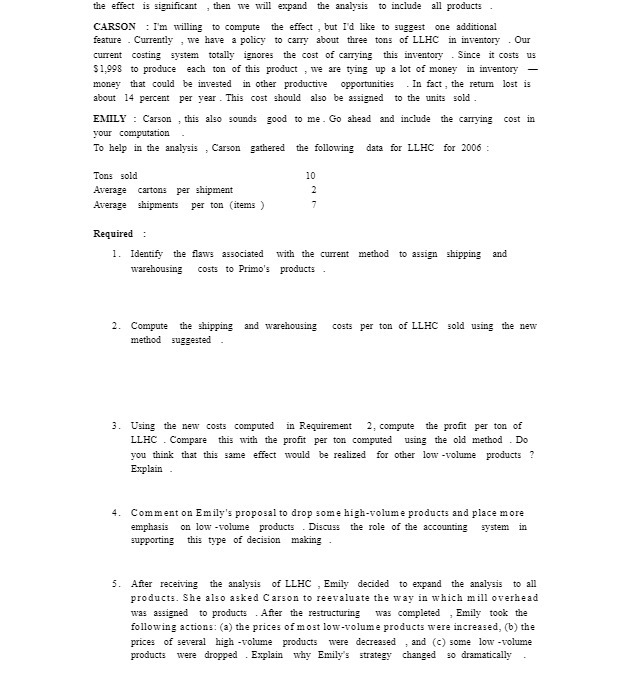
the effect is significant , then we will expand the analysis to include all products CARSON : I'm willing to compute the effect , but I'd like to suggest one additional feature . Currently , we have a policy to carry about three tons of LLHC in inventory . Our current costing system totally ignores the cost of carrying this inventory . Since it costs me $1,998 to produce each ton of this product , we are tying up a lot of money in inventory money that could be invested in other productive opportunities . In fact , the return lost is about 14 percent per year . This cost should also be assigned to the units sold . EMILY : Carson , this also sounds good to me. Go ahead and include the carrying cost in your computation To help in the analysis , Carson gathered the following data for LLHC for 2006 : Tong sold 10 Average cartons per shipment Average shipments per ton (items ) Required : 1. Identify the flaws associated with the current method to assign shipping and warehousing costs to Primo's products 2. Compute the shipping and warehousing costs per ton of LLHC sold using the new method suggested 3. Using the new costs computed in Requirement 2, compute the profit per ton of LLHC . Compare this with the profit per ton computed using the old method . Do you think that this same effect would be realized for other low -volume products ? Explain 4. Comment on Emily's proposal to drop some high-volume products and place more emphasis on low -volume products . Discuss the role of the accounting system in supporting this type of decision making 5. After receiving the analysis of LLHC , Emily decided to expand the analysis to all products. She also asked Carson to reevaluate the way in which mill overhead was assigned to products . After the restructuring was completed , Emily took the following actions: (a) the prices of most low-volume products were increased, (b) the prices of several high -volume products were decreased , and (c) some low -volume products were dropped . Explain why Emily's strategy changed so dramatically

Step by Step Solution

There are 3 Steps involved in it

1 Expert Approved Answer
Step: 1 Unlock blur-text-image

Question Has Been Solved by an Expert!

Get step-by-step solutions from verified subject matter experts

Step: 2 Unlock
Step: 3 Unlock

Students Have Also Explored These Related Accounting Questions!