







Question: The Einstein i showed that the Gini coefficient g can be calculated from the three groups of people in the economy-wide labour market as
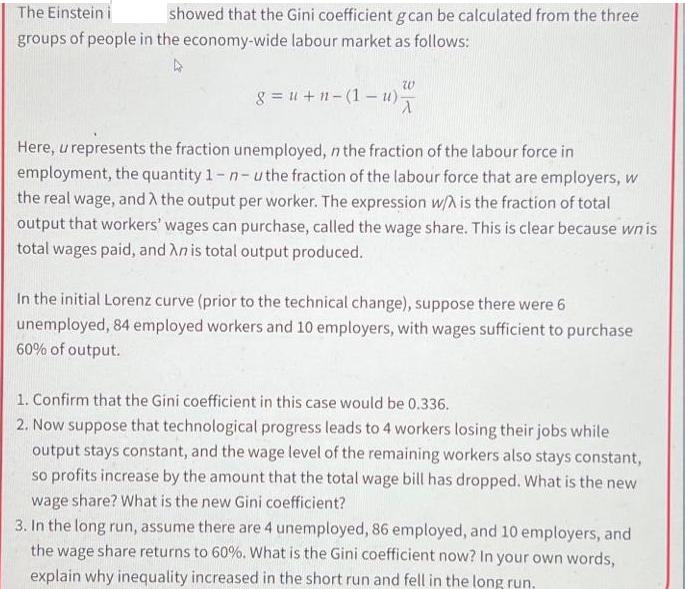
The Einstein i showed that the Gini coefficient g can be calculated from the three groups of people in the economy-wide labour market as follows: W A g="+"-(1-u)- Here, u represents the fraction unemployed, n the fraction of the labour force in employment, the quantity 1-n-u the fraction of the labour force that are employers, w the real wage, and the output per worker. The expression w/A is the fraction of total output that workers' wages can purchase, called the wage share. This is clear because wn is total wages paid, and An is total output produced. In the initial Lorenz curve (prior to the technical change), suppose there were 6 unemployed, 84 employed workers and 10 employers, with wages sufficient to purchase 60% of output. 1. Confirm that the Gini coefficient in this case would be 0.336. 2. Now suppose that technological progress leads to 4 workers losing their jobs while output stays constant, and the wage level of the remaining workers also stays constant, so profits increase by the amount that the total wage bill has dropped. What is the new wage share? What is the new Gini coefficient? 3. In the long run, assume there are 4 unemployed, 86 employed, and 10 employers, and the wage share returns to 60%. What is the Gini coefficient now? In your own words, explain why inequality increased in the short run and fell in the long run.
Step by Step Solution
3.39 Rating (155 Votes )
There are 3 Steps involved in it
The image you provided contains a text that describes a way of calculating the Gini coefficient from the three groups of people in an economywide labo... View full answer

Get step-by-step solutions from verified subject matter experts
 Study Help