







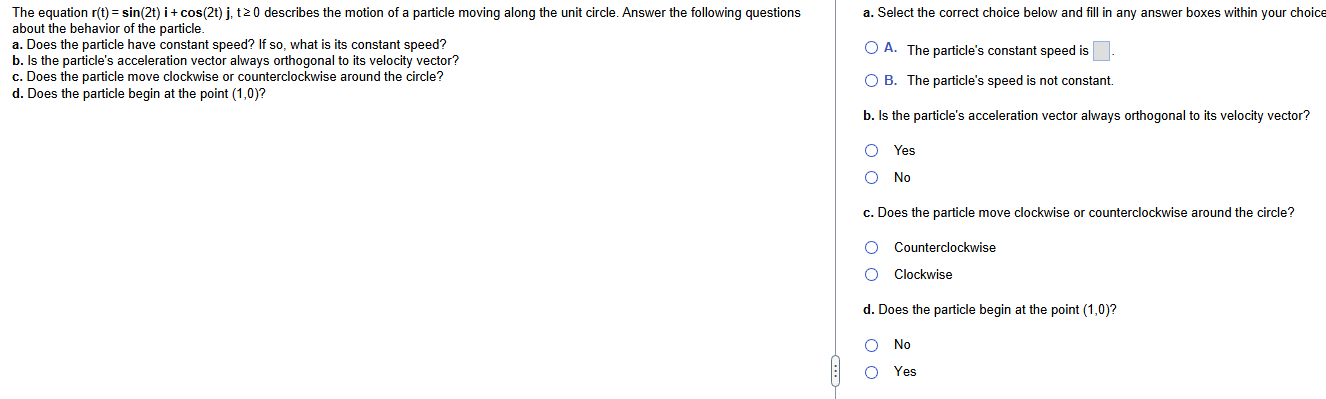
Question: The equation ( r ( t ) = boldsymbol { operatorname { s i n } } ( 2 t )
The equation rtboldsymboloperatorname s i n tmathbfiboldsymboloperatorname c o s tmathbfjmathrmtgeq describes the motion of a particle moving along the unit circle. Answer the following questions about the behavior of the particle.
a Does the particle have constant speed? If so what is its constant speed?
b Is the particle's acceleration vector always orthogonal to its velocity vector?
c Does the particle move clockwise or counterclockwise around the circle?
d Does the particle begin at the point
a Select the correct choice below and fill in any answer boxes within your choice
A The particle's constant speed is
B The particle's speed is not constant.
b Is the particle's acceleration vector always orthogonal to its velocity vector?
Yes
No
c Does the particle move clockwise or counterclockwise around the circle?
Counterclockwise
Clockwise
d Does the particle begin at the point
No
Yes
Step by Step Solution
There are 3 Steps involved in it
1 Expert Approved Answer
Step: 1 Unlock

Question Has Been Solved by an Expert!
Get step-by-step solutions from verified subject matter experts
Step: 2 Unlock
Step: 3 Unlock
 Study Help