



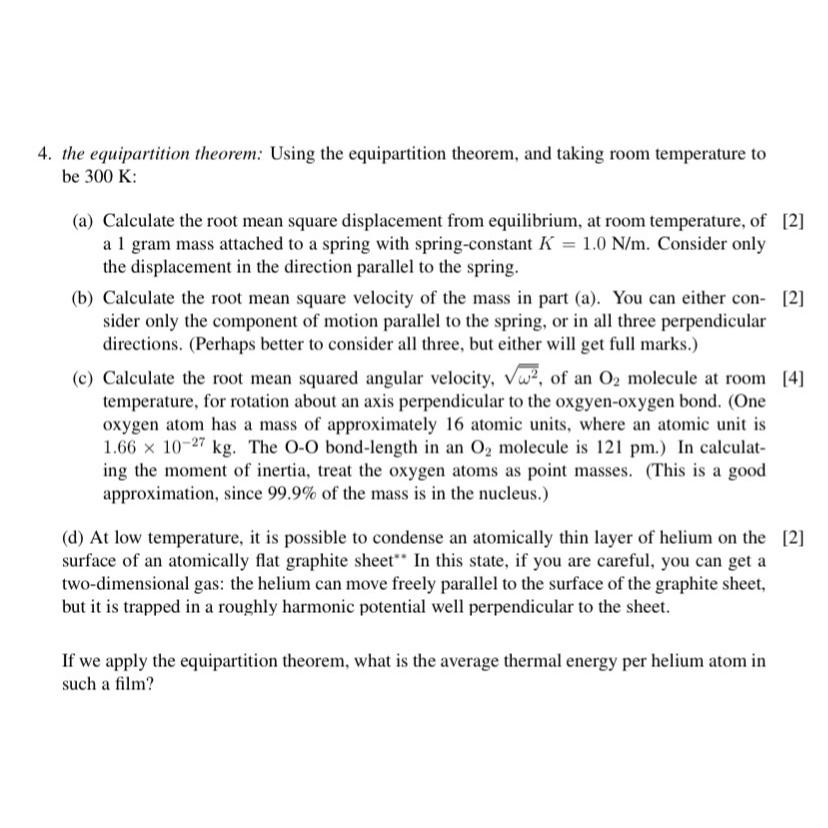
Question: the equipartition theorem: Using the equipartition theorem, and taking room temperature to be 3 0 0 K : ( a ) Calculate the root mean
the equipartition theorem: Using the equipartition theorem, and taking room temperature to be :
a Calculate the root mean square displacement from equilibrium, at room temperature, of
a gram mass attached to a spring with springconstant Consider only the displacement in the direction parallel to the spring.
b Calculate the root mean square velocity of the mass in part a You can either con
sider only the component of motion parallel to the spring, or in all three perpendicular directions. Perhaps better to consider all three, but either will get full marks.
c Calculate the root mean squared angular velocity, of an molecule at room
temperature, for rotation about an axis perpendicular to the oxgyenoxygen bond. One oxygen atom has a mass of approximately atomic units, where an atomic unit is The bondlength in an molecule is In calculating the moment of inertia, treat the oxygen atoms as point masses. This is a good approximation, since of the mass is in the nucleus.
d At low temperature, it is possible to condense an atomically thin layer of helium on the
surface of an atomically flat graphite sheet" In this state, if you are careful, you can get a twodimensional gas: the helium can move freely parallel to the surface of the graphite sheet, but it is trapped in a roughly harmonic potential well perpendicular to the sheet.
If we apply the equipartition theorem, what is the average thermal energy per helium atom in such a film?
Step by Step Solution
There are 3 Steps involved in it
1 Expert Approved Answer
Step: 1 Unlock

Question Has Been Solved by an Expert!
Get step-by-step solutions from verified subject matter experts
Step: 2 Unlock
Step: 3 Unlock