







Question: The Fibonacci sequence is defined using the following recursive formula: F(0) = 0 F(1) = 1 F(N) = F(N-1) + F(N-2) if N 2 2
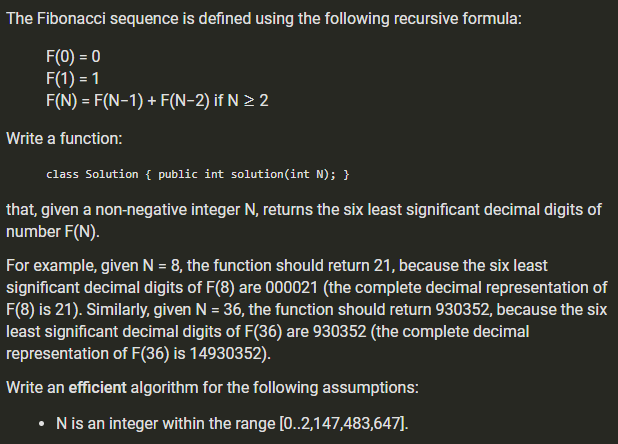
The Fibonacci sequence is defined using the following recursive formula: F(0) = 0 F(1) = 1 F(N) = F(N-1) + F(N-2) if N 2 2 Write a function: class Solution { public int solution(int N); } that, given a non-negative integer N, returns the six least significant decimal digits of number F(N). For example, given N = 8, the function should return 21, because the six least significant decimal digits of F(8) are 000021 (the complete decimal representation of F(8) is 21). Similarly, given N = 36, the function should return 930352, because the six least significant decimal digits of F(36) are 930352 (the complete decimal representation of F(36) is 14930352). Write an efficient algorithm for the following assumptions: . N is an integer within the range [0..2,147,483,647]
Step by Step Solution
There are 3 Steps involved in it

Get step-by-step solutions from verified subject matter experts
 Study Help