







Question: The final exam for this course is a visual presentation ( usually PowerPoint slides ) - also known as the Pitch Deck. A pitch is
The final exam for this course is a visual presentation usually PowerPoint slides also known as the "Pitch Deck." A "pitch" is a short, compelling explanation of the business you are developing. A "deck" is slang for a set of slides. The Pitch Deck is an accumulation of everything we have discussed in the course. You will submit your slides as an assignment. You are not required to present them. Follow the guidelines below for the deck. More is not better...put effort into making these slides as good as you can. Make them visually interesting, think about the questions people might have and proactively answer them on the slides, add enough data to convince the audience that your business can be profitable.
The discussions to date have been designed to help you think about various aspects of your business, but you may find the Business Canvas template helpful to organize your thoughts. There is more information on the Business Canvas in the weekly content modules.
Why is this the final exam? As an entrepreneur or business owner, you may find yourself in the position of pitching your business. A pitch deck may be used to secure investment, to court advisors, to explore potential partnerships, etc. It is a good practice to develop a pitch deck early and update it often. You never know when you might have an opportunity to "pitch" your business idea!
Here is an example scenario:
You have been working on the written business plan for your startup for a couple months and have a few friends and family willing to invest, but you know you will need more financing for startup costs. You have considered a business loan but have been reluctant to call the bank. You are confident in your business idea and think it solves a clear problem for customers and has a pretty large market opportunity. You have some work to do on the operational details, but the unit economics seem to work so far and you think this business can be profitable within a relatively short time frame. From what youve read, it seems like something a venture capitalist, angel investor, or other private equity would be interested in IF you found the right fit. You dont really know where to even get started to connect with these kinds of investors though. Youre heading into the local coffee shop to consider what to do next when you run into Tom, a friend from high school who you havent seen in years.
You: Hey, Tom! Long time no see! How have you been?
Tom: Im doing well! I have been doing freelance tech consulting work for a couple years at that coworking space downtown. Lots of startups to keep things interesting and free snacks!
You: Thats awesome! Ive actually been working on a business plan for a new venture. Want to grab a table? Id love to get your thoughts on it
Tom: Oh Id love to but Im late for a meeting with some VCs Tell you what, shoot me your pitch deck and Ill see if I can get you some feedback.
You: Thanks! Ill send it right now.
You pull out your phone and email Tom your pitch deck thankful that you had one ready to go
Your pitch deck should stand alone. You will often be asked to send one without the opportunity to have a meeting or a phone call to explain it The pitch deck must be compelling enough to convince the recipient they want to talk to you to hear more. Therefore, it should contain enough information to answer the basic questions about a business, but not so much information or so many slides that its too long to hold the recipients attention. There is no one right way to create a pitch deck. Some investors have a preferred format, but most will look for the following elements which can be used as a general guideline for your pitch deck:
Slide Title what is the name of the business
Slide Company PurposeDescription what is your mission or vision?
Slide What is the problemneed What problem are you solving?
Slide The solution.
Slide Why now?
Slide Market opportunity
Slide Getting Customers or how you will Go to Market
Slide Competitor Analysis & Differentiation
Slide Traction
Slide Financials
Slide Team
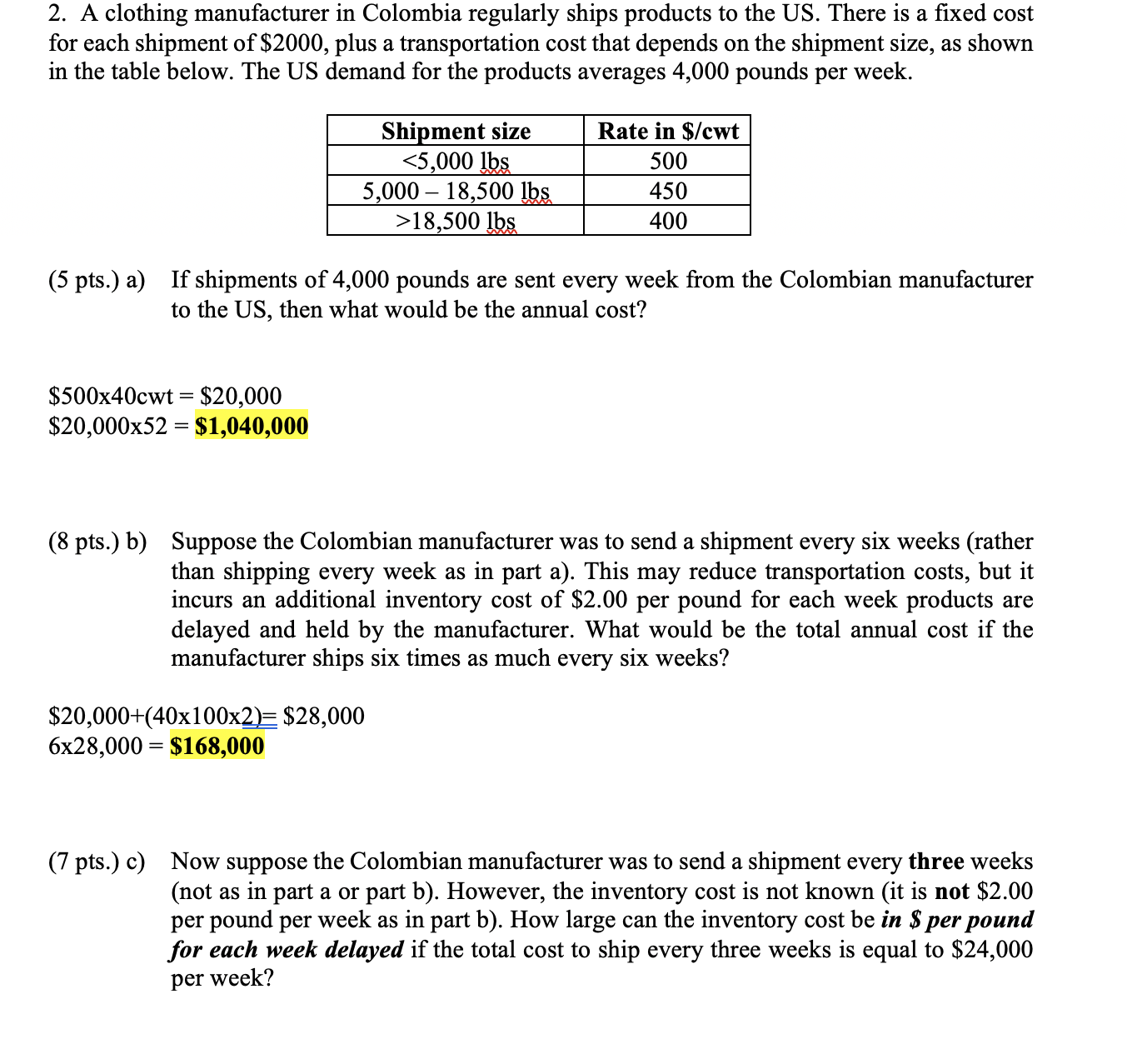
Slide Call to ActionA clothing manufacturer in Colombia regularly ships products to the US There is a fixed cost
for each shipment of $ plus a transportation cost that depends on the shipment size, as shown
in the table below. The US demand for the products averages pounds per week.
pts a If shipments of pounds are sent every week from the Colombian manufacturer
to the US then what would be the annual cost?
$$
$$
pts b Suppose the Colombian manufacturer was to send a shipment every six weeks rather
than shipping every week as in part a This may reduce transportation costs, but it
incurs an additional inventory cost of $
Step by Step Solution
There are 3 Steps involved in it
1 Expert Approved Answer
Step: 1 Unlock

Question Has Been Solved by an Expert!
Get step-by-step solutions from verified subject matter experts
Step: 2 Unlock
Step: 3 Unlock
 Study Help