







Question: = The finite difference tridiagonal matrix A is a persymmetric matrix, which is a matrix that is symmetric about both diagonals, i.e., dij aji =
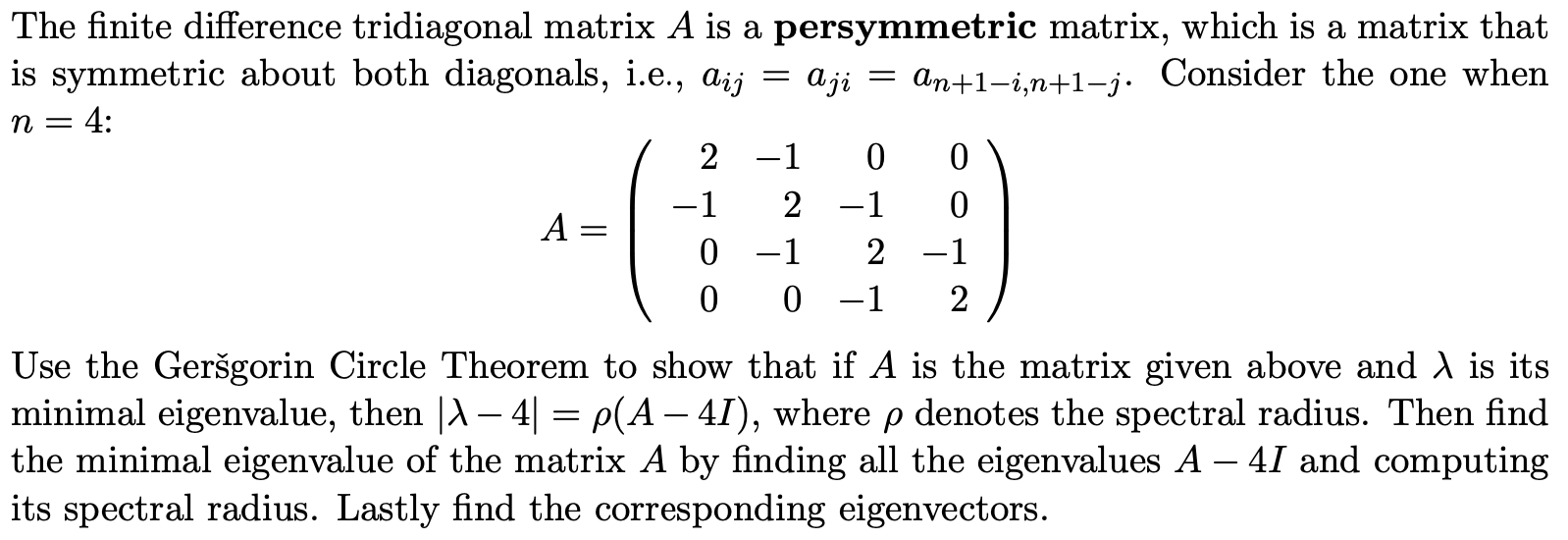
= The finite difference tridiagonal matrix A is a persymmetric matrix, which is a matrix that is symmetric about both diagonals, i.e., dij aji = An+1-i,n+1-j. Consider the one when n = 4: 2 -1 0 0 -1 2 -1 0 A= 0 -1 2 -1 0 0 -1 2 Use the Gergorin Circle Theorem to show that if A is the matrix given above and is its minimal eigenvalue, then 1-4 = P(A - 41), where p denotes the spectral radius. Then find the minimal eigenvalue of the matrix A by finding all the eigenvalues A 41 and computing its spectral radius. Lastly find the corresponding eigenvectors. = The finite difference tridiagonal matrix A is a persymmetric matrix, which is a matrix that is symmetric about both diagonals, i.e., dij aji = An+1-i,n+1-j. Consider the one when n = 4: 2 -1 0 0 -1 2 -1 0 A= 0 -1 2 -1 0 0 -1 2 Use the Gergorin Circle Theorem to show that if A is the matrix given above and is its minimal eigenvalue, then 1-4 = P(A - 41), where p denotes the spectral radius. Then find the minimal eigenvalue of the matrix A by finding all the eigenvalues A 41 and computing its spectral radius. Lastly find the corresponding eigenvectors
Step by Step Solution
There are 3 Steps involved in it

Get step-by-step solutions from verified subject matter experts
 Study Help