







Question: the firm i chose was Microsoft. how would i do section. IV Market analysis? Netflix Welcome, Tatiana ... Inbox (86) - tatisn1... Inbox - tatinicoole...
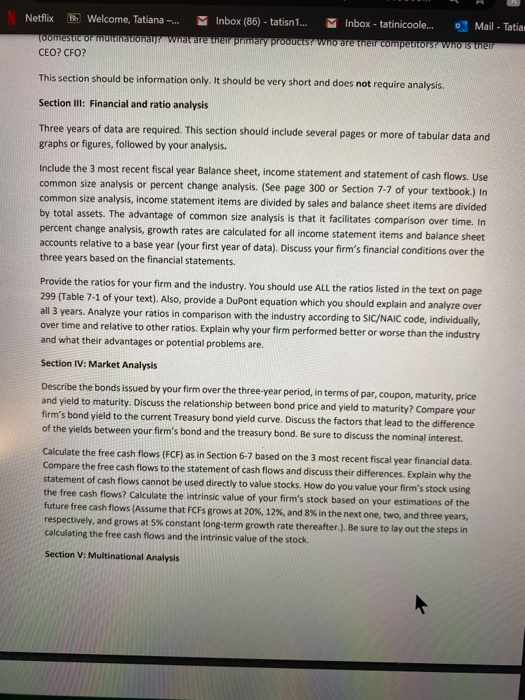
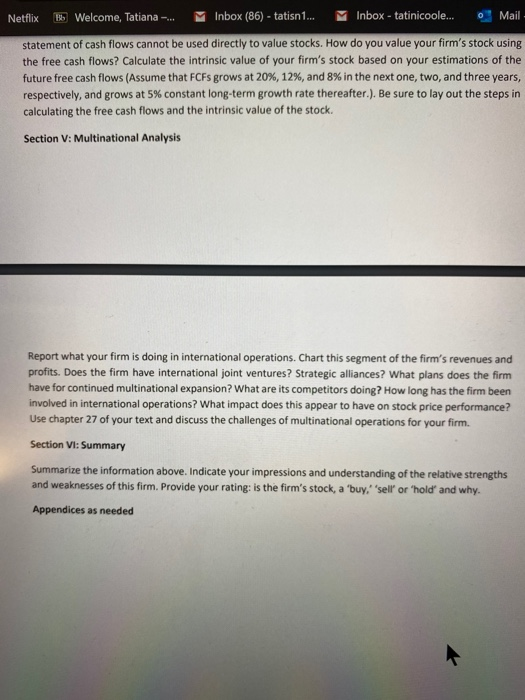
Netflix Welcome, Tatiana ... Inbox (86) - tatisn1... Inbox - tatinicoole... O Mail - Tatial (Womestic or multinationalt what are their primary prodUST Who are their comped OTS? Who is their CEO? CFO? This section should be information only. It should be very short and does not require analysis. Section Ill: Financial and ratio analysis Three years of data are required. This section should include several pages or more of tabular data and graphs or figures, followed by your analysis. Include the 3 most recent fiscal year Balance sheet, income statement and statement of cash flows. Use common size analysis or percent change analysis. (See page 300 or Section 7-7 of your textbook.) in common size analysis, income statement items are divided by sales and balance sheet items are divided by total assets. The advantage of common size analysis is that it facilitates comparison over time. In percent change analysis, growth rates are calculated for all income statement items and balance sheet accounts relative to a base year (your first year of data). Discuss your firm's financial conditions over the three years based on the financial statements. Provide the ratios for your firm and the industry. You should use ALL the ratios listed in the text on page 299 (Table 7-1 of your text). Also, provide a DuPont equation which you should explain and analyze over all 3 years. Analyze your ratios in comparison with the industry according to SIC/NAIC code, individually, over time and relative to other ratios. Explain why your firm performed better or worse than the industry and what their advantages or potential problems are. Section IV: Market Analysis Describe the bonds issued by your firm over the three-year period, in terms of par,coupon, maturity, price and yield to maturity. Discuss the relationship between bond price and yield to maturity? Compare your firm's bond yield to the current Treasury bond yield curve. Discuss the factors that lead to the difference of the yields between your firm's bond and the treasury bond. Be sure to discuss the nominal interest. Calculate the free cash flows (FCF) as in Section 6-7 based on the 3 most recent fiscal year financial data. Compare the free cash flows to the statement of cash flows and discuss their differences. Explain why the statement of cash flows cannot be used directly to value stocks. How do you value your firm's stock using the free cash flows? Calculate the intrinsic value of your firm's stock based on your estimations of the future free cash flows (Assume that FCEs grows at 20%, 12%, and 8% in the next one, two, and three years, respectively, and grows at 5% constant long-term growth rate thereafter.). Be sure to lay out the steps in calculating the free cash flows and the intrinsic value of the stock. Section V: Multinational Analysis Mail Netflix Bo Welcome, Tatiana -... Inbox (86) - tatisn1... Inbox - tatinicoole... statement of cash flows cannot be used directly to value stocks. How do you value your firm's stock using the free cash flows? Calculate the intrinsic value of your firm's stock based on your estimations of the future free cash flows (Assume that FCFs grows at 20%, 12%, and 8% in the next one, two, and three years, respectively, and grows at 5% constant long-term growth rate thereafter.). Be sure to lay out the steps in calculating the free cash flows and the intrinsic value of the stock. Section V: Multinational Analysis Report what your firm is doing in international operations. Chart this segment of the firm's revenues and profits. Does the firm have international joint ventures? Strategic alliances? What plans does the firm have for continued multinational expansion? What are its competitors doing? How long has the firm been involved in international operations? What impact does this appear to have on stock price performance? Use chapter 27 of your text and discuss the challenges of multinational operations for your firm. Section VI: Summary Summarize the information above. Indicate your impressions and understanding of the relative strengths and weaknesses of this firm. Provide your rating: is the firm's stock, a 'buy.' 'sell' or 'hold' and why. Appendices as needed Netflix Welcome, Tatiana ... Inbox (86) - tatisn1... Inbox - tatinicoole... O Mail - Tatial (Womestic or multinationalt what are their primary prodUST Who are their comped OTS? Who is their CEO? CFO? This section should be information only. It should be very short and does not require analysis. Section Ill: Financial and ratio analysis Three years of data are required. This section should include several pages or more of tabular data and graphs or figures, followed by your analysis. Include the 3 most recent fiscal year Balance sheet, income statement and statement of cash flows. Use common size analysis or percent change analysis. (See page 300 or Section 7-7 of your textbook.) in common size analysis, income statement items are divided by sales and balance sheet items are divided by total assets. The advantage of common size analysis is that it facilitates comparison over time. In percent change analysis, growth rates are calculated for all income statement items and balance sheet accounts relative to a base year (your first year of data). Discuss your firm's financial conditions over the three years based on the financial statements. Provide the ratios for your firm and the industry. You should use ALL the ratios listed in the text on page 299 (Table 7-1 of your text). Also, provide a DuPont equation which you should explain and analyze over all 3 years. Analyze your ratios in comparison with the industry according to SIC/NAIC code, individually, over time and relative to other ratios. Explain why your firm performed better or worse than the industry and what their advantages or potential problems are. Section IV: Market Analysis Describe the bonds issued by your firm over the three-year period, in terms of par,coupon, maturity, price and yield to maturity. Discuss the relationship between bond price and yield to maturity? Compare your firm's bond yield to the current Treasury bond yield curve. Discuss the factors that lead to the difference of the yields between your firm's bond and the treasury bond. Be sure to discuss the nominal interest. Calculate the free cash flows (FCF) as in Section 6-7 based on the 3 most recent fiscal year financial data. Compare the free cash flows to the statement of cash flows and discuss their differences. Explain why the statement of cash flows cannot be used directly to value stocks. How do you value your firm's stock using the free cash flows? Calculate the intrinsic value of your firm's stock based on your estimations of the future free cash flows (Assume that FCEs grows at 20%, 12%, and 8% in the next one, two, and three years, respectively, and grows at 5% constant long-term growth rate thereafter.). Be sure to lay out the steps in calculating the free cash flows and the intrinsic value of the stock. Section V: Multinational Analysis Mail Netflix Bo Welcome, Tatiana -... Inbox (86) - tatisn1... Inbox - tatinicoole... statement of cash flows cannot be used directly to value stocks. How do you value your firm's stock using the free cash flows? Calculate the intrinsic value of your firm's stock based on your estimations of the future free cash flows (Assume that FCFs grows at 20%, 12%, and 8% in the next one, two, and three years, respectively, and grows at 5% constant long-term growth rate thereafter.). Be sure to lay out the steps in calculating the free cash flows and the intrinsic value of the stock. Section V: Multinational Analysis Report what your firm is doing in international operations. Chart this segment of the firm's revenues and profits. Does the firm have international joint ventures? Strategic alliances? What plans does the firm have for continued multinational expansion? What are its competitors doing? How long has the firm been involved in international operations? What impact does this appear to have on stock price performance? Use chapter 27 of your text and discuss the challenges of multinational operations for your firm. Section VI: Summary Summarize the information above. Indicate your impressions and understanding of the relative strengths and weaknesses of this firm. Provide your rating: is the firm's stock, a 'buy.' 'sell' or 'hold' and why. Appendices as needed
Step by Step Solution
There are 3 Steps involved in it

Get step-by-step solutions from verified subject matter experts
 Study Help