







Question: The first 2 questions refer to this C/C++ code fragment: inti=1;intj=2;f(i,i,j); Function is defined as: void f( int x, int y, int z){ x=3; z=y;
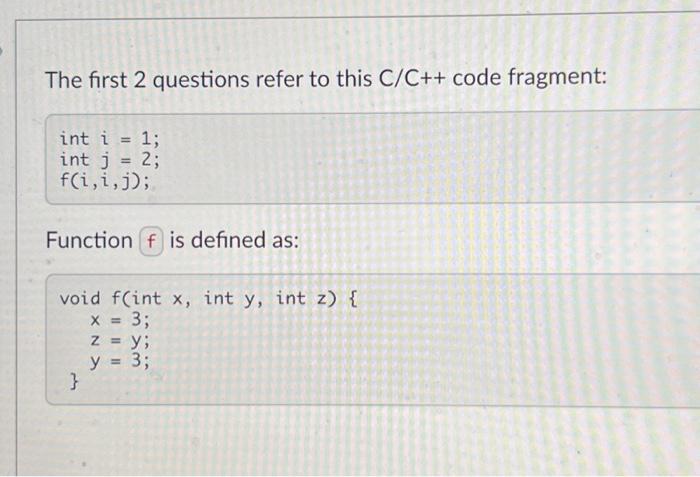
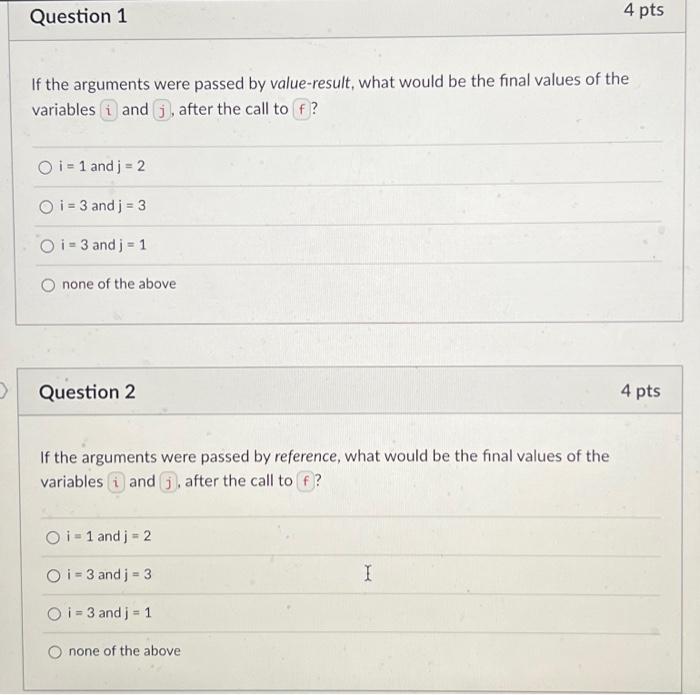
The first 2 questions refer to this C/C++ code fragment: inti=1;intj=2;f(i,i,j); Function is defined as: void f( int x, int y, int z){ x=3; z=y; y=3; \} If the arguments were passed by value-result, what would be the final values of the variables i and after the call to f ? i=1andj=2i=3andj=3i=3andj=1 none of the above Question 2 4 pts If the arguments were passed by reference, what would be the final values of the variables i and after the call to ? i=1andj=2i=3andj=3i=3andj=1 none of the above
Step by Step Solution
There are 3 Steps involved in it
1 Expert Approved Answer
Step: 1 Unlock

Question Has Been Solved by an Expert!
Get step-by-step solutions from verified subject matter experts
Step: 2 Unlock
Step: 3 Unlock
 Study Help