







Question: The first five pages is the case study and the last pages is the questions to the case study SECTION 2 - All questions are
The first five pages is the case study and the last pages is the questions to the case study 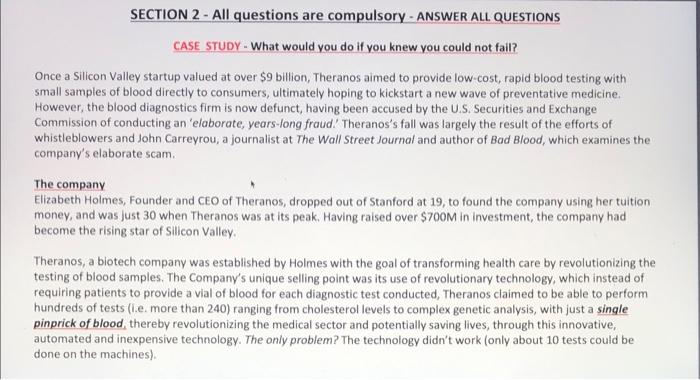
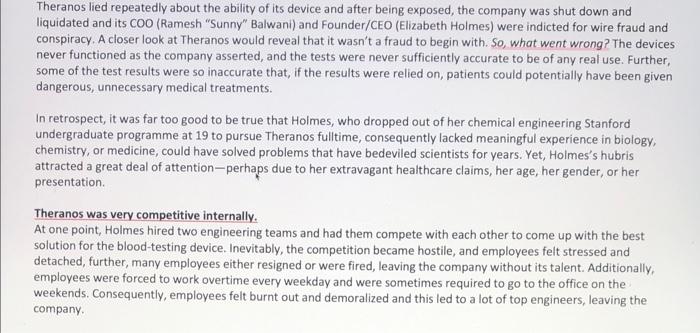
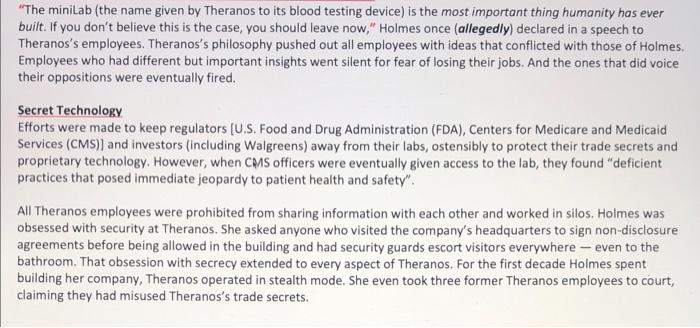
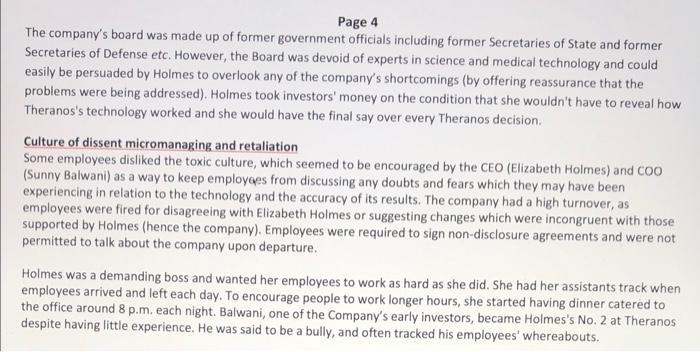
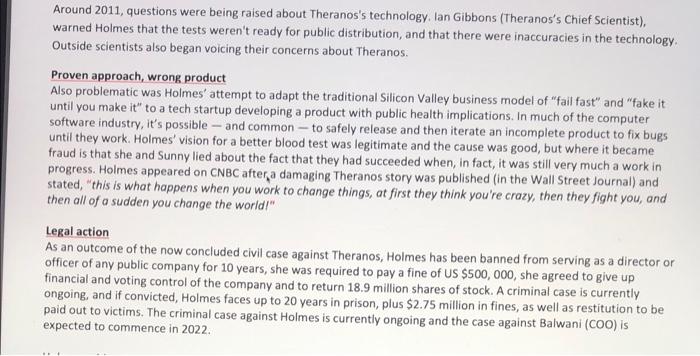
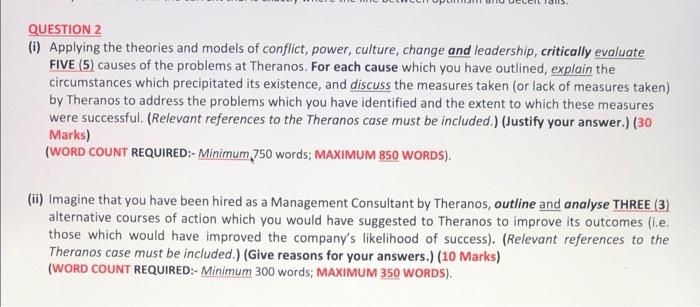
SECTION 2 - All questions are compulsory - ANSWER ALL QUESTIONS CASE STUDY. What would you do if you knew you could not fail? Once a Silicon Valley startup valued at over $9 billion, Theranos aimed to provide low-cost, rapid blood testing with small samples of blood directly to consumers, ultimately hoping to kickstart a new wave of preventative medicine. However, the blood diagnostics firm is now defunct, having been accused by the U.S. Securities and Exchange Commission of conducting an 'elaborate, years-long fraud! Theranos's fall was largely the result of the efforts of whistleblowers and John Carreyrou, a journalist at The Wall Street Journal and author of Bad Blood, which examines the company's elaborate scam. The company Elizabeth Holmes, Founder and CEO of Theranos, dropped out of Stanford at 19, to found the company using her tuition money, and was just 30 when Theranos was at its peak. Having raised over $700M in investment, the company had become the rising star of Silicon Valley Theranos, a biotech company was established by Holmes with the goal of transforming health care by revolutionizing the testing of blood samples. The Company's unique selling point was its use of revolutionary technology, which instead of requiring patients to provide a vial of blood for each diagnostic test conducted, Theranos claimed to be able to perform hundreds of tests (le more than 240) ranging from cholesterol levels to complex genetic analysis, with just a single pinprick of blood thereby revolutionizing the medical sector and potentially saving lives, through this innovative, automated and inexpensive technology. The only problem? The technology didn't work (only about 10 tests could be done on the machines). Theranos lied repeatedly about the ability of its device and after being exposed, the company was shut down and liquidated and its COO (Ramesh "Sunny" Balwani) and Founder/CEO (Elizabeth Holmes) were indicted for wire fraud and conspiracy. A closer look at Theranos would reveal that it wasn't a fraud to begin with. So, what went wrong? The devices never functioned as the company asserted, and the tests were never sufficiently accurate to be of any real use. Further, some of the test results were so inaccurate that, if the results were relied on patients could potentially have been given dangerous, unnecessary medical treatments. In retrospect, it was far too good to be true that Holmes, who dropped out of her chemical engineering Stanford undergraduate programme at 19 to pursue Theranos fulltime, consequently lacked meaningful experience in biology, chemistry, or medicine, could have solved problems that have bedeviled scientists for years. Yet, Holmes's hubris attracted a great deal of attention-perhaps due to her extravagant healthcare claims, her age, her gender, or her presentation Theranos was very competitive internally. At one point, Holmes hired two engineering teams and had them compete with each other to come up with the best solution for the blood-testing device. Inevitably, the competition became hostile, and employees felt stressed and detached, further, many employees either resigned or were fired, leaving the company without its talent. Additionally, employees were forced to work overtime every weekday and were sometimes required to go to the office on the weekends. Consequently, employees felt burnt out and demoralized and this led to a lot of top engineers, leaving the company "The minilab (the name given by Theranos to its blood testing device) is the most important thing humanity has ever built. If you don't believe this is the case, you should leave now," Holmes once (allegedly) declared in a speech to Theranos's employees. Theranos's philosophy pushed out all employees with ideas that conflicted with those of Holmes. Employees who had different but important insights went silent for fear of losing their jobs. And the ones that did voice their oppositions were eventually fired. Secret Technology Efforts were made to keep regulators (U.S. Food and Drug Administration (FDA), Centers for Medicare and Medicaid Services (CMS)) and investors (including Walgreens) away from their labs, ostensibly to protect their trade secrets and proprietary technology. However, when CMAS officers were eventually given access to the lab, they found "deficient practices that posed immediate jeopardy to patient health and safety". All Theranos employees were prohibited from sharing information with each other and worked in silos, Holmes was obsessed with security at Theranos. She asked anyone who visited the company's headquarters to sign non-disclosure agreements before being allowed in the building and had security guards escort visitors everywhere - even to the bathroom. That obsession with secrecy extended to every aspect of Theranos. For the first decade Holmes spent building her company, Theranos operated in stealth mode. She even took three former Theranos employees to court, claiming they had misused Theranos's trade secrets. Page 4 The company's board was made up of former government officials including former Secretaries of State and former Secretaries of Defense etc. However, the Board was devoid of experts in science and medical technology and could easily be persuaded by Holmes to overlook any of the company's shortcomings (by offering reassurance that the problems were being addressed). Holmes took investors' money on the condition that she wouldn't have to reveal how Theranos's technology worked and she would have the final say over every Theranos decision Culture of dissent micromanaging and retaliation Some employees disliked the toxic culture, which seemed to be encouraged by the CEO (Elizabeth Holmes) and COO (Sunny Balwani) as a way to keep employees from discussing any doubts and fears which they may have been experiencing in relation to the technology and the accuracy of its results. The company had a high turnover, as employees were fired for disagreeing with Elizabeth Holmes or suggesting changes which were incongruent with those supported by Holmes (hence the company). Employees were required to sign non-disclosure agreements and were not permitted to talk about the company upon departure. Holmes was a demanding boss and wanted her employees to work as hard as she did. She had her assistants track when employees arrived and left each day. To encourage people to work longer hours, she started having dinner catered to the office around 8 p.m. each night. Balwani, one of the Company's early investors, became Holmes's No. 2 at Theranos despite having little experience. He was said to be a bully, and often tracked his employees' whereabouts, a Around 2011, questions were being raised about Theranos's technology, lan Gibbons (Theranos's Chief Scientist), warned Holmes that the tests weren't ready for public distribution, and that there were inaccuracies in the technology Outside scientists also began voicing their concerns about Theranos Proven approach, wrong product Also problematic was Holmes' attempt to adapt the traditional Silicon Valley business model of "fail fast" and "fake it until you make it to a tech startup developing a product with public health implications. In much of the computer software industry, it's possible - and common - to safely release and then iterate an incomplete product to fix bugs until they work. Holmes' vision for a better blood test was legitimate and the cause was good, but where it became fraud is that she and Sunny lied about the fact that they had succeeded when, in fact, it was still very much a work in progress. Holmes appeared on CNBC after a damaging Theranos story was published in the Wall Street Journal) and stated, "this is what happens when you work to change things, at first they think you're crazy, then they fight you, and then all of a sudden you change the world!" Legal action As an outcome of the now concluded civil case against Theranos, Holmes has been banned from serving as a director or officer of any public company for 10 years, she was required to pay a fine of US $500,000, she agreed to give up financial and voting control of the company and to return 18.9 million shares of stock. A criminal case is currently ongoing, and if convicted, Holmes faces up to 20 years in prison, plus $2.75 million in fines, as well as restitution to be paid out to victims. The criminal case against Holmes is currently ongoing and the case against Balwani (COO) is expected to commence in 2022. QUESTION 2 0) Applying the theories and models of conflict, power, culture, change and leadership, critically evaluate FIVE (5) causes of the problems at Theranos. For each cause which you have outlined, explain the circumstances which precipitated its existence, and discuss the measures taken (or lack of measures taken) by Theranos to address the problems which you have identified and the extent to which these measures were successful. (Relevant references to the Theranos case must be included.) (Justify your answer.) (30 Marks) (WORD COUNT REQUIRED:- Minimum 750 words; MAXIMUM 850 WORDS). (ii) Imagine that you have been hired as a Management Consultant by Theranos, outline and analyse THREE (3) alternative courses of action which you would have suggested to Theranos to improve its outcomes (i.e. those which would have improved the company's likelihood of success). (Relevant references to the Theranos case must be included.) (Give reasons for your answers.) (10 Marks) (WORD COUNT REQUIRED:- Minimum 300 words; MAXIMUM 350 WORDS) Step by Step Solution
There are 3 Steps involved in it
1 Expert Approved Answer
Step: 1 Unlock

Question Has Been Solved by an Expert!
Get step-by-step solutions from verified subject matter experts
Step: 2 Unlock
Step: 3 Unlock
 Study Help