







Question: the first one is wrong so don't do it, I post it to let you see the steps. so they should be only one question.
the first one is wrong so don't do it, I post it to let you see the steps. so they should be only one question.
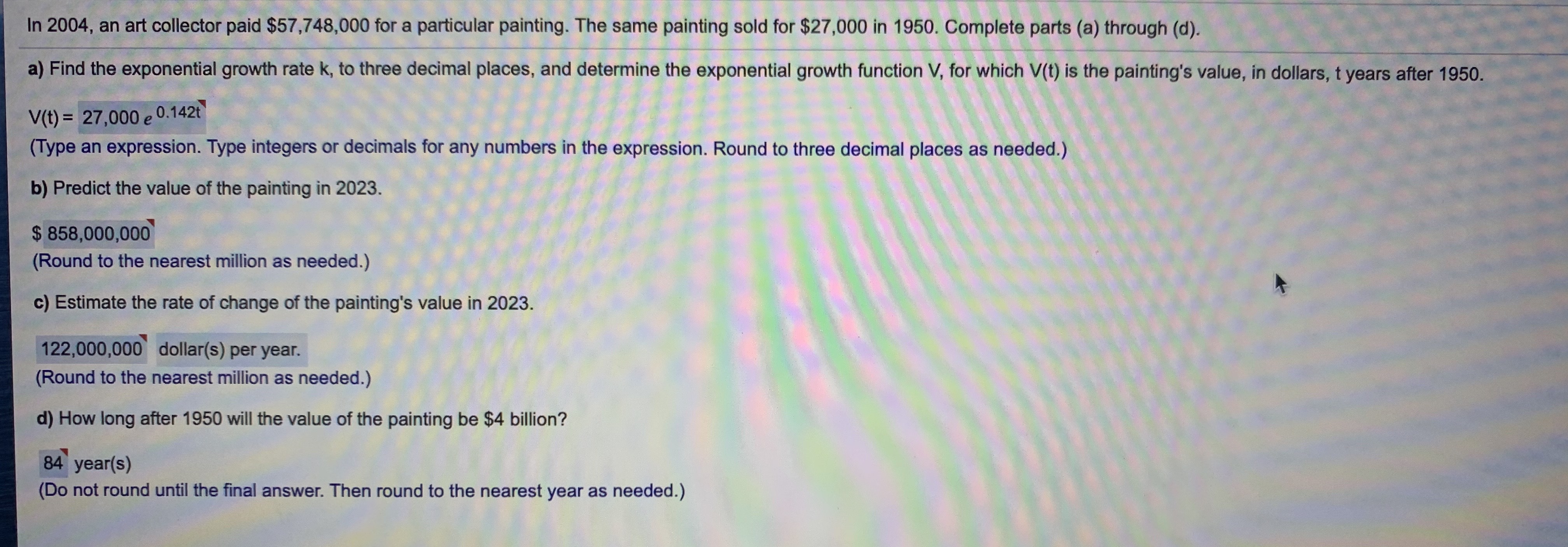

In 2004, an art collector paid $57,748,000 for a particular painting. The same painting sold for $27,000 in 1950. Complete parts (a) through (d). a) Find the exponential growth rate k, to three decimal places, and determine the exponential growth function V, for which V(t) is the painting's value, in dollars, t years after 1950. V(t) = 27,000 e 0.142t (Type an expression. Type integers or decimals for any numbers in the expression. Round to three decimal places as needed.) b) Predict the value of the painting in 2023. $ 858,000,000 (Round to the nearest million as needed.) K c) Estimate the rate of change of the painting's value in 2023. 122,000,000 dollar(s) per year. (Round to the nearest million as needed.) d) How long after 1950 will the value of the painting be $4 billion? 84 year (s) (Do not round until the final answer. Then round to the nearest year as needed.)In 2004, an art collector paid $134,619,000 for a particular painting. The same painting sold for $28,000 in 1950. Complete parts (a) through (d). a) Find the exponential growth rate k, to three decimal places, and determine the exponential growth function V, for which V(t) is the painting's value, in dollars, t years after 1950. V(t) = (Type an expression. Type integers or decimals for any numbers in the expression. Round to three decimal places as needed.)
Step by Step Solution
There are 3 Steps involved in it

Get step-by-step solutions from verified subject matter experts
 Study Help