







Question: The first project is designed to help students understand the fundamental concepts in project scheduling within the context of a comprehensive real-world problem using manual
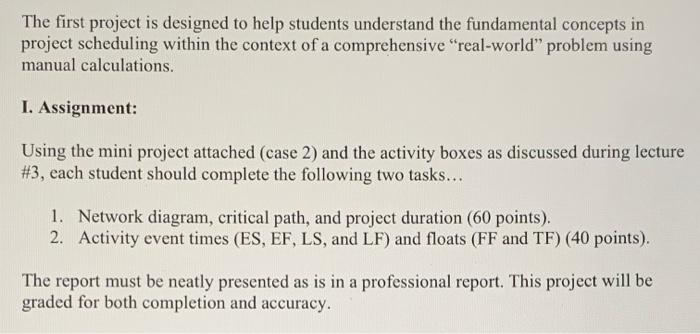
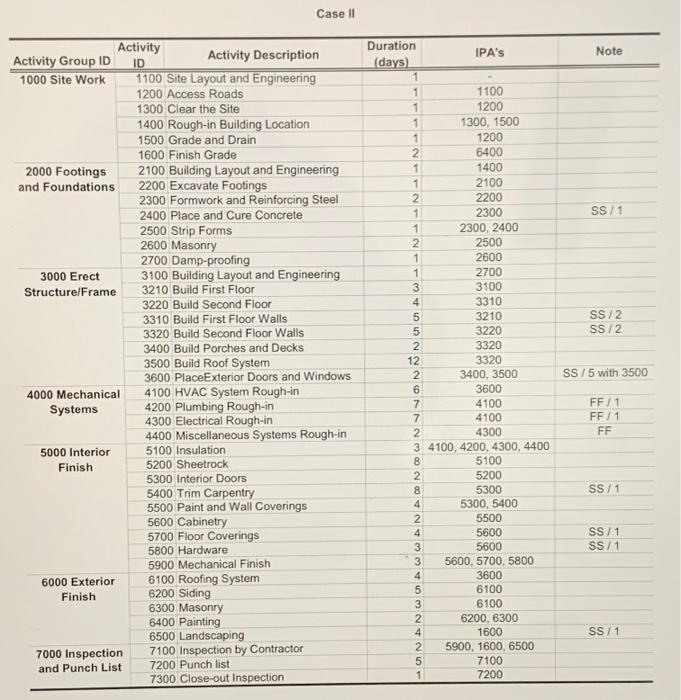
The first project is designed to help students understand the fundamental concepts in project scheduling within the context of a comprehensive "real-world" problem using manual calculations. 1. Assignment: Using the mini project attached (case 2) and the activity boxes as discussed during lecture #3, each student should complete the following two tasks... 1. Network diagram, critical path, and project duration (60 points). 2. Activity event times (ES, EF, LS, and LF) and floats (FF and TF) (40 points). The report must be neatly presented as is in a professional report. This project will be graded for both completion and accuracy. Case II Note SS/ 1 SS12 SS/2 Activity Activity Group ID Activity Description ID 1000 Site Work 1100 Site Layout and Engineering 1200 Access Roads 1300 Clear the Site 1400 Rough-in Building Location 1500 Grade and Drain 1600 Finish Grade 2000 Footings 2100 Building Layout and Engineering and Foundations 2200 Excavate Footings 2300 Formwork and Reinforcing Steel 2400 Place and Cure Concrete 2500 Strip Forms 2600 Masonry 2700 Damp-proofing 3000 Erect 3100 Building Layout and Engineering Structure/Frame 3210 Build First Floor 3220 Build Second Floor 3310 Build First Floor Walls 3320 Build Second Floor Walls 3400 Build Porches and Decks 3500 Build Roof System 3600 PlaceExterior Doors and Windows 4000 Mechanical 4100 HVAC System Rough-in Systems 4200 Plumbing Rough-in 4300 Electrical Rough-in 4400 Miscellaneous Systems Rough-in 5000 Interior 5100 Insulation Finish 5200 Sheetrock 5300 Interior Doors 5400 Trim Carpentry 5500 Paint and Wall Coverings 5600 Cabinetry 5700 Floor Coverings 5800 Hardware 5900 Mechanical Finish 6000 Exterior 6100 Roofing System Finish 6200 Siding 6300 Masonry 6400 Painting 6500 Landscaping 7000 Inspection 7100 Inspection by contractor and Punch List 7200 Punch list 7300 Close-out Inspection Duration IPA's (days) 1 1 1100 1 1200 1 1300, 1500 1 1200 2 6400 1 1400 1 2100 2 2200 1 2300 1 2300, 2400 2 2500 1 2600 1 2700 3 3100 4 3310 5 3210 5 3220 2 3320 12 3320 2 3400, 3500 6 3600 7 4100 7 4100 2 4300 3 4100, 4200, 4300, 4400 8 5100 2 5200 8 5300 4 5300, 5400 2 5500 4 5600 3 5600 3 5600, 5700, 5800 4 3600 5 6100 3 6100 2 6200, 6300 4 1600 2 5900, 1600, 6500 5 7100 1 7200 SS/5 with 3500 FF/1 FF / 1 FF SS/1 SS / 1 SS/ 1 SS / 1
Step by Step Solution
There are 3 Steps involved in it

Get step-by-step solutions from verified subject matter experts
 Study Help