







Question: The first two select options are: -Neither -Project A -Project B -Both projects A and B The third select options are: Yes or No The
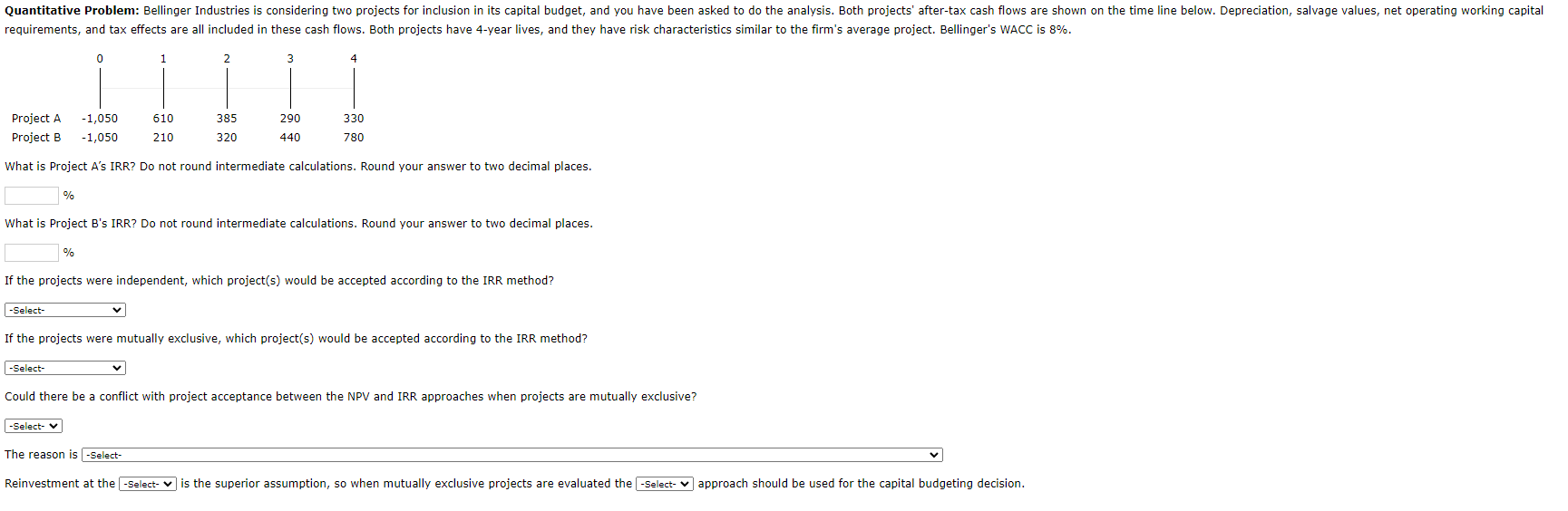 The first two select options are: -Neither -Project A -Project B -Both projects A and B
The third select options are: Yes or No
The fourth select options are:
- the NPV and IRR approaches use the same reinvestment rate assumption and so both approaches reach the same projct acceptance when mutually exclusive projects are considered.
-the NPV and IRR approaches use different reinvestment rate assumption and so there can be a conflict in project acceptance when mutally exclusive projects are considered.
The last two select answer choices are:
Last first options: -IRR -WACC
Last second options: -NPV -IRR
What is Project A's IRR? Do not round intermediate calculations. Round your answer to two decimal places. What is Project B's IRR? Do not round intermediate calculations. Round your answer to two decimal places. If the projects were independent, which project(s) would be accepted according to the IRR method? If the projects were mutually exclusive, which project(s) would be accepted according to the IRR method? Could there be a conflict with project acceptance between the NPV and IRR approaches when projects are mutually exclusive? The reason is - -Select- Reinvestment at the is the superior assumption, so when mutually exclusive projects are evaluated the | approach should be used for the capital budgeting decision
Step by Step Solution
There are 3 Steps involved in it

Get step-by-step solutions from verified subject matter experts
 Study Help