Question: The flowchart is developed with all the data given and initial analysis is provided. Potential admits 10% Registration Buffer 2 Doctor Buffer 1 R55/hu -20-201
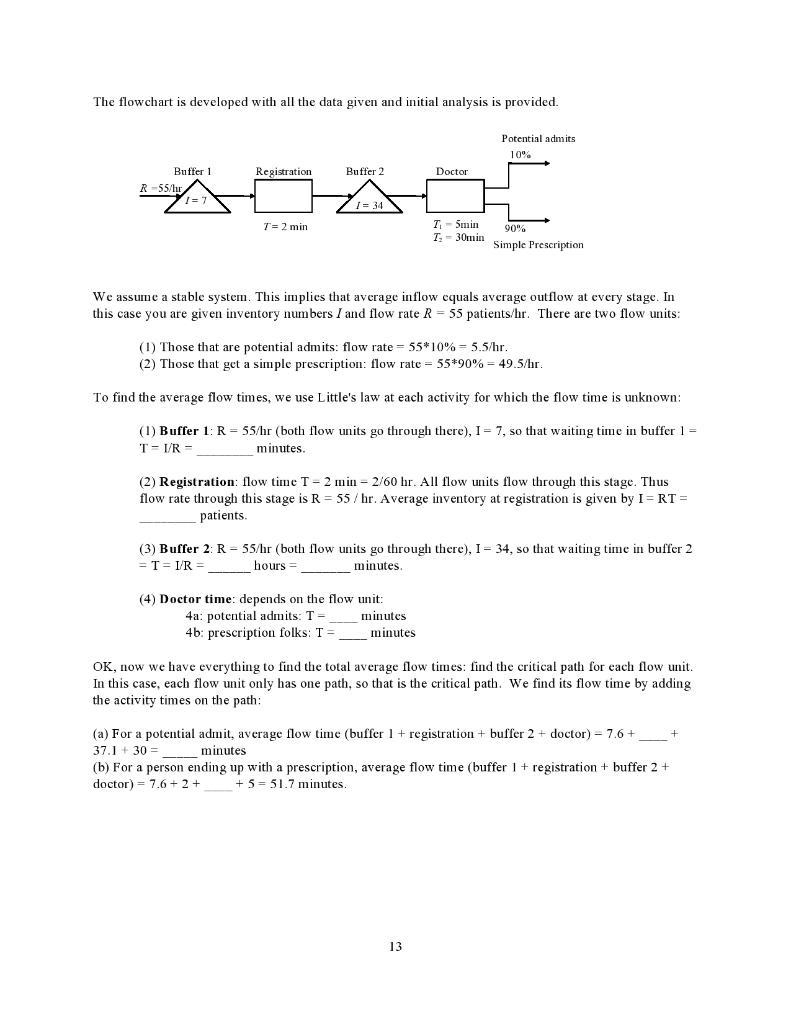
The flowchart is developed with all the data given and initial analysis is provided. Potential admits 10% Registration Buffer 2 Doctor Buffer 1 R55/hu -20-201 I = 34 T= 2 min T-5min 90 T: - 30min Simple Prescription We assume a stable system. This implies that average inflow equals average outflow at every stage. In this case you are given inventory numbers I and flow rate R = 55 patients/hr. There are two flow units: (1) Those that are potential admits: flow rate= 55*10% = 5.5/hr. (2) Those that get a simple prescription: flow rate = 55+90% = 49.5/hr To find the average flow times, we use Little's law at each activity for which the flow time is unknown: (1) Buffer 1: R = 55/hr (both flow units go through there), I = 7, so that waiting time in buffer 1 = T-IR- minutes. (2) Registration: flow time T-2 min - 2/60 hr. All flow units flow through this stage. Thus flow rate through this stage is R = 55/hr. Average inventory at registration is given by 1 = RT = patients (3) Buffer 2: R - 55/hr (both flow units go through there), I = 34, so that waiting time in buffer 2 = T = IR minutes hours (4) Doctor time: depends on the flow unit: 4a: potential admits: T = minutes 4b: prescription folks: T = minutes OK, now we have everything to find the total average flow times: find the critical path for each flow unit. In this case, each flow unit only has one path, so that is the critical path. We find its flow time by adding the activity times on the path: + (a) For a potential admit, average flow time (buffer 1 + registration + buffer 2 + doctor) = 7.6+ 37.1 + 30 minutes (b) For a person ending up with a prescription, average flow time (buffer 1 + registration + buffer 2 + doctor) = 7.6 + 2 + 5 = 51.7 minutes. 13 14 Chapter 3 The answer to the other questions is found as follows: 1. On average, how long does a patient spend in the emergency room?Use weighted average on two types of flow unit. 2. On average, how many patients are being examined by a doctor? This question asks for the average inventory at the doctor's activity. Again, first calculate inventory of cach type of flow unit: (a) Potential admits: R= patients/hr, T= hr, thus, I = RT = patients (b) Simple prescription: R patients/hr, T = min hr, thus I =RT = patients Thus, total inventory at the doctor is patients. min= 3. On average, how many patients are in the ER? This question asks for total inventory in ER = inventory in buffer 1 + inventory in registration + inventory in buffer 2 + inventory with doctors = patients









 Study Help