







Question: The following code aims to check whether a number is prime and find the total number of prime numbers less than 10,000. However, the
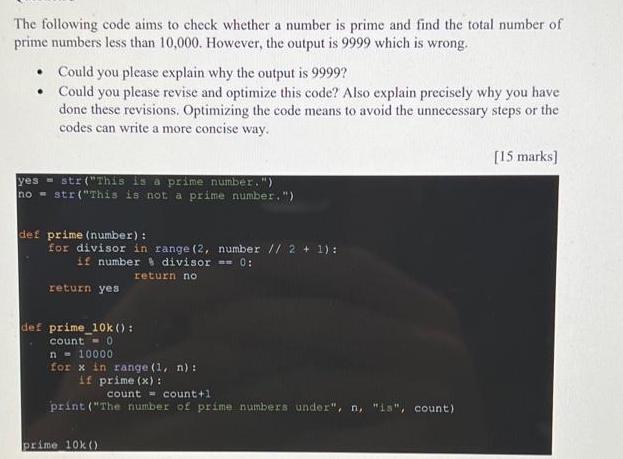
The following code aims to check whether a number is prime and find the total number of prime numbers less than 10,000. However, the output is 9999 which is wrong. Could you please explain why the output is 9999? Could you please revise and optimize this code? Also explain precisely why you have done these revisions. Optimizing the code means to avoid the unnecessary steps or the codes can write a more concise way. yes str("This is a prime number.") nostr("This is not a prime number.") def prime (number): for divisor in range (2, number // 2 + 1): if number divisor == 0: return yes return no def prime_10k (): count = 0 n = 10000 for x in range (1, n): if prime (x): count = count+1 print ("The number of prime numbers under", n, "is", count) prime 10k () [15 marks]
Step by Step Solution
There are 3 Steps involved in it
The code provided has a few issues that are causing incorrect output Here are the problems and the revised code 1 Indentation The code block inside th... View full answer

Get step-by-step solutions from verified subject matter experts
 Study Help