



Question: The following table summarizes cash flows for a project: a. Choose the appropriate expression you need to solve to find the IRR(s) for this set
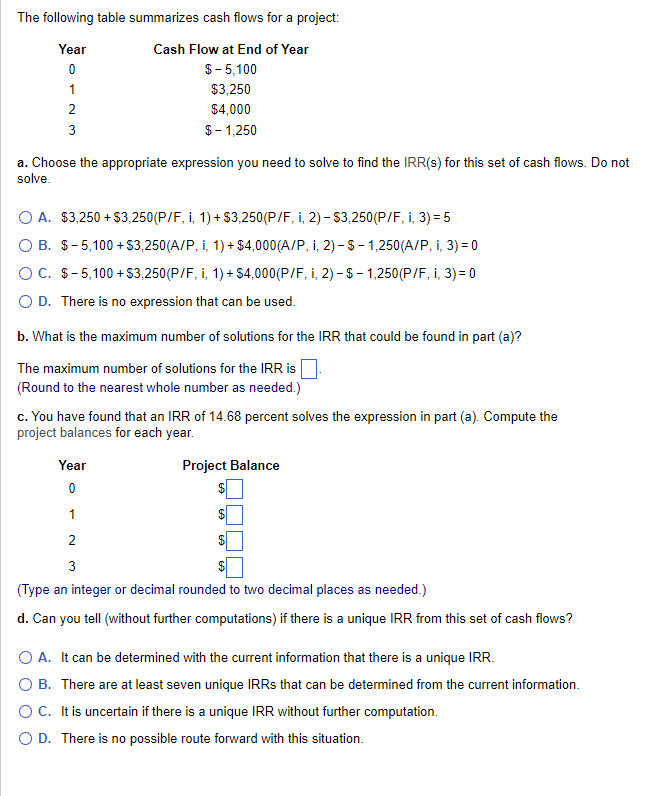
The following table summarizes cash flows for a project: a. Choose the appropriate expression you need to solve to find the IRR(s) for this set of cash flows. Do not solve. A. $3,250+$3,250(P/F,i,1)+$3,250(P/F,i,2)$3,250(P/F,i,3)=5 B. $5,100+$3,250(A/P,i,1)+$4,000(A/P,i,2)$1,250(A/P,i,3)=0 C. $5,100+$3,250(P/F,i,1)+$4,000(P/F,i,2)$1,250(P/F,i,3)=0 D. There is no expression that can be used. b. What is the maximum number of solutions for the IRR that could be found in part (a)? The maximum number of solutions for the IRR is (Round to the nearest whole number as needed.) c. You have found that an IRR of 14.68 percent solves the expression in part (a). Compute the project balances for each year. (Type an integer or decimal rounded to two decimal places as needed.) d. Can you tell (without further computations) if there is a unique IRR from this set of cash flows? A. It can be determined with the current information that there is a unique IRR. B. There are at least seven unique IRRs that can be determined from the current information. C. It is uncertain if there is a unique IRR without further computation. D. There is no possible route forward with this situation
Step by Step Solution
There are 3 Steps involved in it

Get step-by-step solutions from verified subject matter experts