







Question: The following two problems extend the simulation procedure described above and can be solved along the same lines: (a) Show that a waiting time x
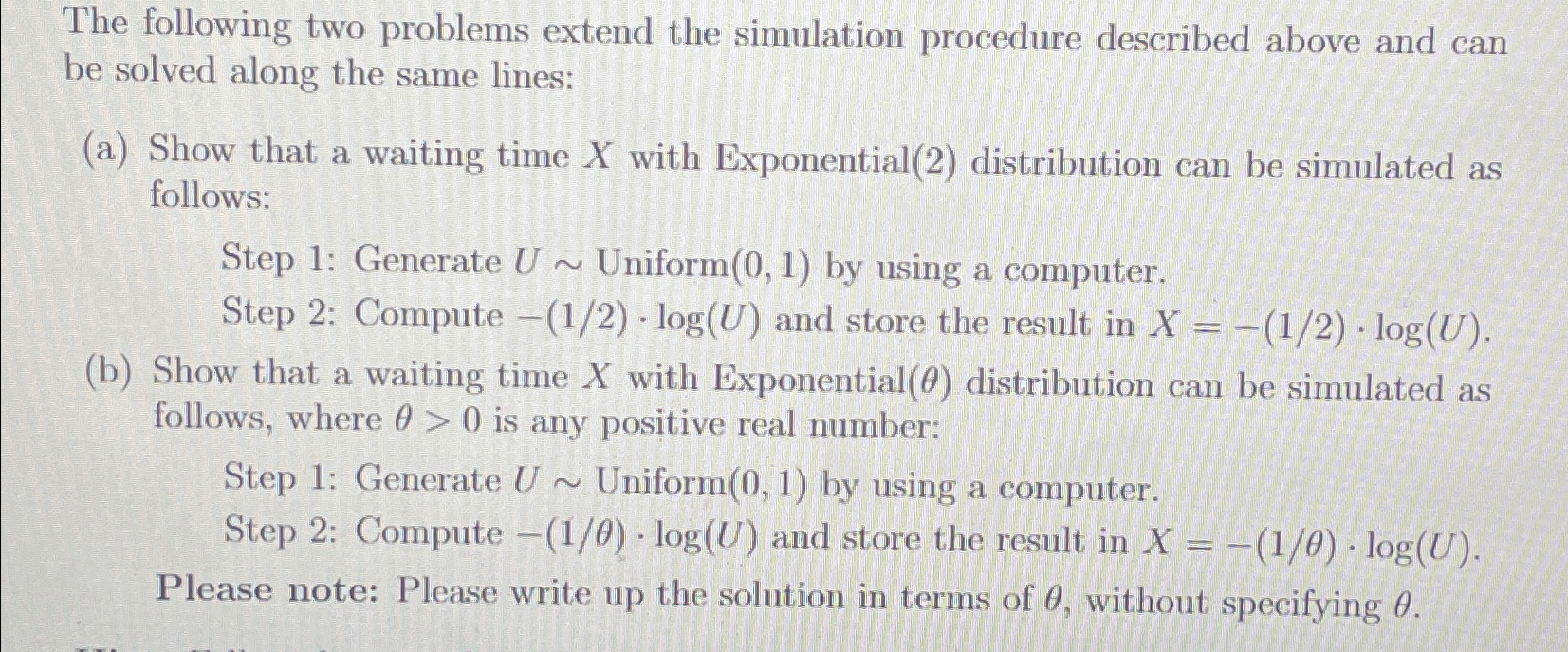
The following two problems extend the simulation procedure described above and can be solved along the same lines:\ (a) Show that a waiting time
xwith Exponential(2) distribution can be simulated as follows:\ Step 1: Generate
UUniform(0,1)by using a computer.\ Step 2: Compute
-((1)/(2))*log(U)and store the result in
x=-((1)/(2))*log(U).\ (b) Show that a waiting time
xwith
Exponential(\\\\theta )distribution can be simulated as follows, where
\\\\theta >0is any positive real number:\ Step 1: Generate
UUniform(0,1)by using a computer.\ Step 2: Compute
-((1)/(\\\\theta ))*log(U)and store the result in
x=-((1)/(\\\\theta ))*log(U). Please note: Please write up the solution in terms of
\\\\theta , without specifying
\\\\theta .
The following two problems extend the simulation procedure described above and can be solved along the same lines: (a) Show that a waiting time X with Exponential(2) distribution can be simulated as follows: Step 1: Generate UUniform(0,1) by using a computer. Step 2: Compute (1/2)log(U) and store the result in X=(1/2)log(U). (b) Show that a waiting time X with Exponential() distribution can be simulated as follows, where >0 is any positive real number: Step 1: Generate UUniform(0,1) by using a computer. Step 2: Compute (1/)log(U) and store the result in X=(1/)log(U). Please note: Please write up the solution in terms of , without specifying
Step by Step Solution
There are 3 Steps involved in it

Get step-by-step solutions from verified subject matter experts
 Study Help