







Question: The force component N B acting perpendicular to the cut, or parallel to the axis of the beam, is called the normal force; the force
The force component acting perpendicular to the cut, or parallel to the axis of the beam, is called the normal force; the force component acting tangentially to the cut, or perpendicular to the axis of the beam, is called the shear force; the couple moment is called the bending moment. The forces and moments acting on the two segments act in opposite directions, as required by Newton's third law, and can be determined by applying the equilibrium equations to the freebody diagram of either segment. Provided the structural member is homogeneous and is not irreversibly deformed, these loadings can be considered to act at the centroid of the member's crosssection. The customary sign conventions are to say the normal force is positive if it creates tension, the shear force is positive if it causes the beam segment to rotate clockwise, and a bending moment is positive if it causes the beam to bend concave upward. Oppositelyacting loadings are considered negative.
Part B Internal Loading on a Semicircular Member
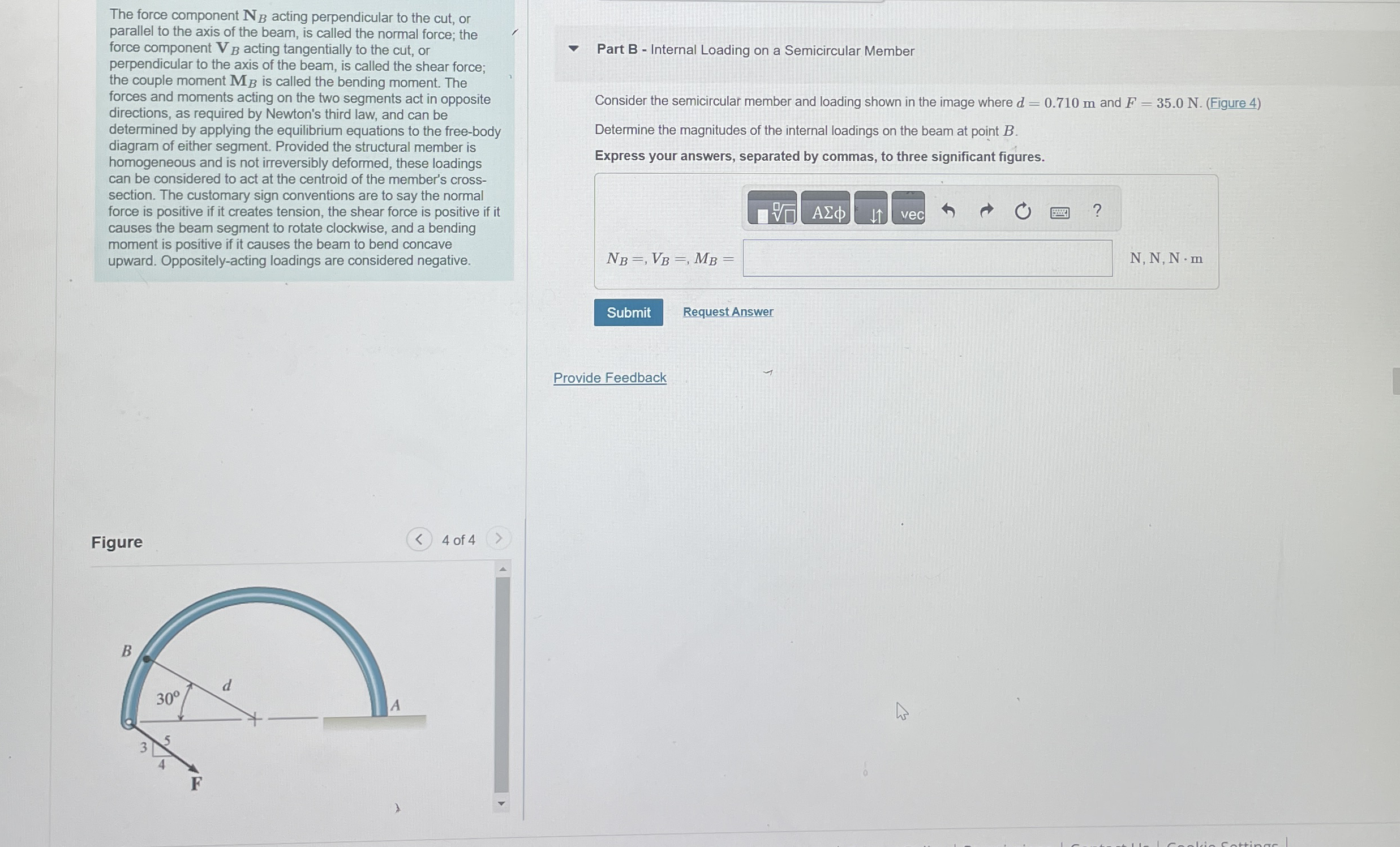
Consider the semicircular member and loading shown in the image where and Figure
Determine the magnitudes of the internal loadings on the beam at point
Express your answers, separated by commas, to three significant figures.
Request Answer
Provide Feedback
Figure
of
Step by Step Solution
There are 3 Steps involved in it
1 Expert Approved Answer
Step: 1 Unlock

Question Has Been Solved by an Expert!
Get step-by-step solutions from verified subject matter experts
Step: 2 Unlock
Step: 3 Unlock
 Study Help