







Question: The formula for finding the amount A n one has to pay periodically ( let ' s just assume it is monthly ) , over
The formula for finding the amount one has to pay periodically lets just assume it is monthly
over months to payoff a debt of dollars and interest rate per period is given by
This is known as the amortization formula. Note that we may assume that and $$dots, For
example consider $ million mortgage the average home price Santa Cruz annual
interest, which corresponds monthly interest. year, month mortgage, would
have a monthly payment about $
another fun exercise for your own amusement, you can figure out how much you'd have make
year pay this mortgage and still have money for income taxes, property taxes, insurance, and maybe
some food.
You will prove that the formula for correct. this, have introduce the concept
discounting cash flows, because the bank needs the sum discounted cash flows from the stream
payments equal the principle.
A dollar today worth more than one the next period, since a dollar today would worth
tomorrow accumulates interest. Equivalently, can think one dollar period from now being
worth today. thus say a dollar received a year from now has Present Value
Similarly a dollar collected two periods has For our amortization
formula right, the bank needs the stream cash flows over the periods have a total
equal the priniciple Thus need
will prove that following proposition.
Proposition: The amount given equation satisfies equation Thus a stream payments
amount each and every month the set dots, has prove this proposition,
will proceed the following steps
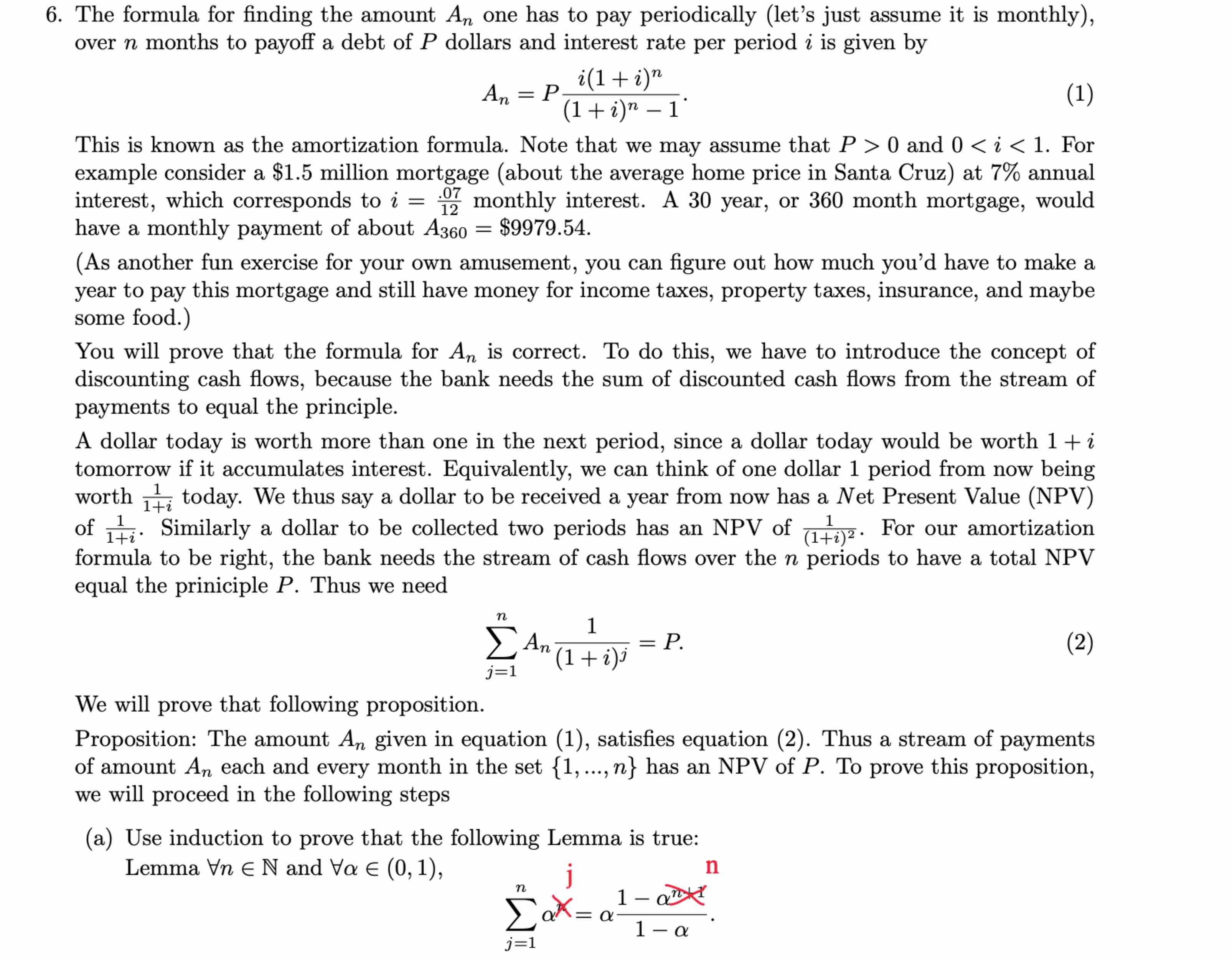
Use induction prove that the following Lemma true:
Lemma AAninN and
Step by Step Solution
There are 3 Steps involved in it
1 Expert Approved Answer
Step: 1 Unlock

Question Has Been Solved by an Expert!
Get step-by-step solutions from verified subject matter experts
Step: 2 Unlock
Step: 3 Unlock
 Study Help