







Question: The Fourier series approximation to the forcing function is given by f(t)=5[1+4(1sin120t+2sin360t+3sin600t+.)] The transfer function for this problem based on the parameters (m,c and k
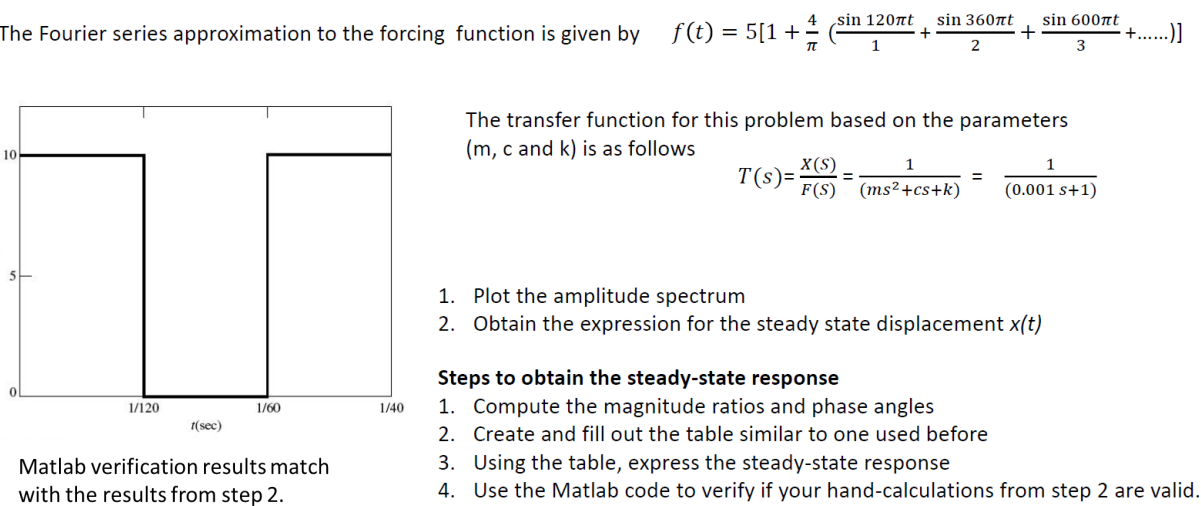
The Fourier series approximation to the forcing function is given by f(t)=5[1+4(1sin120t+2sin360t+3sin600t+.)] The transfer function for this problem based on the parameters (m,c and k ) is as follows T(s)=F(S)X(S)=(ms2+cs+k)1=(0.001s+1)1 1. Plot the amplitude spectrum 2. Obtain the expression for the steady state displacement x(t) Steps to obtain the steady-state response 1. Compute the magnitude ratios and phase angles 2. Create and fill out the table similar to one used before Matlab verification results match 3. Using the table, express the steady-state response with the results from step 2 . 4. Use the Matlab code to verify if your hand-calculations from step 2 are valid. The Fourier series approximation to the forcing function is given by f(t)=5[1+4(1sin120t+2sin360t+3sin600t+.)] The transfer function for this problem based on the parameters (m,c and k ) is as follows T(s)=F(S)X(S)=(ms2+cs+k)1=(0.001s+1)1 1. Plot the amplitude spectrum 2. Obtain the expression for the steady state displacement x(t) Steps to obtain the steady-state response 1. Compute the magnitude ratios and phase angles 2. Create and fill out the table similar to one used before Matlab verification results match 3. Using the table, express the steady-state response with the results from step 2 . 4. Use the Matlab code to verify if your hand-calculations from step 2 are valid
Step by Step Solution
There are 3 Steps involved in it

Get step-by-step solutions from verified subject matter experts
 Study Help